Locations:





Swift, aggressive thiamin therapy may be key to preventing long-term neurological injury

Image content: This image is available to view online.
View image online (https://assets.clevelandclinic.org/transform/a49d2310-babf-46dc-8b49-743557d55425/wernicks-encephalopathy-treated-with-iv-thiamine-2211049567)
Alcohol use and brain disorder concept
Wernicke’s encephalopathy (WE) remains one of the most urgent yet under-recognized neurological consequences of thiamin (vitamin B1) deficiency. Despite its longstanding place in medical literature, the disorder continues to pose a number of clinical challenges, including inconsistent diagnostic criteria, variable symptoms and a striking lack of consensus regarding optimal thiamin dosing.
Advertisement
Cleveland Clinic is a non-profit academic medical center. Advertising on our site helps support our mission. We do not endorse non-Cleveland Clinic products or services. Policy
A recent case report published in the Journal of Addictive Diseases highlights these persistent gaps and an emerging concern: Current dosing norms may be insufficient for many patients, and clinical hesitation around high-dose therapy may delay recovery.
A 40-year-old man with a history of severe alcohol use disorder (AUD) presents to the hospital after a witnessed syncopal episode with a two-minute loss of consciousness and myoclonus. He says he has not eaten for two days. According to his roommate, the patient consumes beer daily, but the quantity and type are unknown.
The patient can perform all instrumental activities of daily living and works odd jobs to support himself. Earlier in the year, he underwent simple surgical repair (Graham patch) of a perforated duodenal ulcer.
On admission, he is alert and oriented to person, place, time and event. His vital signs include blood pressure 121/72 mmHg, heart rate 92, temperature 98.5°F and respiratory rate 16. Finger-stick glucose is notable for a blood glucose of 54 mg/dL, which improves with 1 L of 50% dextrose IV. His sodium level is 135 mmol/L, so he is given 1 L of 0.9% NaCl (normal saline).
The patient’s initial lab work reveals elevated aspartate aminotransferase (183 U/L), decreased hemoglobin (10.6 g/dL) and a positive fecal occult blood test. His physical examination is significant for bilateral scleral icterus and macerated feet bilaterally secondary to poor hygiene. An electrocardiogram, head CT scan without contrast, and 24-hour continuous electroencephalogram show no abnormalities.
Advertisement
Classically, WE is associated with a triad of ophthalmoplegia, altered mental status and ataxia – yet the reality is far more complex, explains Cleveland Clinic psychiatrist Akhil Anand, MD, who coauthored the case.
“WE is a spectrum disorder, not a fixed constellation of symptoms,” he says. “Fewer than one in five patients present with all three signs, and many only show subtle or atypical neurological changes. As a result, clinicians relying solely on the classic triad risk missing a substantial proportion of cases — an error with serious consequences, given that untreated WE can lead to permanent brain injury or death.”
Although AUD is a leading cause of WE, recent analyses emphasize that up to 17% of non-alcohol-related cases arise from dietary insufficiency alone (Figure 1). A range of factors, including gastrointestinal surgeries, hyperemesis and prolonged food restriction, can compromise thiamin intake or absorption. Dr. Anand notes that patients with multiple contributing factors, such as surgical recovery combined with poor nutritional intake, may be particularly vulnerable.
“These heterogeneous pathways into deficiency further strengthen the argument for a diagnostic system that accounts for diverse etiologies rather than focusing primarily on alcohol history,” he says. “Although the patient in this case had AUD, which undoubtedly contributed to the development of WE, we could not ignore his food restriction as a principal source of his thiamin deficiency. In addition, we suspected the patient had failed to follow his scheduled feeding routine following his Graham patch surgery, which likely worsened his nutritional deficits.”
Advertisement
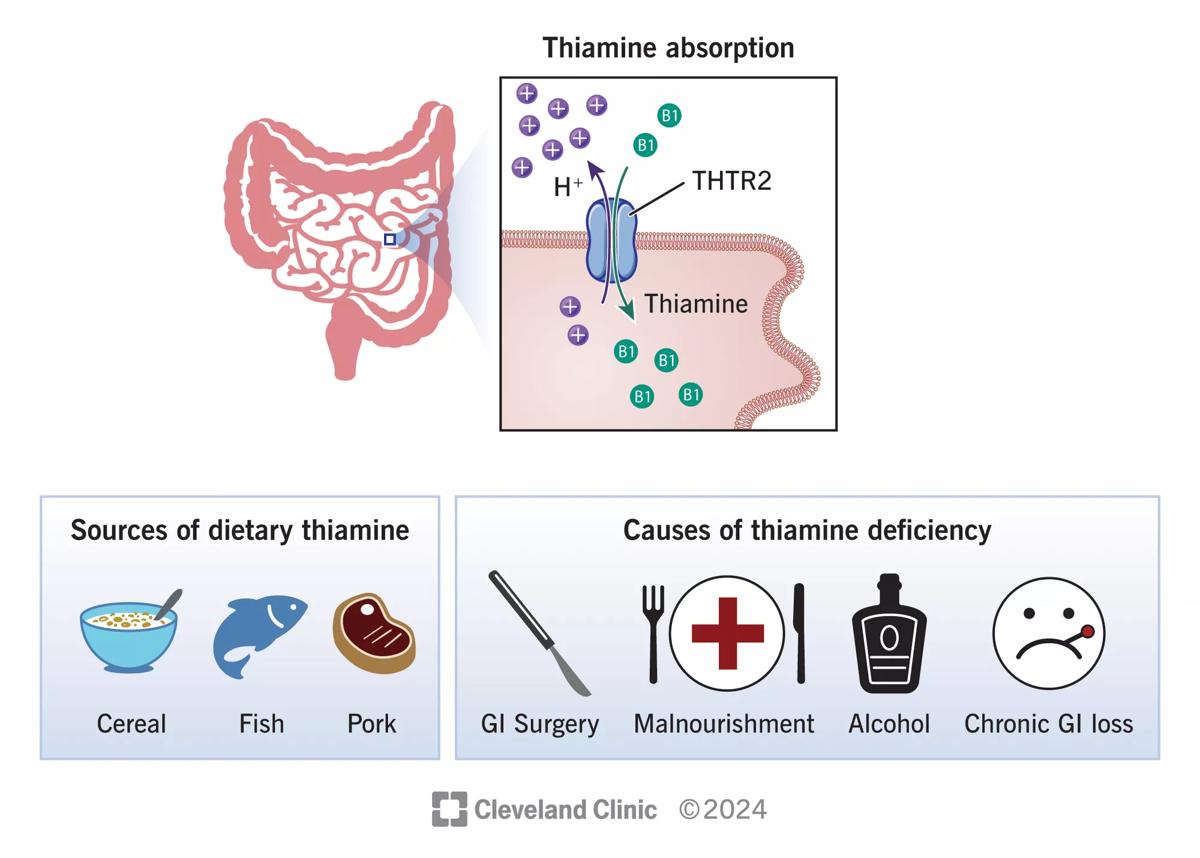
Image content: This image is available to view online.
View image online (https://assets.clevelandclinic.org/transform/165b260c-7b62-4028-aec7-86dbc8ebd002/Wernicke-s-encephalopathy_01_22-NEU-3409738-01)
Figure 1. Significant sources of thiamin include fortified cereals, egg noodles, pork, black beans, and fish, especially trout and tuna. Dietary thiamin is absorbed via active transport against a proton gradient. This process is mediated by the transmembrane proteins thiamin transporter 1 (THTR1) and thiamin transporter 2 (THTR2), located in the intestines, kidneys, liver, muscle, brain, etc. THTR2 absorbs most thiamin in the intestines. Gastrointestinal (GI) surgery and inadequate dietary intake can impair absorption, risking thiamin deficiency. Long-term alcohol consumption and chronic vomiting and/or diarrhea increase the excretion of thiamin, also risking thiamin deficiency.
The patient was admitted for treatment of a physiologic nonepileptic seizure and an upper-gastrointestinal (GI) bleed workup (Figure 2). An esophagogastroduodenoscopy (EGD), which was performed to rule out upper-GI blood loss, revealed no gross lesions.
Although the patient did not exhibit significant alcohol withdrawal, he was placed on the Clinical Institute Withdrawal Assessment for Alcohol (CIWA) protocol, given his history of AUD. He received a 1-L multivitamin “banana bag” IV (i.e., 100 mg thiamin, 1 mg folic acid, and 2 g magnesium). In addition, he received thiamin (100 mg IV) twice daily, oral folic acid (1 g daily), and one dose of magnesium (2 g IV).
Alarmingly, the patient became acutely confused following the EGD. His neurological exams rapidly deteriorated throughout the day as he became more confused and showed ophthalmoplegia, tongue fasciculations and tremors.
He was diagnosed with WE, and his IV thiamin was increased to 100 mg three times/day. Over the next few days, encephalopathy persisted. On day six, the medical team increased the patient’s IV thiamin to 500 mg three times/day. The next day, he appeared to be alert and oriented, and the ophthalmoplegia resolved.
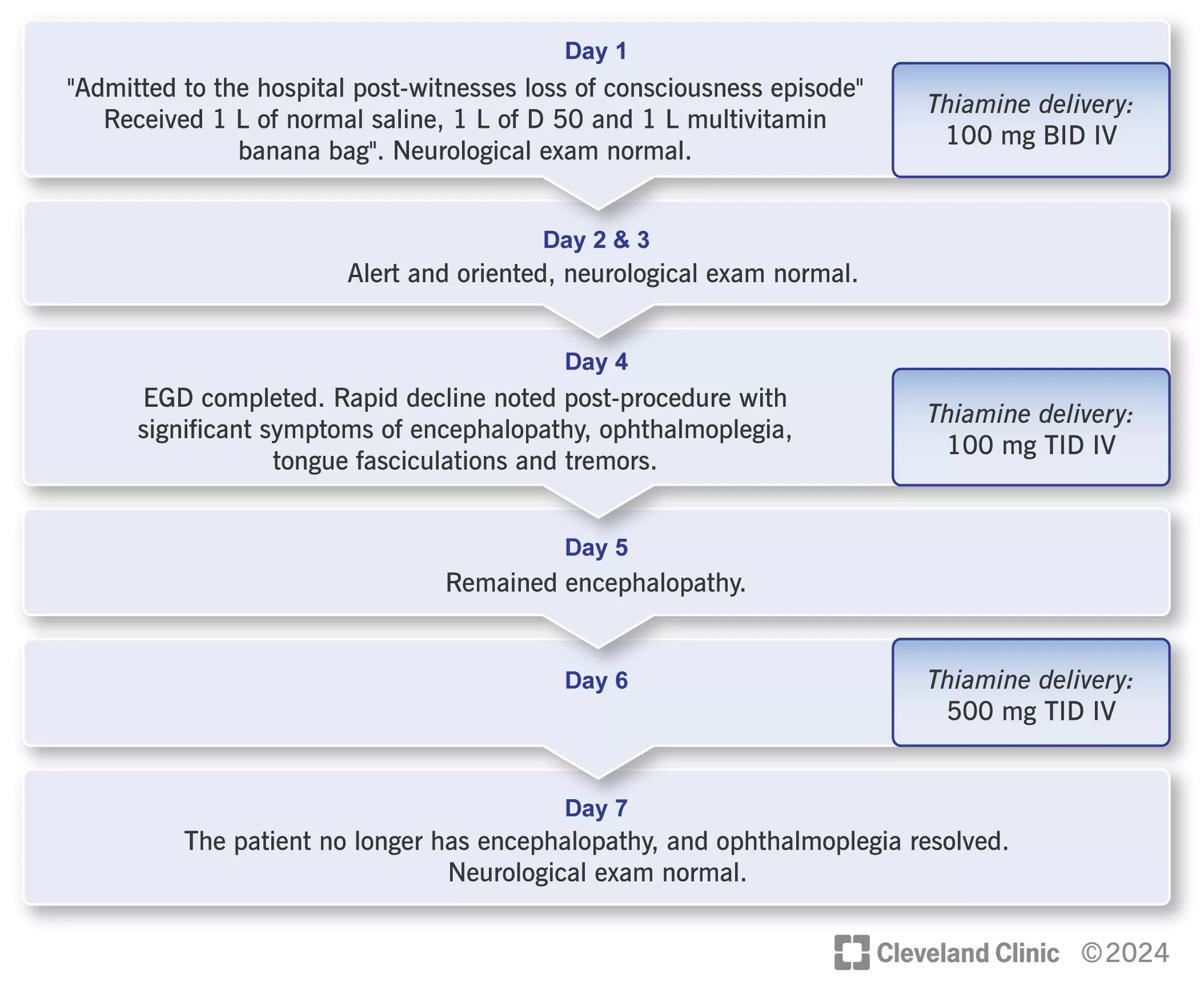
Image content: This image is available to view online.
View image online (https://assets.clevelandclinic.org/transform/5bc5301a-f825-4f5e-925d-671f2bdbf716/Wernicke-s-encephalopathy-timeline_03_22-NEU-3409738-01)
Figure 2. Historical timeline of the patient’s seven-day hospitalization.
Although IV thiamin is universally accepted as the cornerstone of WE management, recommended doses vary widely across continents and clinical specialties. In the United States, manufacturers’ instructions often suggest 100 mg IV daily, with optional intramuscular supplementation if symptoms persist. However, growing observational data suggest that higher doses may produce more rapid and reliable symptom reversal with few side effects, Dr. Anand says, particularly among patients with multiple risk factors or severe thiamin deficiency.
Advertisement
“In this particular case, low-dose thiamin administered over several days yielded no improvement in mental status or ocular findings, yet a transition to high-dose therapy resulted in rapid clinical recovery,” he says.
Dr. Anand emphasizes another barrier to timely diagnosis and treatment: overreliance on laboratory measures of thiamin status. Costly, slow and often inaccurate, serum thiamin tests are not sufficiently reliable to guide real-time clinical decision-making, he explains.
“Evidence suggests that when WE is suspected, treatment should not be delayed for laboratory confirmation,” Dr. Anand says. “Thiamin has an excellent safety profile even at high doses, making empiric therapy a low-risk, high-reward intervention.”
This case emphasizes the urgent need for updated, evidence-based guidelines that differentiate between alcohol-related and non-alcohol-related WE, says Dr. Anand, who recently coauthored a systematic literature review on the diagnosis and treatment of the disease. In particular, he notes that randomized, controlled trials comparing low and high thiamin dosing strategies are overdue.
“Unfortunately, the diagnostic and therapeutic landscape has not kept pace with our modern understanding of WE,” he says. “Swift, adequately dosed thiamin — supported by inclusive diagnostic criteria — may offer the best chance at rapid recovery and long-term neurological preservation.”
Advertisement
Advertisement

Integrating behavioral health expertise into the management of complex neurological disorders

New approach empowers providers to recognize and reduce risk in patients with neurological disorders

Systemic framework outlines safe, patient-centered discontinuation strategies

Reducing symptoms through multidisciplinary care and thoughtful environmental design

Strengthening patient care through thoughtfully created spaces

Standardized approach empowers providers to recognize risk in patients with MS and coordinate timely care

Protecting maternal health through clinician education and timely psychiatric interventions

Complex presentation underscores the overlap between MS-related complaints and bipolar-spectrum illness
 Search