Locations:





The new application that could augment cancer detection, improve efficiency
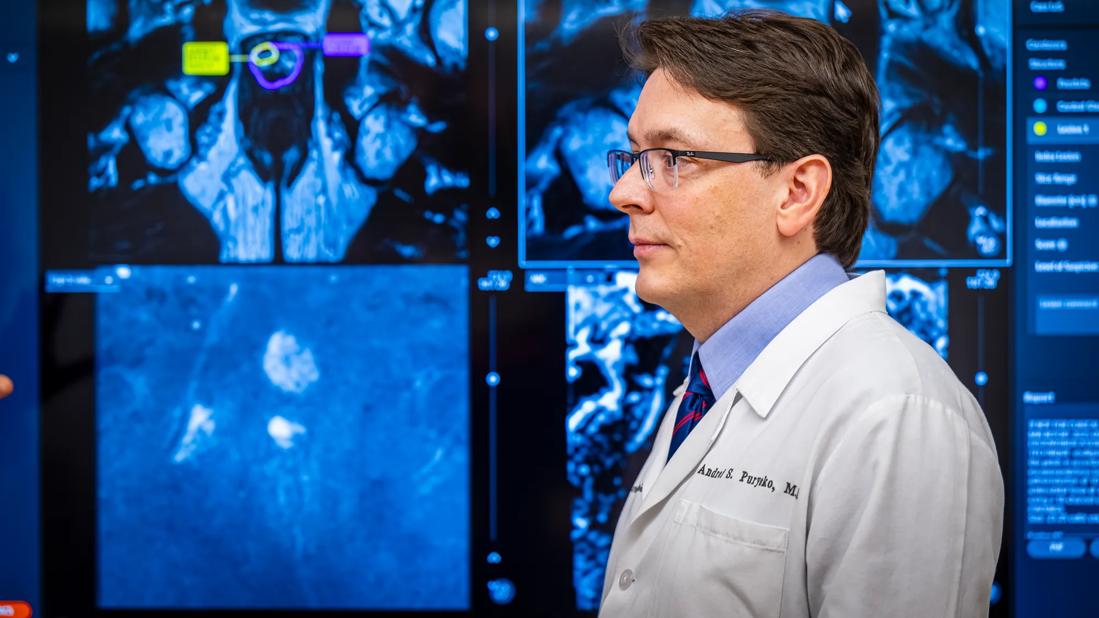
Image content: This image is available to view online.
View image online (https://assets.clevelandclinic.org/transform/4e42e388-4ab9-478f-8951-ef174be899f5/CCC_7569108_12-18-25_001_SCG)
Dr. Purysko stands in front of prostate imaging screens
Cleveland Clinic researchers are evaluating whether AI-based software can assist radiologists in detecting prostate cancer on MRI exams. The investigators say the technology has the potential to augment detection and add efficiency to conventional prostate cancer screening.
Advertisement
Cleveland Clinic is a non-profit academic medical center. Advertising on our site helps support our mission. We do not endorse non-Cleveland Clinic products or services. Policy
The application, known as the AI Rad Companion (AIRC) Prostate MRI from Siemens Healthineers, was cleared for use by the U.S. Food and Drug Administration in 2025. Cleveland Clinic has become the first healthcare system to use this technology in a clinical trial. The AI software detects and segments suspicious prostate lesions, supporting urologic oncologists’ clinical decision-making for biopsy and treatment.
Principal investigator Andrei Purysko, MD, Section Head of Abdominal Imaging at Cleveland Clinic, says rigorously testing the technology is the first step before its broader clinical implementation.
“We are being really intentional about deployment,” he says. “We want to make sure the technology performs in line with our experts and is able to identify any blind spots.”
The AI algorithm was developed and trained using MRI exams interpreted by radiologists and biopsy results as the ground truth. The software was designed to replicate that expertise and serve as a partner in the process by detecting potential areas of clinically significant prostate cancer.
This technology addresses some of the shortcomings associated with MRI, an adjunct to standard prostate-specific antigen (PSA)-based testing that emerged nearly two decades ago. MRI has been hailed as a game-changer within the field, leading to a new standard of care in prostate cancer. In large studies, MRI demonstrates a high negative predictive value in prostate cancer, affirming that, in most cases, when no suspicious lesions are detected, the risk of having significant cancers is very low.
Advertisement
While MRI has decreased overdiagnosis and overtreatment, it’s also not a perfect method.
“There are a number of challenges related to interpretation, particularly when differentiating cancer from benign conditions, like benign prostatic hyperplasia, that can mimic cancer on an MRI,” explains Dr. Purysko.
The AI software is powered to decipher the key image sequences from an MRI exam, including diffusion-weighted images, which pinpoint the motion of water molecules.
“When you have cancerous tissues, the water molecules are not moving as freely, so that creates a bright signal in MRI. The system is looking for those.”
It also provides two scores: the prostate imaging reporting and data system (PI-RADS) score, a 5-point scale used in routine clinical practice to indicate the likelihood of cancer, and a second associated with a probability map, which can be especially useful as a supplement to PI-RADS scores in cases of equivocal MRI results.
“If the MRI results are negative on the AI system, we can rule out cancer with confidence—potentially avoiding an unnecessary biopsy,” he says. “But a PI-RADS 3 score assigned by a radiologist conveys a level of uncertainty.” And the AI score adds yet another layer of data to inform clinical decision-making.
The tool can also help identify lesions in challenging locations. “The distal ends of the prostate, for example, are more challenging for us to interpret the results, but the AI model does a good job picking up those lesions,” says Dr. Purysko.
Advertisement
It also performs noninterpretative tasks, such as delineating the prostate and the targets for biopsy. These color-coded maps are overlaid on the plain ultrasound, which the urologist will use to perform the biopsy and potentially inform subsequent treatment, such as radiation therapy.
“The visual aid can be helpful for determining where they could boost the radiation treatment within the prostate,” notes Dr. Purysko.
The demand for prostate cancer imaging studies has “skyrocketed,” inundating radiologists, according to Dr. Purysko. For context, MRI has become a standard part of care in what is now the most common cancer in the U.S. In 2026, more than 330,000 men will be diagnosed with prostate cancer.
Time will tell how the AI tool will alter the standard workflow, but Dr. Purysko says the research team is pleased with its performance so far. Imaging is processed in approximately five minutes, compared to about 15 to 20 minutes for a regular interpretation.
This technology is garnering enthusiasm among the Cleveland Clinic urologic oncologists with whom Dr. Purysko is collaborating.
Christopher Weight, MD, Director of Urologic Oncology, notes, "This study is very exciting because it gives us a chance to see how this promising technology actually works in clinical practice. It is not enough for an AI system to 'beat' the average doctor, it needs to actually improve care in a meaningful way."
The research team is well on its way to enrolling its goal of 150 participants. Eligibility criteria include men aged 55 to 80 who have an elevated PSA and no prior prostate cancer diagnosis.
Advertisement
Dr. Purysko notes that the innovation could offer a consistent, reliable interpretation and address some existing challenges. However, he still emphasizes the continued need for a human specialist to oversee the process and ensure it’s working as intended.
Dr. Weight concurs, adding, "The appeal of these types of computer-aided interpretation systems is their ability to scale expertise. I have the pleasure of working with one of the best genitourinary radiology teams in the world,” he says. “I doubt AI will easily surpass their expertise; however, most urologic oncologists are not so lucky, and this technology could potentially bring that expertise to any team in the world.”
In the meantime, findings from the trial are revealing opportunities for improvement within the existing workflow. Dr. Purysko concludes, “We are being very intentional about the deployment; we're just not just blindly trusting AI. We're really vetting it to make sure that its performance aligns with that of our experts.”
Advertisement
Advertisement

Combining advanced imaging with targeted therapy in prostate cancer and neuroendocrine tumors
Approach offers a ‘middle ground’ between radical prostatectomy and active surveillance

AI histologic classifier reliably predicts clinical risk in men post-prostatectomy

Historic collaboration connects two Cleveland Clinic locations, enables real-time sharing of metrics and surgical progress

Patient factors and cancer characteristics are key to deciding between focal therapies and whole gland treatment

Novel research to evaluate noninvasive treatments in ED and chronic pelvic pain
Correlation found between the biomarker HSD3B1 and resistance to combined hormone therapy and radiotherapy
FDA-approved therapy offers promise for patients with castrate-resistant prostate cancer
 Search