Locations:





A membership model built on collaboration, guidance and global partnership
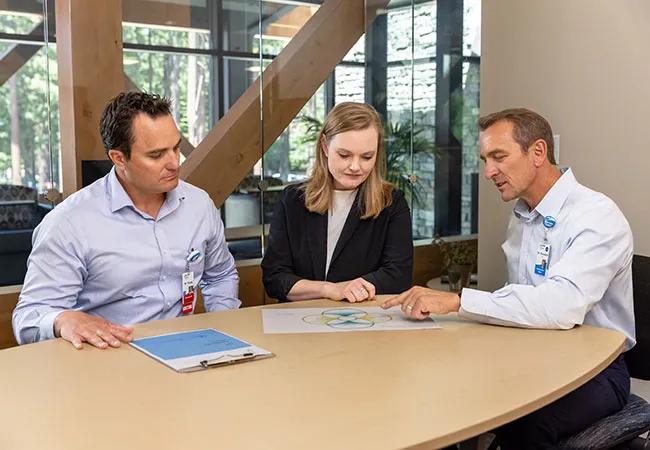
Image content: This image is available to view online.
View image online (https://assets.clevelandclinic.org/transform/1519b219-c0e2-4ffe-bc83-b2324f27c10c/26-IEM-7868908-CQD-Connected-Program-IEM-650-450)
Photo of Cleveland Clinic Connected discussion
As healthcare challenges intensify, hospital administrators and clinicians are looking for ways to access practical expertise beyond their walls without relinquishing control of patient care or facility management.
Advertisement
Cleveland Clinic is a non-profit academic medical center. Advertising on our site helps support our mission. We do not endorse non-Cleveland Clinic products or services. Policy
Cleveland Clinic Connected was developed to address those needs.
The program is a long-term, consultative relationship. It gives member hospitals access to Cleveland Clinic’s wealth of clinical and operational knowledge while leaving ownership, governance and patient care firmly in local hands.
Through offerings such as advisory services, assessments of clinical service lines, educational and training programs, and strategic guidance, the program aims to help organizations improve their quality, patient experience, and clinical and operational capabilities.
The program is available to domestic and international hospitals and healthcare systems. It draws on Cleveland Clinic’s decades of experience as a global healthcare provider, operating hospitals and healthcare facilities in North America, Europe and the Middle East.
“We serve as a hands-on mentor, sharing practical insights Cleveland Clinic has gained over 105 years,” says Vinh Nguyen, Vice President of International and Emerging Markets at Cleveland Clinic.
Cleveland Clinic Connected began in 2018.
It emerged from Cleveland Clinic’s broader strategy to expand its global presence and share its unique care model beyond the healthcare system’s own facilities, building a network of independent, like-minded, quality-focused organizations to improve patient care around the world.
The goals are multifaceted: extending Cleveland Clinic’s clinical expertise, supporting hospitals seeking to improve and differentiate their services, and building relationships in regions where the organization may expand further in the future.
Advertisement
Currently, the program has six international members and three in the United States, with plans for additional growth.
Cleveland Clinic evaluates potential members based on criteria that include:
A membership’s duration is a minimum of five years, allowing time to build relationships and implement meaningful improvements.
The delivery of consultative services follows a hybrid model, combining virtual collaboration with in-person engagement. Cleveland Clinic teams travel to member sites, and member physicians and administrators visit Cleveland Clinic locations for observerships and training.
While several other American healthcare organizations offer consultation services, Cleveland Clinic Connected is distinct, Nguyen says. “By working closely with a limited number of members, we can build stronger relationships and provide more meaningful advisory support.”
Relationships in healthcare can take many forms, from branding arrangements to management agreements. Cleveland Clinic Connected is structured differently.
Its members retain full command of their operations, using Cleveland Clinic as a collaborative resource. Cleveland Clinic does not manage member facilities, employ their physicians or assume governance roles. The member’s brand and identity is not erased or diluted.
Advertisement
“It's really about cultural integration rather than imposing our own culture on our members,” says neurologist Emad Estemalik, MD, MBA, a Cleveland Clinic Connected Medical Director. “We’re giving them guidance and access to our intellectual property — how we deliver care, how we approach quality and safety. What they do with this information is ultimately their decision.”
That distinction is central to the program’s design and to how it is presented to prospective members, some of whom might worry that the relationship could lead to acquisition or loss of autonomy.
“We establish from the outset that we are not there to take over,” Nguyen says. “We are there to understand how their teams work and how they deliver care, then identify where our experience can be most helpful.”
Each collaboration is customized, not one-size-fits-all. The scope varies by an individual member’s priorities, needs, market situation and goals.
Some members may be focused on existing operations; others on building programs — or even entire hospitals — from scratch.
For example, Croatia’s Radiochirurgia Zagreb hospital, which became a member in 2025, is concentrating on solidifying its position as a leader in oncology care in southern and eastern Europe.

Image content: This image is available to view online.
View image online (https://assets.clevelandclinic.org/transform/c43a30f4-9230-4e1f-860b-5a46dc78ea8e/Radiochirurgia_Zagreb)
Croatia's Radiochirurgia Zagreb cancer hospital
Central Asian University, another 2025 addition to Cleveland Clinic Connected, will leverage the collaboration to create a new hospital on the university’s expanded medical campus in Tashkent, Uzbekistan. Cleveland Clinic will provide direction on facility design and management, development and validation of medical education and residency programs, establishment of a nursing school, physician recruitment, supply chain management, and digital transformation.
Advertisement
“We're guiding them through processes we're familiar with, how we've established hospitals according to market needs and geographical and population differences,” Dr. Estemalik says.

Image content: This image is available to view online.
View image online (https://assets.clevelandclinic.org/transform/4e856737-d516-497c-91d9-a4e19f6902f7/cc-connected-uzbekistan)
Rendering of Central Asian University Hospital. Courtesy of Central Asian University and HKS Architects
Through its relationships with member hospitals in key markets, Cleveland Clinic gains visibility, increased brand recognition and clinical connections between local physicians and Cleveland Clinic specialists.
Members, in turn, get extensive mentoring and support in a variety of areas including clinical and hospital operations; patient care; medical education; professional and leadership development; marketing; supply chain; architecture and design; safety, quality and patient experience; caregiver retention; and strategic planning and growth.
“Safety, quality and patient experience remain at the core of all our engagements and drive the value of the relationship,” says Erick Vidmar, an Executive Director in International and Emerging Markets who oversees Cleveland Clinic Connected’s domestic members.
How that focus is translated into day-to-day practice — particularly across diverse healthcare systems — is a central part of the program’s work.
At the center of every Cleveland Clinic Connected engagement is a focus on helping member organizations elevate safety, quality and patient experience — not by imposing a rigid set of standards, but by translating Cleveland Clinic’s principles into each member’s local context.
“That is the cornerstone of the program,” says Michelle Medina, MD, Cleveland Clinic Connected’s Medical Director for the Asia region.
Advertisement
The process begins with sharing how Cleveland Clinic defines and approaches safety, quality and patient experience, then working with members to operationalize those ideas. Leaders and frontline caregivers are engaged in understanding what those principles mean in practice: what should be measured, how performance should be communicated and what tools are needed to support continuous improvement.
“We help them understand our guiding principles and then translate those into actual processes,” Dr. Medina says. “What does that look like for executive leadership? What does it look like for caregivers? What are the tools, and how can they be applied in a local setting?”
Rather than exporting Cleveland Clinic’s metrics, the program helps members develop measurement systems that reflect their own realities.
That approach extends to how improvement efforts evolve over time. As organizations gain experience with foundational tools and governance structures, Cleveland Clinic Connected helps them think about progression — from basic capabilities at the frontline level to systemwide integration.
“There’s a natural question: How do you move from having tools in place to actually maturing as an organization?” Dr. Medina says. “That’s where we’re focusing now — helping them see how they can improve over time.”
Importantly, the program is designed as a coaching relationship, not an auditing function.
That coaching often includes working with frontline caregiver teams, whose insights can drive meaningful change. In some cases, local adaptations of Cleveland Clinic practices have produced innovations tailored to specific environments.
Dr. Medina cites an example from Vinmec International Healthcare System in Vietnam, where teams adapted the use of checklists — a common safety tool — not only to improve clinical reliability but also to better manage limited resources.
“They took the concept and applied it in a way that made sense for their setting,” she says. “That’s their context, not ours — and it works for them.”
The result is a model that blends Cleveland Clinic’s experience with local expertise, reinforcing a culture of continuous improvement rather than prescribing a single way of working.
Physician-to-physician consultations regarding complex patient care issues — known as eClinical Reviews — are an optional feature of Cleveland Clinic Connected.
Physicians at member hospitals can submit medical records, imaging, lab work and other information for review by Cleveland Clinic specialists. The specialists provide a detailed written assessment describing how they would approach the case.
The most common areas for consultation are cardiology, oncology and neurology — specialties that often involve difficult issues and complicated decision-making and that benefit from the multidisciplinary teamwork Cleveland Clinic is known for.
The consultation report is returned to the member hospital’s medical team, not directly to the patient. This preserves the local physician’s central role in care.
While not all members utilize eClinical Reviews, the consultations illustrate the program’s broader emphasis on collaboration and shared clinical insight.
A significant portion of Cleveland Clinic Connected’s activity takes place outside the United States, where healthcare systems, regulations and clinical practices can differ substantially.
Cleveland Clinic draws on its experience operating in international markets — including London and Abu Dhabi — as well as on local expertise.
“We approach each market with humility rather than assuming we already understand it,” Nguyen says. “Our members help us learn the local landscape as we work together.”
That learning process includes collaboration with Cleveland Clinic’s in-country representatives, consultation with third-party experts and input from Cleveland Clinic physicians with ties to specific regions.
The organization also considers geographic relationships between members and its global hubs.
“We consider how easily each member can connect with our major hubs,” Nguyen says. “We build those pathways early so that, if a member faces a complex case beyond its capabilities, the team can quickly connect the patient with the appropriate Cleveland Clinic hospital.”
Cleveland Clinic leaders expect the Connected program to continue expanding domestically and internationally, with potential growth in Europe and Latin America, as well as further development in Asia.
At the same time, they emphasize that growth will remain deliberate.
“We see opportunities to expand, but we will do so thoughtfully and selectively,” Nguyen says.
The long-term vision centers on building a network of relationships — connecting local providers with Cleveland Clinic expertise while preserving the strengths of each organization.
For physicians and healthcare leaders evaluating the model, Dr. Estemalik offers a simple proposition:
“If you’re looking to expand your horizons, elevate patient care and connect with some of the best clinical teams in the world,” he says, “we're the organization you want to work with.”
Photo at top: A Cleveland Clinic Connected representative meets with officials from Barton Health, a not-for-profit community healthcare system serving California and Nevada. Barton Health became a Connected member in 2025.
Advertisement

Expertise can travel even when the patient and their care cannot
Three-day program focuses on leadership, safety, operations and change management
Advanced software streamlines charting, supports deeper patient connections
How holding simulations in clinical settings can improve workflow and identify latent operational threats

Interactive Zen Quest experience helps promote relaxing behaviors
Cleveland Clinic and IBM leaders share insights, concerns, optimism about impacts
Cleveland Clinic partners with Palantir to create logistical command center
A Q&A with organizational development researcher Gina Thoebes
 Search