Locations:





New study confirms prevalence, downstream effects of dysphagia and dysphonia

Image content: This image is available to view online.
View image online (https://assets.clevelandclinic.org/transform/7be90715-7689-43fe-92be-0cf08646684a/GER_4130711_11-16-23_080_SCG-jpg)
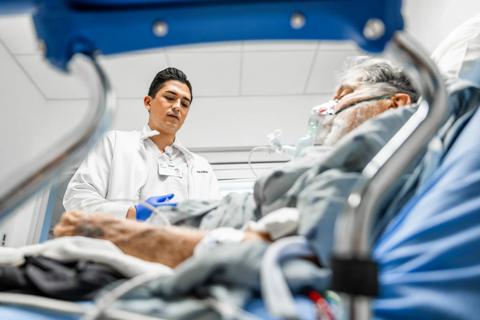
Dr. Hashmi with patient
Difficulties with speech and swallowing, which commonly affect geriatric patients, can reduce quality of life and exacerbate or even cause serious health problems. Until now, dysphagia and dysphonia have not been well studied despite their perceived prevalence. Now, however, a new study by Cleveland Clinic physicians has confirmed that as many as 29% of geriatric patients suffers from one of these potentially debilitating conditions.
Advertisement
Cleveland Clinic is a non-profit academic medical center. Advertising on our site helps support our mission. We do not endorse non-Cleveland Clinic products or services. Policy
“I think the main takeaway for clinicians is just how common these disorders are,” explains Ardeshir Hashmi, MD, Section Chief of the Center for Geriatric Medicine. “Fortunately, there are several tools to help address these diagnoses that can very easily be integrated into clinical practice.” Dr. Hashmi is coauthor of the study, which was presented at the annual meeting of the American Geriatrics Society in May.
Although many older patients report problems with voice or swallowing, Dr. Hashmi says these issues are frequently dismissed by both patients and their doctors. “Patients may ignore the problem because they feel like it’s simply part of getting older, but this fatalism often extends to clinicians as well,” he says.
Dr. Hashmi emphasizes the importance of asking patients about these voice- and swallowing-related concerns, which can be symptoms of potentially serious medical issues, including esophageal cancer and vocal cord tumors.
Difficulty swallowing is linked to aspiration pneumonia, malnutrition, weight loss, and shortened life expectancy. In many cases, these issues can prevent patients from taking important medications simply because it’s too difficult for them to swallow their pills, notes Paul Bryson, MD, MBA, study coauthor and Director of the Cleveland Clinic Voice Center. In addition, voice problems like hoarseness can make it hard for older patients to communicate, leading them to be treated as cognitively impaired, frail or incompetent.
Failing to ask patients about these problems is a missed opportunity, he adds, because they can often be solved. Potential remedies include medication management. For example, patients may be able to replace their prescription pills or capsules with liquid or powdered formulations.
Advertisement
“Learning about problems with voice and swallowing offers an opportunity for consultation with otolaryngology and speech-language pathology, where potential problems can be further explored, understood and treated – often with meaningful impact on quality of life,” explains Dr. Bryson.
Researchers surveyed 300 new patients who were seeking generalized care at Cleveland Clinic’s geriatric center. Participants were asked to self-report problems with voice, swallowing and pill swallowing. A total of 82 patients (27%) reported at least one problem. Twenty-four percent of surveyed patients reported swallowing difficulties, and 8% said they had voice difficulties.
Surprisingly, only 5% reported difficulty swallowing pills. Dr. Hashmi notes that this number was lower than expected and may reflect under-reporting by patients who are resigned to the issue or feel it’s a lower priority. Alternatively, it may indicate that patients view pills as essential to their health and fear losing access to medications, he says, adding that it’s a question he’d like to explore further.
Mario Belfiglio, a medical student at Cleveland Clinic Lerner College of Medicine and lead author of the study, adds that he and his team were surprised by patients’ lack of interest in referrals for voice and swallowing problems. Of the 82 patients who reported a problem, only 36 accepted a referral to address the issue, and just 11 of those actually made an appointment. “There are a multitude of potential reasons for this disconnect,” he explains, “but we think it’s an area worthy of further study.”
Advertisement
Notably, voice and swallowing problems were well known and chronic for 21 of the patients who declined referral; these issues were not viewed as significant issue for 24 of those who declined further care.
In light of these findings, Dr. Hashmi urges clinicians to be more proactive about discussing voice and swallowing problems with their geriatric patients and consider integrating screening questions about these issues into their clinical workflow. “Again, clinicians should also be aware that available treatments can significantly improve these patients’ lives,” says Dr. Hashmi.
Investigators are planning to expand their research by studying a larger patient population and more closely examining dysphagia and dysphonia in specific subpopulations segregated by race and income level.
“We’d also like to follow these patients over time and learn more about the course of their illness,” Dr. Hashmi says. “Did they follow through to the end of the referral? Did their symptoms or not? We hope the answers to these questions will inform how we approach these common problems in elderly patients.”
Advertisement
Advertisement

Using the EMR to identify subtle symptoms at triage

Making decisions that prioritize biological age and functional status over chronological age alone

New study aims to streamline dementia diagnoses and expand access to timely, accurate care
Commentary cautions against using age as a surrogate for physiologic reserve and individual preferences

New research highlights serious risks and the critical need for earlier advance care planning
Initiatives focus on the physical and emotional well-being of geriatric patients and their caregivers
Researchers explore the mental and physical benefits of social prescribing

Multidisciplinary approach helps address clinical and psychosocial challenges in geriatric care
 Search