Locations:





The progressive training program aims to help clinicians improve patient care
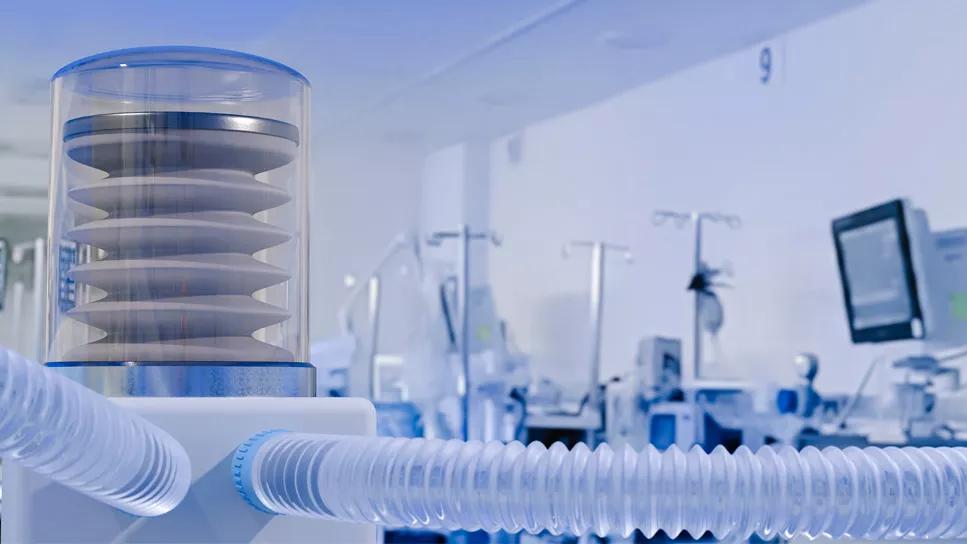
Image content: This image is available to view online.
View image online (https://assets.clevelandclinic.org/transform/c5c34092-f5cb-47c3-9420-08876c2149fb/ventilator-1218136220)
Medical Ventilator
Mechanical ventilators have advanced significantly over the past several years and have progressed to the point where these lifesaving devices now offer an array of settings and functions that can be optimized for patient care.
Advertisement
Cleveland Clinic is a non-profit academic medical center. Advertising on our site helps support our mission. We do not endorse non-Cleveland Clinic products or services. Policy
Unfortunately, clinician training on how to use these devices hasn’t kept up. Few training programs provide in-depth ventilator training, notes Eduardo Mireles-Cabodevila, MD. Most of the education caregivers receive is focused on a single disease, or a few modes, or worse, provided by the medical device companies themselves, typically in a single training session when the device is delivered. In addition, most ventilator training is offered to respiratory therapists, which leaves physicians even further out of the loop.
As a result, many providers use only a fraction of each ventilator’s capabilities, missing important opportunities to give patients the best breathing support for their condition.
“There are features on the ventilator that can make it a better interaction for the patient,” Dr. Mireles says. “But if providers don’t know what these features can do, they won’t use them.”
Dr. Mireles serves as Director of the Medical Intensive Care Unit at Cleveland Clinic.
He and Professor Robert Chatburn, MHHS, RRT-NPS, FAARC, clinical research manager of respiratory therapy at Cleveland Clinic, are working to close that education gap with SEVA, or Standardized Education for Ventilatory Assistance, a program that provides universal, standardized training in the theory and practice of mechanical ventilation.
Early ventilators had just one mode of ventilation. A mode is a pre-programmed pattern of patient-ventilator interaction, like a station on a radio. Later generations of ventilators added two or three more options. But today’s devices offer dozens of modes, each providing a slightly different combination of settings for specific patient needs.
Advertisement
Understanding which mode to use can make a big difference in patient care, improving patient comfort or reducing the risk of lung injury. Some modes may provide breathing support that’s optimized for patients who are heavily sedated, while other settings are geared toward patients who are conscious and almost ready to breathe on their own.
But the sheer number of modes is overwhelming, notes Professor Chatburn.
“We have one ventilator with 75 different modes,” says Chatburn. “The problem is that no individual clinician has the time to understand them all.”
Adding to the confusion, each manufacturer labels their modes differently, so names aren’t consistent from device to device.
“Suddenly, you have 700 different names for modes,” Dr. Mireles says. “Then, you find modes that have the same commercial name but, when analyzed, are not the same mode.”
Chatburn and Mireles started by developing a system to classify ventilator modes using standardized terms. They then added these terms to the Cleveland Clinic’s EHR system, listing the generic name for each mode, followed by the different branded terms, similar to how drugs are ordered. This was a crucial step toward helping providers use ventilators consistently.
“We all know that standardizing care is a good thing,” Chatburn says. “But you can’t do that if you don’t communicate with your peers about what the tools in your toolbox can do.”
The two also launched SEVA-VentRounds, which began as a bedside training with fellows and evolved to a biweekly, 30-minute live conference aimed at improving understanding of ventilator use and modes. In addition, they began collaborating on translational research studies on mechanical ventilation.
Advertisement
SEVA grew out of this work.
“In our view, it was sort of like Basic Life Support training or CPR,” Chatburn says. “Once the steps of CPR got standardized, it could reliably spread throughout the world.”
The program features six progressive training modules that train providers on how to understand current and future modes of ventilation, select modes based on the goals of mechanical ventilation, optimize the patient-ventilator settings, and monitor the interactions. More importantly, SEVA trains in applying a standardized way with standardized terms to ensure we all end up speaking the same language.
Each segment of the training is based on research published by the group. It includes online training modules with quizzes to test the learner’s knowledge, followed by team-based training and simulations that include gaming elements to engage participants.
“The feedback we’ve received has been outstanding,” Dr. Mireles says. “Our learners’ confidence has increased, and we can see that their knowledge has increased on the standardized tests that we use.”
The course is expanding throughout the United States; SEVA is now being offered internationally, with the program currently being translated into Spanish.
“The goal is for this to become an Advanced Cardiac Life Support ACLS or Basic Life Support course that people around the world can take to improve patient care,” explains Dr. Mireles.
The SEVA program is open to all caregivers, including physicians, respiratory therapists, and others.
Advertisement
Beyond expanding ventilator education, Prof. Chatburn and Dr. Mireles also hope to bring change to the medical device industry itself, such as introducing generic names for modes.
“We’ve consulted with ventilator manufacturers, and they’re beginning to understand that they have a problem,” Dr. Mireles says. “To the extent that manufacturers could start speaking the same language at a basic level, that would be a great thing. To close the gap in education in ventilator training, we need to speak the same language, train for the future, and make training accessible to every caregiver. The SEVA program aims to do that, with the ultimate goal of improving patient care."
Advertisement
Advertisement
Collaborative citywide initiative reshapes protocols to boost cardiac arrest survival

Takeaways from the most recent annual meeting centered around clinical advances, AI integration and professional development
ECMO specialists partner with ethicists to guide fellow caregivers in critical decision-making
Study underscores the magnitude of stroke in pediatric ECMO patients
Medical and surgical perspectives on current and emerging uses of ECMO and Impella
Highlights and insights from recent Cleveland Clinic experience
Young man saved multiple times by rapid collaborative response
How careful measurement, provocative testing and repeat assessment can maximize the diagnostic value of PAC
 Search