Locations:





Commentary cautions against using age as a surrogate for physiologic reserve and individual preferences
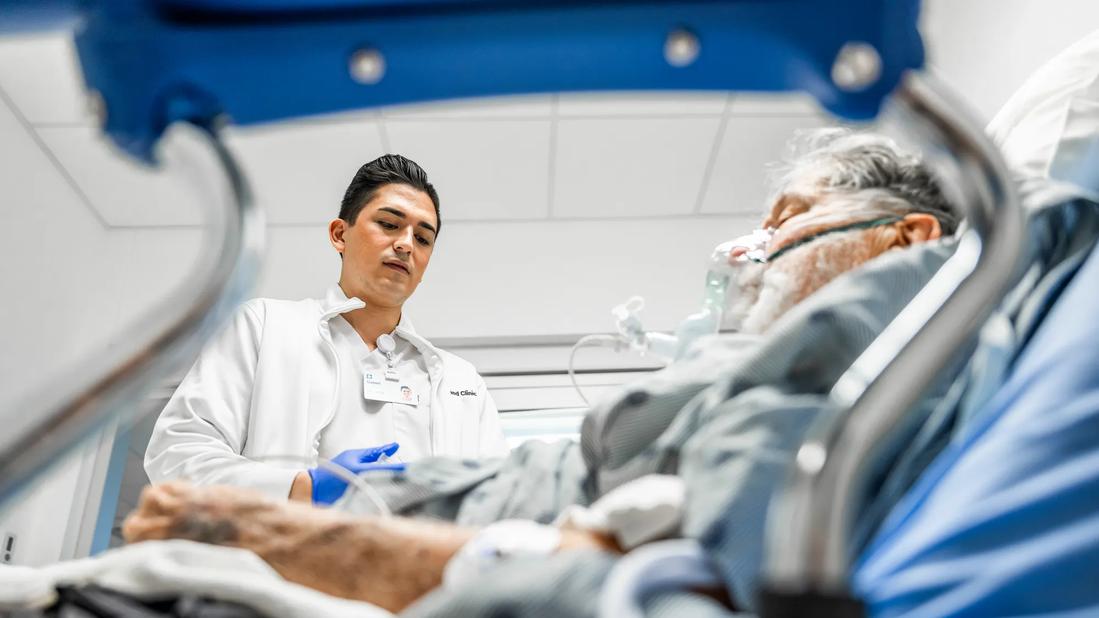
Image content: This image is available to view online.
View image online (https://assets.clevelandclinic.org/transform/19cc3ab7-ae31-4694-8231-6db250cae3ed/PHI_5273708_09-16-24_1360_MLC)
Geriatric patient in ICU
This article is reprinted without references from the Cleveland Clinic Journal of Medicine (May 2026, 93 (5) 263-265; doi.org/10.3949/ccjm.93a.25105). The open-access and fully referenced original article is available at ccjm.org/content/93/5/263.
Advertisement
Cleveland Clinic is a non-profit academic medical center. Advertising on our site helps support our mission. We do not endorse non-Cleveland Clinic products or services. Policy
By Astefanos Al-Dalakta, MD; Ruth Diana Lee, MD; Chadi Tabaja, MD; Issam Motairek, MD; and Eduardo Mireles-Cabodevila, MD
The intensive care unit compresses time. Decisions that shape outcomes are made amid the sounds of alarms and ventilators and constant motion. It was in this setting that an 87-year-old woman arrived, having been transferred from another hospital, her voice silenced by the tube that kept her alive. She’d been intubated for stridor, caused by a large mass in her neck that had collapsed her trachea.
As clinicians at the bedside, we felt the weight of our own bias creeping in. Here was a woman nearing 90, intubated, with a large tumor for which all therapy seemed perhaps excessive. Given her age, it was tempting to think that hospice might be the kindest path. But her daughter hesitated. She said that before this illness, her mother lived independently, cooked for herself, and was enjoying her life. So, later that morning, sedation was held.
We reviewed the options with our patient. Our conversation demonstrated her ability to participate in decision-making (albeit intubated) and clearly express her preferences. She declined hospice care. She wished to continue living and was not prepared to transition to comfort-focused treatment.
Physicians are not immune to biases. Ageism, defined as stereotypes, prejudice, or discrimination based on a person’s age, often manifests in ways we may not immediately recognize, especially in healthcare.
It’s an attitude that can, consciously or unconsciously, influence how we view and treat older patients, affecting everything from the language we use to the medical decisions we make. This can sometimes lead to assumptions that older patients are less likely to benefit from aggressive treatments or that their frailty makes intensive care unwarranted.
Advertisement
In the scenario described above, our patient’s age and condition made us think that she might be better suited for hospice care. This bias, however well-meaning, could have prematurely closed the door to treatment options.
Bias toward older patients may arise through multiple mechanisms. One important factor is the historical underrepresentation of older patients in clinical trials; for example, between 1996 and 2002, patients age 75 and older accounted for only 8.3% of participants enrolled in National Cancer Institute–sponsored breast, colorectal, lung, and prostate cancer trials.
This exclusion may stem from a desire to reduce mortality rates or minimize confounding variables that arise from the increased medical complexity often present in older patients. Consequently, most of our guideline-directed care is derived from younger cohorts, which can make it challenging to generalize evidence to an older population. Extrapolating data from younger cohorts can potentially lead to suboptimal or even harmful treatments for an already vulnerable population.
Similarly, age and frailty often coexist and influence perioperative and treatment-related risk, shaping clinicians’ perception of risk at the time of hospital admission and becoming a source of anchoring bias. However, evidence consistently shows that chronological age alone should not be viewed as a contraindication to surgery or chemotherapy. Frailty indices, and not age per se, are among the strongest predictors of postoperative complications, length of stay, functional decline, and prolonged recovery in older adults.
Advertisement
At the same time, multiple geriatric-oncology studies show that carefully selected older patients, including those older than 80, can achieve postoperative morbidity, mortality, and cancer-control outcomes comparable to those in younger individuals when decisions are based on physiologic reserve, comorbidities, and goals of care rather than age alone.
Disparities in research and treatment options create a cycle of inequity in care, where older patients are frequently overlooked for treatments that may align with their health status or preferences. Acknowledging our vulnerabilities —whether stemming from ageism, the pressures of a critical care environment, or our own preconceived notions — requires humility and reflection.
When caring for critically ill older adults, it’s essential that we move beyond chronological age toward an assessment of biological age, taking into account frailty, baseline functional status, cognitive reserve, and physiologic resilience, which more accurately inform prognosis and treatment tolerance.
Importantly, countering ageism requires intentionally exploring care pathways that may initially seem unreasonable or “not viable” by conventional clinical heuristics, but that, in the appropriate context—as in this case—emerge as both rational and clearly aligned with the patient’s goals.
Advertisement
Advertisement

Using the EMR to identify subtle symptoms at triage
Making decisions that prioritize biological age and functional status over chronological age alone

New study aims to streamline dementia diagnoses and expand access to timely, accurate care

New research highlights serious risks and the critical need for earlier advance care planning
Initiatives focus on the physical and emotional well-being of geriatric patients and their caregivers
Researchers explore the mental and physical benefits of social prescribing

Multidisciplinary approach helps address clinical and psychosocial challenges in geriatric care

Effective screening, advanced treatments can help preserve quality of life
 Search