Locations:





 Search
Analysis is one of the largest-ever series of RMSK outcomes, first to include all RMSK patients
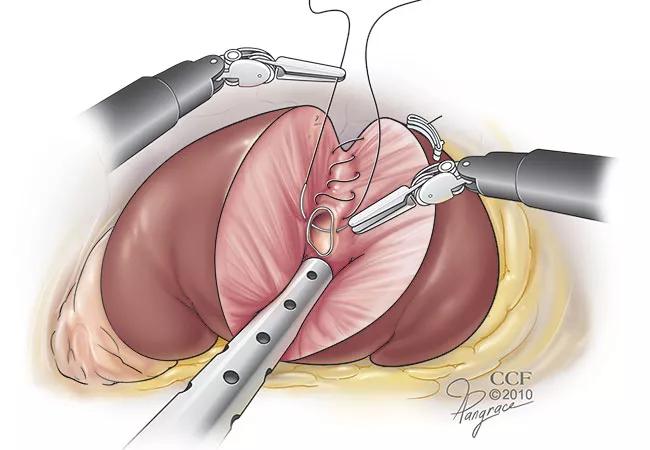
Image content: This image is available to view online.
View image online (https://assets.clevelandclinic.org/transform/15bd1578-a43c-48a5-a2d2-fe1247f07bbe/650x450-partial-nephrectomy_jpg)
650×450-partial-nephrectomy
For most patients with renal masses in a solitary kidney (RMSK), nephron-sparing approaches are feasible and dialysis is typically unnecessary, a new comprehensive review from Cleveland Clinic finds.
Advertisement
Cleveland Clinic is a non-profit academic medical center. Advertising on our site helps support our mission. We do not endorse non-Cleveland Clinic products or services. Policy
About 1% to 2% of people have just one kidney, either from birth or later loss due to cancer, trauma, kidney stones, or other reasons. “Tumor in a solitary kidney is one of our biggest challenges. We have to remove the cancer but also aim to save enough kidney to allow patients to stay off dialysis,” explains lead author Steven C. Campbell, MD, PhD, professor of surgery, residency program director, and member of the Cleveland Clinic’s Center for Urologic Oncology.
The retrospective analysis of 1024 patients diagnosed with RMSK at Cleveland Clinic between 1975 and 2022 is one of the largest-ever series of RMSK outcomes and the first to include all RMSK patients, not just those who underwent successful partial nephrectomies (PNs). Dr. Campbell presented these findings at the 2022 American Urological Association meeting in New Orleans.
“Most studies have only examined those who underwent PN and excluded those who ended up with radical nephrectomy (RN). This is the first analysis that provides the big picture of every patient who walks in the door with a solitary kidney and a tumor in it, and exactly what happens to them over time,” Dr. Campbell explains.
The use of nephron-sparing surgery to preserve kidney function was pioneered at Cleveland Clinic by the world-renowned urologist Andrew C. Novick, MD, beginning in the 1980’s. “Through the years we’ve learned a great amount managing this patient population,” says Dr. Campbell, who trained under Dr. Novick along with several colleagues involved in this study.
Advertisement
Of the 1024 Cleveland Clinic RMSK patients, 82% underwent PN, 10% cryoablation, 5% RN, and 3% active surveillance. The majority (79%) had solitary kidneys due to contralateral nephrectomy, while 12% had congenital solitary kidney and 9% had severe contralateral atrophy. On final pathology, renal cell carcinoma (RCC) was found in 86% and benign histology in 12%.
Partial nephrectomy was performed with cold ischemia in 42% and warm ischemia in 53%. Among those who underwent PN, the median preoperative estimated glomerular filtration rate (eGFR) was 57ml/min/1.73m2, the new baseline eGFR was 40ml/min/1.73m2, and final eGFR was 40ml/min/1.73m2, with median follow-up of 55 months. Overall, PN saved a median of 77% of global renal function, and only 4% of those who underwent the PN eventually required long-term dialysis.
Among the 54 patients (5%) who underwent RN, 41 were planned, mostly due to severe preexisting CKD and/or near total replacement of the kidney such that there wasn’t enough parenchymal to be saved. Thirteen were converted from PN (1.5%), mostly due to locally advanced cancer or concern about margin status.
Overall, 87% of RN patients required long-term dialysis. The other 13% all had small atrophic contralateral kidneys that “kicked in just enough to keep them off dialysis,” Campbell notes.
The tyrosine kinase inhibitors (TKIs) axitinib or pazopanib – agents that block blood flow to the tumor – were used for eight weeks prior to surgery in 22 patients who had biopsy-proven clear cell RCC and R.E.N.A.L. score of 10 or greater. In those patients, median reduction of tumor volume was 57%, R.E.N.A.L. score was reduced in 47%, and PN was successful in 20 (91%). Overall, 21% of all PN cases with a solitary kidney over the past decade at Cleveland Clinic have received preoperative TKI.
Advertisement
“We’ve been using TKIs more over the last ten years. These are often the most difficult cases, where without some help it’s debatable whether we’d be able to perform a PN but with the TKI to shrink the tumor we’re able to do it,” Dr. Campbell says.
However, he notes that TKIs only work for clear cell tumors and not those with other histologies. And, because TKIs are expensive and have side effects “We don’t want to use them unless we really need to. But when we do use TKIs, we’ve found them to be rather helpful.”
Perioperative complications included need for transfusion in 6% and 90-day Clavien III-IV complications in 8%. There were only 6 mortalities within 90 days of surgery (0.6%). Five-year survival rates were 72% overall, 74% among those who underwent PN, 76% for cryoablation, 44% for RN, and 42% for active surveillance.
The Cleveland Clinic team is now working on two more analyses from the RMSK database. One will delve further into short and long-term functional outcomes for the 842 PN patients. The other will describe outcomes of patients who were treated with cryoablation, a procedure reserved for relatively small, non-central tumors.
Overall, Dr. Campbell says, “We’ve dedicated ourselves to providing strong outcomes for this challenging group of patients, to publish our experiences, and to teach the next generation to take on these most difficult of cases.”
Advertisement
Advertisement

Creating a safe space for patients

Long-term immune effects reshape preventative strategies and timelines
Large-scale database also reveals potential for immunotherapy to protect against cancer
Findings may help guide discussions around prognosis and allogeneic stem cell transplantation

Research underscores the importance of access to timely diagnosis and treatment in this patient population.
A Cleveland Clinic model combining clinical staging, genomics and AI predicts survival with 18% greater accuracy — and could help match patients to more effective treatments.
Study serves as ‘cautionary tale’ for physicians tempted to rely on liquid biopsy results alone

Direct delivery of viral-based vector KB707 to the lungs may boost anti-tumor response and help overcome immune checkpoint inhibitor resistance