Locations:





G-TORe uses endoscopic suturing to stop peristomal leakage without upsizing the feeding tube
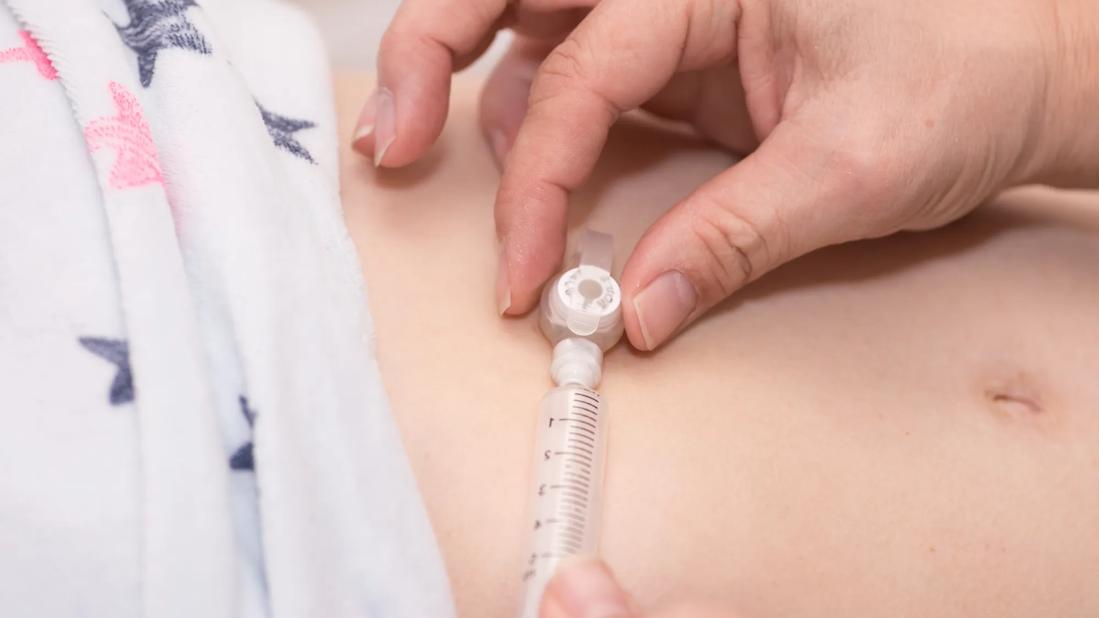
Image content: This image is available to view online.
View image online (https://assets.clevelandclinic.org/transform/9b7bc172-09ea-4cb2-944d-6e7e8e38e189/complex-nutritional-needs)
image of stomach feeding tube
Peristomal leakage is a significant complication for patients with feeding tubes, and traditional management approaches are largely ineffective — and often make the problem worse. Now, Cleveland Clinic physicians have developed a new approach for managing peristomal leakage with endoscopic suturing.
Advertisement
Cleveland Clinic is a non-profit academic medical center. Advertising on our site helps support our mission. We do not endorse non-Cleveland Clinic products or services. Policy
The technique, Gastrostomy Transoral Outlet Reduction, or G-TORe, applies sutures to the inside of the stomach endoscopically, then cinches the sutures to tighten the stoma around the feeding tube. The strategy was inspired by a technique used in bariatric surgery, says Cleveland Clinic gastroenterologist Hassan Siddiki, MD, who developed the technique.
“This should encourage gastroenterologists to be more creative and keep an open mind about how they can adapt different technologies and devices for various diagnoses and patient populations,” he says.
Dr. Siddiki presented a case study on the new technique at the American College of Gastroenterology’s annual meeting in October.
Around 200,000 patients receive feeding tubes in the United States each year. Patients are typically malnourished, and many are on chemotherapy, creating a significant risk that the incision made during insertion won’t heal. This can lead to leakage around the stoma, causing skin to break down and leading to painful infections.
“You’re starting with a population that is already quite sick, so healing in these patients can become a major problem,” Dr. Siddiki says.
There are currently few good options for managing peristomal leaks in these patients. Topical medications applied to the wound aren’t very effective and are often painful. To solve the leak itself, providers often intuitively try to close the gap by giving the patient a larger tube; however, this only makes the problem worse.
“The wound becomes even bigger because the underlying problem is the malnutrition,” Dr. Siddiki explains. “The patient goes down a road where they keep getting bigger and bigger tubes, the hole keeps getting larger and the leakage worsens.”
Advertisement
A 70-year-old female patient presented with a history of bile duct cancer and complex hepatobiliary surgery. Already malnourished, the patient was given a feeding tube to augment her nutrition and support her recovery from surgery. However, the tube itself caused significant problems, including large-volume leakage, skin infection and a peristomal abscess. The patient was also in a significant amount of pain.
Other providers attempted to resolve the problem by using a balloon tube and topical skin treatments but were not successful.
In considering solutions, the Cleveland Clinic team was reminded of bariatric outlet reduction, a minimally invasive technique that uses endoscopic suturing in a “purse-string” stitch to constrict the outlet to the stomach.
“We wanted to provide her some relief by creating solutions that we already provide to patients for a different reason in the bariatric population,” Dr. Siddiki explains.
To perform the G-TORe procedure, Dr. Siddiki inserted a guide wire through the existing tube, then pulled the tube out over the wire. He then used an endoscope to apply five to six uninterrupted running sutures using a purse-string stitch. The sutures were then pulled tight like a drawstring to reduce the size of the stoma.
The procedure stopped the leak immediately and completely. After four days, the patient was discharged to her home, where her skin healed well and she was able to finish chemotherapy.
Cleveland Clinic gastroenterologists have since used the G-TORe technique on several more patients, with good results.
Advertisement
Dr. Siddiki notes that not all medical centers offer endoscopic suturing, which could limit adoption of the approach. G-TORe also requires an endoscopist with experience using suture equipment, he adds.
“We’re hoping that with the evolution of these devices it will become easier for other endoscopists to start adopting endoscopic suturing and offering this technique to patients,” he says.
Next, the team plans to continue offering the procedure to patients and will collect data on outcomes.
“We would like to study G-TORe as the first-line intervention for peristomal leakage,” Dr. Siddiki says.
Advertisement
Advertisement
Study found lower rates of nausea, vomiting and healthcare use through 12 months of follow-up
Q&A with the Director, Advanced Pediatric Nutrition Support and Intestinal Rehabilitation Program
Calculator saves time, reduces error

Findings suggest insurance coverage alone may not ensure timely specialty care and treatment
Study identifies patient and procedural factors associated with missed endoscopy appointments
Real-time case discussion connects IBD specialists across disciplines, institutions and countries
Findings show significant energy savings and no association with increased surgical site infection, mortality or ICU admission
A complex pelvic exenteration underscores the importance of early multidisciplinary planning for locally invasive cancers
 Search