Locations:





Gene mutations discovered in some patients may lead to malignancy
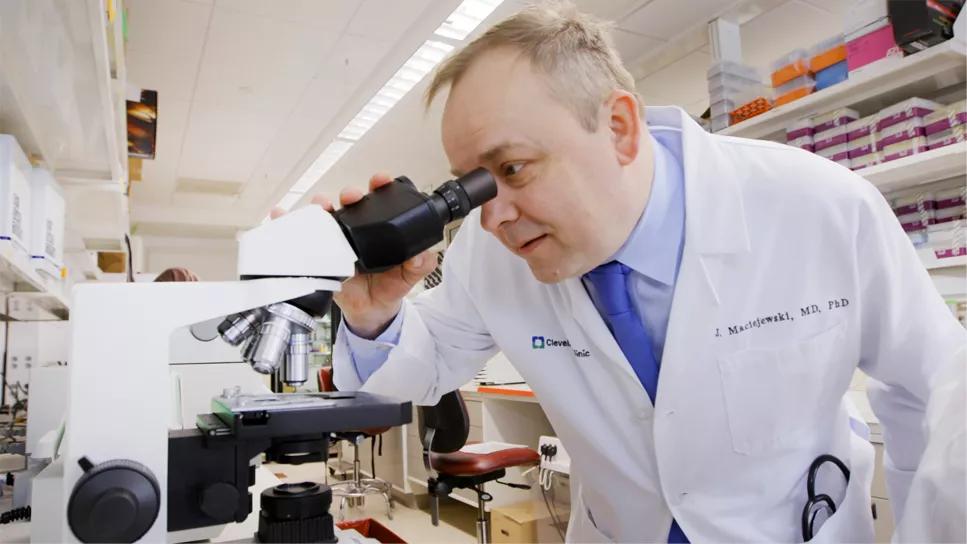
Image content: This image is available to view online.
View image online (https://assets.clevelandclinic.org/transform/ffa0a500-28f7-43ad-a131-63a26098ba1c/paroxysmal-nocturnal-hemoglobinuria-maciejewski)
maciejewski_650x450
Aplastic anemia is a rare bone marrow failure disorder in which patients’ immune cells turn against stem cells in the bone marrow and damage blood production. The result is anemia, a lack of platelets responsible for blood clotting, and a lack of white cells responsible for immune defenses.
Advertisement
Cleveland Clinic is a non-profit academic medical center. Advertising on our site helps support our mission. We do not endorse non-Cleveland Clinic products or services. Policy
Treatments are effective for most aplastic anemia patients. However, 10 to 15 percent of patients typically progress to a myelodysplastic syndrome (MDS) and/or acute myeloid leukemia (AML). Clinicians have struggled to predict which patients with the autoimmune disease are at risk for these blood cancers.
Recent research is providing greater insight into the late development of MDS and/or AML in acquired aplastic anemia.
Investigators including Cleveland Clinic oncologist Jaroslaw Maciejewski, MD, PhD, who conducted a multicenter study have identified acquired mutations normally found in leukemia in a large proportion of patients with aplastic anemia.
Aplastic anemia has been considered a nonmalignant condition, so the discovery will change hematologists’ understanding of the disease. Detection of these mutations suggests that the autoimmunity responsible for damaging bone marrow in aplastic anemia may represent the body’s response to very early stages of leukemia.
“We learned that some patients with aplastic anemia carry seeds for future leukemia or, if you wish, actually have a pre-leukemic condition that may require a different treatment,” says Dr. Maciejewski, Chairman of the Department of Translational Hematology and Oncology Research. “If the mutations are found, many patients are at higher risk for developing the dreadful complication of leukemia out of aplastic anemia. Previously we could not explain this complication. This is a paradigm shift regarding how we view this disease.”
Advertisement
The researchers’ findings were published in The New England Journal of Medicine.
Aplastic anemia is widely accepted as an autoimmune disease in which destruction of bone marrow hematopoietic stem and progenitor cells by the immune system leads to pancytopenia. The later development of MDS, AML or both in some aplastic anemia patients has been termed clonal hematopoiesis or clonal evolution, although there is evidence of this process in patients who do not progress to leukemic conditions. The origin and dynamics of clonal evolution in aplastic anemia and its relationship to the development of MDS and/or AML has been unknown.
Dr. Maciejewski and colleagues at Cleveland Clinic; the National Heart, Lung, and Blood Institute; and Japan’s Kanazawa, Kyoto and Nagoya universities and the University of Tokyo used advanced genetic analysis to study the clonal hematopoiesis process in aplastic anemia. The investigators performed next-generation genetic sequencing and array-based karyotyping on a total of 668 blood samples from the 439 study participants. They chose 106 genes for targeted sequencing, including genes in which mutations were already associated with myeloid cancers.
Almost half the patients with aplastic anemia in the study showed evidence of expanded hematopoietic cell clones, and about one-third had acquired mutations in candidate genes for MDS and/or AML. Clonal hematopoiesis in the study participants usually manifested as somatic mutations in a few known MDS/AML driver genes — DNMT3A, ASXL1, BCOR and BCORL1.
Advertisement
In total, the researchers identified 249 somatic mutations in 156 patients (36 percent of the study population). About one-third, or 56 of these 156 patients, were found to have multiple mutations. With few exceptions, the presence and number of mutations per patient significantly correlated with increasing patient age.
In a subset of patients with severe aplastic anemia, the researchers tested blood samples after the patients underwent six months of immunosuppressive therapy. Overall, they found no association between the presence of mutations and response to treatment. However, when they examined the mutations individually, two mutations (of BCOR and BCORL1) were associated with a good immunotherapy response.
Although more research is needed, good overall survival was associated with the presence of these “favorable” somatic mutations. In contrast, hematopoietic clones carrying mutations in DNMT3A, ASXL1 and a few other genes were more likely to increase in size over time, and these gene mutations as a group were associated with a reduced response to immunosuppressive therapy, poorer overall survival, and progression to MDS and/or AML.
Even so, overall survival and progression-free survival rates did not significantly differ between patients with and without somatic mutations.
The discovery of the mutations in myeloid cancer candidate genes could help explain both the immune response and the progression to MDS/AML in some aplastic anemia patients, Dr. Maciejewski says. Although the exact pathogenesis is unknown, in these cases, clonal hematopoiesis may represent the earliest stages of leukemogenesis. The presence of certain mutations may initiate the immune response that results in aplastic anemia. And some mutations may help protect mutated hematopoietic cells from immune-mediated destruction, allowing them to further proliferate.
Advertisement
“This might support the still unproven theory that what makes the immune system destroy our own bone marrow in aplastic anemia is the appearance of these mutations,” Dr. Maciejewski says. “This is one of a few examples of a benign disease in which leukemogenic mutations have now been detected.”
The researchers include a caveat with their findings: “Despite the association of particular gene mutations observed early in the course of disease with the response to therapy and survival, it should be underscored that the complex dynamics of clonal hematopoiesis are highly variable and not necessarily determinative.”
More research on the pathogenesis of aplastic anemia is warranted, Dr. Maciejewski says. “Why is it that some of these clones that cause leukemia in aplastic anemia actually go away, versus some that invariably lead to leukemia?” Future investigation could uncover which mutations drive subsequent leukemia and which ones remain just neutral passenger mutations.
Dr. Maciejewski is Chairman of Cleveland Clinic’s Department of Translational Hematology and Oncology Research and a staff member of the departments of Clinical Pathology and Hematology and Medical Oncology. He is also a Professor of Medicine at Cleveland Clinic Lerner College of Medicine.
Photo Credit: ©Russell Lee
Advertisement
Advertisement

Study reinforces the importance of genetic testing prior to local therapy decisions

Understanding expanding treatment options and potential advances

Adding 177Lu-PSMA-617 to ADT plus an ARPI cut the risk of radiographic progression or mortality by 28%

New program will help patients improve fitness and manage weight after cancer treatment

Cleveland Clinic hematologist highlights new guidelines and treatment advances in immune thrombocytopenia
NIMBLE replaces weekly tumor board delays with same-day multidisciplinary recommendations

Cleveland Clinic study provides validation for the test, which combines AI and pathological data to predict outcomes in postoperative patients

Advanced imaging technology catches metastases much earlier, allowing treatment with fewer side effects
 Search