Locations:





Milestone minimally invasive surgeries reduce pain and recovery time
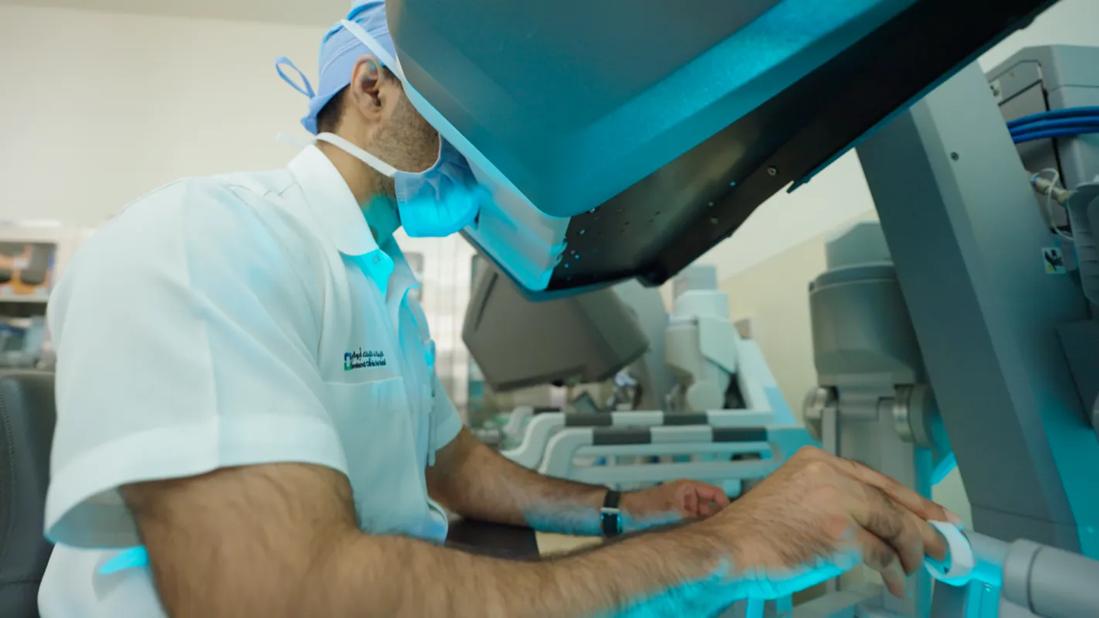
Image content: This image is available to view online.
View image online (https://assets.clevelandclinic.org/transform/7335f41b-5758-48ab-ae5a-72a6298ce3ec/ccad-robotic-lung-transplant)
Surgeon at robotic controls
Surgeons at Cleveland Clinic Abu Dhabi have performed two robotically assisted lung transplants — a complex procedure that has been undertaken by only a few transplant centers worldwide.
Advertisement
Cleveland Clinic is a non-profit academic medical center. Advertising on our site helps support our mission. We do not endorse non-Cleveland Clinic products or services. Policy
The minimally invasive approach using the advanced robotic platform significantly reduced the patients’ postoperative pain, decreased analgesia needs and shortened recovery time. Both patients have returned home and are breathing normally.
The surgeries constitute a milestone for Cleveland Clinic Abu Dhabi’s transplant program which, in less than a decade of existence, has established itself as the most advanced and active center of its kind in the Gulf region, performing more than 800 transplants and achieving a number of procedural firsts.
“Cleveland Clinic has been at the forefront of innovation in heart and lung surgeries for decades, using multidisciplinary teams and advanced technologies to take care of some of the sickest patients,” says Usman Ahmad, MD, the lead surgeon in the robot-assisted lung transplants and chair of Cleveland Clinic Abu Dhabi’s Division of Thoracic Surgery. “This was one of the more complex and innovative operations we’ve undertaken and is a testament to the ability of our cardiothoracic teams.”
“By integrating robotic technology into this already challenging operation, we are not only elevating the standard of care but redefining what is possible for patients in the region,” says Cleveland Clinic Abu Dhabi CEO Georges-Pascal Haber, MD, PhD.
Both transplant recipients had idiopathic pulmonary fibrosis as well as secondary pulmonary hypertension. This chronic, progressive condition scars and stiffens lung tissue, making breathing increasingly difficult and reducing blood oxygenation.
Advertisement
For patients with advanced disease who meet acceptance criteria, lung transplantation is the gold standard and sometime the only viable treatment. Post-transplant outcomes are improving, with survival rates of 55% at five years and median survival approximately six years.
But standard surgical incisions for lung transplant — sternotomy, clamshell or thoracotomy — are invasive, cause significant morbidity and prolong recovery.
“We have to cut through patients’ sternum and chest muscles, which hinders the process of recovery significantly,” Dr. Ahmad says. “That's why whatever we can do to make the incision small is helpful.”
However, the complex nature of lung transplantation surgery and the constrained anatomy of the chest make traditional minimally invasive approaches without sternal division challenging.
Sicker patients also may require cardiopulmonary support — either heart-lung bypass or extracorporeal membrane oxygenation (ECMO) — which can affect decision-making about an open versus minimally invasive approach.
The enhanced dexterity, control, accuracy and visualization that robot-assisted surgical platforms provide has expanded minimally invasive surgery’s applications. In 2022, a surgical team at Cedars-Sinai Medical Center in Los Angeles performed the world’s first robot-assisted lung transplant.
Owing to the steep learning curve, only a few transplant centers have replicated that feat.
Cleveland Clinic has extensive experience in robot-assisted surgeries across multiple disciplines, including heart and lung surgeries.
Advertisement
In thoracic surgery, “we use the robotic platform to resect lung tumors,” Dr. Ahmad says. “We do fine microdissection to separate and remove the cancerous portion of the lung. Sometimes that requires suturing vessels and bronchi. We have a dedicated team of surgeons who are experts in robotic surgery, a cardiothoracic anesthesia team, highly skilled nurses, and ICUs that are dedicated to these types of patients and procedures. Robot-assisted lung transplantation was a matter of putting all that previous experience together and applying it on a bigger scale in a much sicker patient. We do extensive simulations and planning before undertaking such procedures.”
Both Cleveland Clinic Abu Dhabi patients received bilateral grafts, but only one lung in each patient was transplanted robotically. The robot-assisted procedure was done first in each case, then the other lung was transplanted using a minimally invasive incision “to save time, because we are still on a learning curve,” Dr. Ahmad says.
The nature of both patients’ lung disease posed some challenges for performing their transplants robotically.
Ideal candidates for robot-assisted thoracic surgeries are patients with large-volume chest cavities, to allow adequate room to maneuver instruments and avoid damage to vasculature and the heart structures.
“In this part of the world, lung transplant candidates typically present late, with more advanced disease,” Dr. Ahmad says. “They’re generally sicker than our patients in the United States. Because the fibrotic process happens over many years, the inside of the chest gradually contracts. The diaphragm moves up, the heart chambers can expand a bit, the ribs narrow down — everything gets squeezed together. It makes the surgery very challenging.”
Advertisement
Video content: This video is available to watch online.
View video online (https://cdnapisec.kaltura.com/p/2207941/sp/220794100/playManifest/entryId/1_bi9u885h/flavorId/1_5f3sgelj/format/url/protocol/https/a.mp4)
The operative procedure was similar in both transplant cases, with Dr. Ahmad at the robotic platform’s control console.
Following anesthesia induction, a double-lumen intubation tube was placed in the trachea to allow independent ventilation of the right and left lung. Heparin was administered, then right femoral artery and vein cannulation was performed and veno-arterial ECMO was instituted.
The robotic platform was docked utilizing four ports. Pneumonectomy (removal of the recipient’s native right lung) was performed by separating the lung from the heart and from the main windpipe. Through an approximately 5-centimeter incision, the fibrotic right native lung was removed and the donor lung was introduced into the chest.
Using special robotic instruments and fine sutures, the native and donor bronchi were anastomosed, followed by the atrial (pulmonary venous cuff) and pulmonary artery anastomoses.
The robot was undocked and transplantation of the left lung ensued via a left anterior thoracotomy.
Upon completion of bronchial, pulmonary artery and atrial anastomoses and confirmation of hemostasis, graft ventilation and perfusion was initiated. ECMO was discontinued and the cannulae removed. Intraoperative bronchoscopy revealed widely patent and intact bronchial anastomoses. Intraoperative transesophageal echocardiogram showed patent and intact atrial anastomoses with excellent laminar flow.
The surgeries lasted approximately 40 minutes longer than traditional lung transplantation. “This is still early experience and we were being extremely cautious at every step,” Dr. Ahmad says.
Advertisement
Both transplant recipients needed significantly lower dosages and shorter courses of pain medications compared with patients who undergo open lung transplant procedures. They were discharged to home after hospital stays of no more than two weeks.
Patient selection is an important consideration. The goal of Cleveland Clinic Abu Dhabi’s robot-assisted transplant program is to choose the right surgical approach based on each patient’s individual medical needs.
“In general, candidates for the robotic procedure are patients who have enough room in their pleural space where robotic instruments can work without damaging the vessels or colliding with each other or causing damage to intrathoracic structures,” Dr. Ahmad says. “Secondly, some patients are too sick to tolerate minimally invasive transplant surgery and should undergo a quicker procedure through a bigger incision. And the third situation in which robotic surgery is not appropriate is if there are lot of lung adhesions that would require lengthy dissection time. We don't like to have donor lungs on ice for more than six hours.”
The availability of donor organs is another determinant in the program’s progress.
In the Middle East, “there is a significantly higher burden of infectious disease,” Dr. Ahmad says. “Large proportions of the Asian and Middle Eastern populations have been exposed to tuberculosis. So there’s a lot of extra testing of donor organs that we don’t normally think about in the United States, in addition to size and blood type matching.”
Dr. Ahmad is confident the program will build on its initial successes. “Looking to the future, our goals are to continue to grow and to provide this lifesaving resource to as many patients from all over the world as we can,” he says. “By incorporating machine learning and artificial intelligence, we are looking to provide and enhance personalized precision care.”
Cleveland Clinic Abu Dhabi’s lung transplant program has become a hub for international patients. “We not only serve all of the Gulf and Middle East, but we are also seeing increasing numbers of patients from South Asia, Europe and South America,” Dr. Ahmad says. “We are invested in leveraging innovation and technology to provide cutting-edge complex care to our patients. In heart and lung surgery, Cleveland Clinic remains one of the last stops for many patients from across the world.”
Advertisement
Insights on ex vivo lung perfusion, dual-organ transplant, cardiac comorbidities and more
Exploring the cost-effectiveness of end-of-life treatment options
Cleveland Clinic pulmonologists aim to further lower waitlist times and patient mortality
New research aims to improve suboptimal lung transplant outcomes by “looking beyond the walls of hospitals”

While logistical questions remain about RPM, its benefits for both patients and caregivers are abundantly clear
Long-term lung allograft outcomes clinically unaffected by organ exposure, study finds
Research explores how incorporating long-term benefits will impact the new U.S. lung transplant allocation system
First reported intestinal autotransplantation in Ohio expands surgical options for select patients with complex abdominal tumors
 Search