Locations:





The benefits of multiarterial grafting are possible without opening the chest
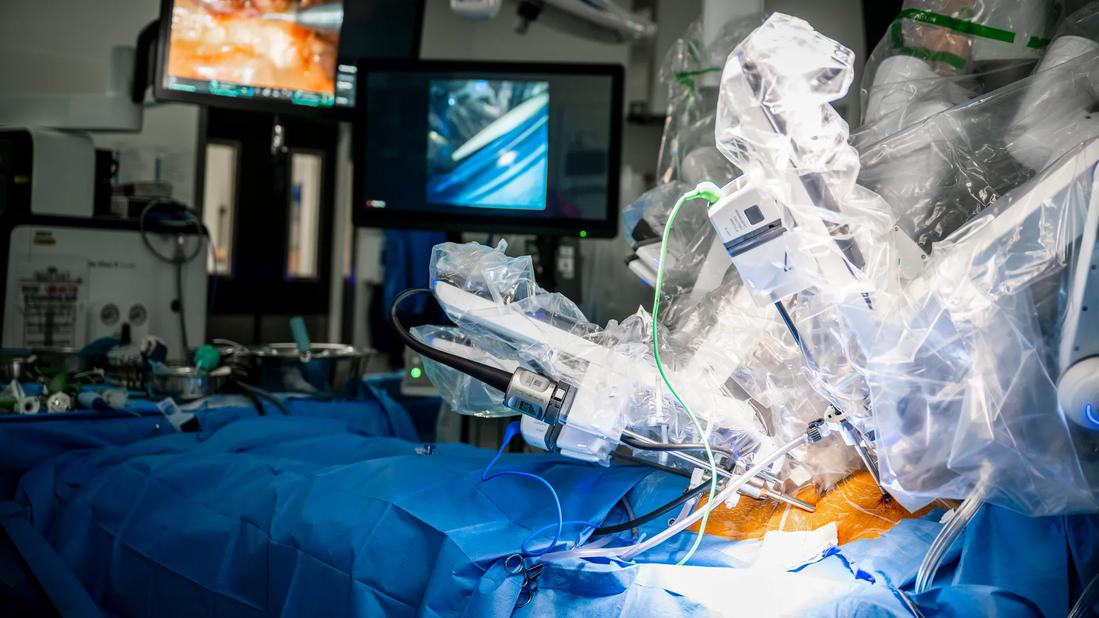
Image content: This image is available to view online.
View image online (https://assets.clevelandclinic.org/transform/63861227-f651-4ddb-b5a8-291fe6c93ea6/HVI_9189967_09-14-26_014_SCG)
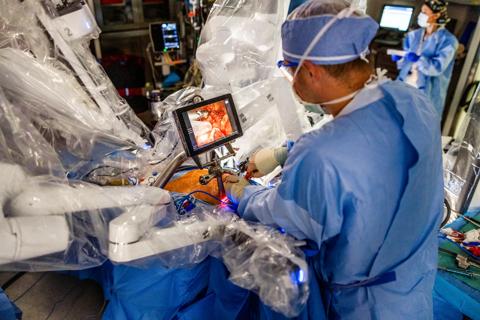
robotic surgery platform during an operation in the OR
As evidence mounts that the fullest benefits of coronary revascularization are gained through coronary artery bypass with multiarterial grafting, cardiovascular physicians now can offer good news to a growing share of their patients: These benefits can be realized without opening the chest at all.
Advertisement
Cleveland Clinic is a non-profit academic medical center. Advertising on our site helps support our mission. We do not endorse non-Cleveland Clinic products or services. Policy
This development comes courtesy of the refinement of totally endoscopic coronary artery bypass (TECAB) and its limited but growing availability. Cleveland Clinic is the latest of a very small number of centers worldwide to offer this highly technical and specialized procedure, thanks to the mid-2026 hire of cardiothoracic surgeon Gianluca Torregrossa, MD, one of the world’s most experienced TECAB operators.
“TECAB is considered the holy grail of coronary revascularization because it incorporates all the benefits of open CABG [coronary artery bypass grafting] in a completely closed chest, with only three keyhole incisions,” says Dr. Torregrossa, Director of Cleveland Clinic’s Robotic Coronary Artery Surgery Program.
Cleveland Clinic has begun offering TECAB to appropriate CABG candidates under the leadership of Dr. Torregrossa, who will be introducing TECAB to his new surgical colleagues who have already been performing the other established robotically assisted approach to coronary revascularization: MIDCAB, or minimally invasive direct coronary artery bypass.
Appreciating what TECAB brings to the table starts with recognizing the utility and limitations of MIDCAB. The MIDCAB procedure involves takedown of the internal mammary artery (IMA) — usually the left IMA (LIMA), very occasionally both IMAs — with the robot through a small incision between the ribs on the left side of the chest. This is followed by a mini-thoracotomy through which the IMA is reattached to the blocked coronary artery (typically the left anterior descending artery [LAD]) below the obstruction, with the coronary anastomosis performed manually by a surgeon at the table.
Advertisement
The utility of MIDCAB is greatest for patients needing only a single LIMA-LAD bypass. For those with blockages in other arteries amenable to stenting, a hybrid procedure combining MIDCAB with stent placement can be performed. The outcomes of MIDCAB alone or MIDCAB-based hybrid procedures are excellent for well-chosen candidates, but patients are still left with some chest scars and with the recovery-related limitations inherent to opening the chest, even if modestly. Moreover, patients receiving stents in a hybrid procedure may not benefit from the full protective surgical collateralization conferred by multiarterial grafting.
TECAB differs from MIDCAB by eliminating the thoracotomy and performing both conduit harvest and coronary anastomosis with the robot rather than manually. The procedure is typically performed on the beating heart without cardiopulmonary bypass, requiring precise local stabilization at the target vessel(s). The entire TECAB procedure is performed via three keyhole incisions of less than a centimeter in the left side of the chest. This translates to minimal postoperative pain and accelerated recovery, as well as cosmetic results more acceptable to patients. For instance, Dr. Torregrossa notes that his first two TECAB cases at Cleveland Clinic represented a typical recovery trajectory: Both patients (one from out of state and one from another continent) were discharged on postoperative day 1 and went to a local hotel for a few days prior to a follow-up office visit before heading home.
Advertisement
He emphasizes, however, that the benefits of TECAB go beyond recovery and cosmesis. In MIDCAB, the small thoracotomy restricts visualization and working angles, which largely limits the procedure to cases requiring a single LIMA-to-LAD graft. In contrast, visualization in TECAB is camera-based, allowing the operative field to be redirected toward anterior and lateral targets, including the LAD, diagonal branches, ramus intermedius, circumflex system, obtuse marginal branches and, in selected cases, the posterolateral branch. “This flexibility allows for robotically assisted multiarterial and multivessel revascularization in cases where MIDCAB generally cannot,” he notes.
Indeed, TECAB’s closed-chest approach facilitates broader use of bilateral IMAs in patients who want a robotic procedure. “This is important, because we know that many patients stand to benefit most from bypass grafting with bilateral IMAs, which are the most durable conduits and offer the best long-term outcomes,” Dr. Torregrossa says.
Unfortunately, bilateral IMA use after sternotomy remains limited, partly because harvesting both arteries reduces sternal perfusion and may increase wound-healing complications. This is particularly a concern in patients with diabetes, obesity, chronic obstructive pulmonary disease or tobacco use. TECAB preserves the sternum and avoids a sternal wound, potentially allowing bilateral IMA grafting in a wider population. Moreover, maintaining normal chest geometry also keeps the right IMA closer to left-sided coronary targets, reducing length constraints and the need for composite or free-graft configurations.
Advertisement
Dr. Torregrossa nevertheless stresses that robotics should not be applied indiscriminately, noting that about half of his recent practice has remained open surgery. “Offering robotics in the context of a strong conventional program is essential for selecting the correct operation and managing anatomy unsuitable for a robotic approach,” he says.
Patient selection is evolving with coronary CT angiography, which increasingly identifies disease before symptoms, extensive ischemia or cardiac damage develop. Earlier detection creates opportunities to tailor treatment using guideline-directed medical therapy or percutaneous coronary intervention (PCI) before defaulting to arterial bypass — and then, when bypass is indicated, to consider robotically assisted or hybrid procedures before resorting to sternotomy-based revascularization.
Dr. Torregrossa sees particular value for robotic approaches in active younger patients with limited disease burden and in adults older than 80 years for whom the prolonged recovery associated with sternotomy may be unacceptable or may risk excessive functional loss. For selected elderly patients, he says, one or two robotically placed arterial grafts combined with PCI or medical therapy may provide an appropriate balance of durability and recovery.
The choice between MIDCAB and TECAB is target-specific, according to Dr. Torregrossa. He says MIDCAB remains preferable when the LAD requires direct tactile control and in cases requiring complex reconstruction, endarterectomy or management of a dissection-prone segment. Otherwise, he increasingly favors TECAB, reflected by a shift in his practice from roughly equal use of the two approaches to use of TECAB in approximately 70% to 80% of robotic cases more recently.
Advertisement
“Today there are very few anatomies that cannot be treated with TECAB,” Dr. Torregrossa says, “and they mostly entail very technical aspects that a surgeon highly experienced in coronary revascularization can identify and know when to proceed with TECAB or choose another approach.”
Nevertheless, due to its complexity and highly specialized nature, TECAB remains a rare procedure performed by fewer than a dozen surgeons worldwide. Dr. Torregrossa is one of the most experienced, with approximately 250 TECAB cases under his belt. A review article on his initial 100 cases is currently under review for publication.
He believes TECAB is poised to grow, however, as emerging platforms and dedicated devices lower barriers to adoption. The latter include improved robotic cardiac stabilizers and devices that simplify endoscopic anastomosis. Dr. Torregrossa is collaborating with industry on technology that could create multiple interrupted sutures and secure them with a single deployment while preserving long-term surgical-quality anastomoses. He also anticipates competition among established and emerging robotic platforms, with new instruments dedicated to coronary surgery.
At Cleveland Clinic, the future holds the opportunity for combining TECAB with other robotic heart procedures without opening the chest. Likely initial combinations include pairing robotic mitral valve repair or aortic valve replacement with TECAB in patients who have concomitant valve disease and coronary artery disease. Experience with these types of thoracotomy-free, all-robotic combination procedures remains limited to case reports and small series, but Cleveland Clinic’s complementary expertise could support systematic expansion, evaluation and training.
“I believe Cleveland Clinic is right now the only center that can offer the entire portfolio of robotic heart operations, including combined procedures,” says Dr. Torregrossa. “That’s a key reason I came here. For patients with coronary disease specifically, we offer a full surgical portfolio including open sternotomy CABG done with multiple arteries, use of bilateral IMAs, on-pump and off-pump procedures, MIDCAB, TECAB and hybrid strategies — and we soon expect to combine TECAB with robotic valve procedures. We are committed to drawing from all these options to tailor our approach to each patient and his or her priorities.”
His cardiologist colleague Paul Poommipanit, MD, echoes that sentiment. “Adding Dr. Torregrossa’s TECAB expertise to our world-class offerings in surgical and percutaneous coronary revascularization broadens the services we can offer to help our patients live healthier, more productive lives,” says Dr. Poommipanit, a staff physician in the Section of Invasive and Interventional Cardiology. “Tailoring patient anatomy and risk factors to ensure appropriate treatment selection is a key part of the success of our premier coronary program.”
“There have been incredible advancements in our technical capabilities from both the surgical and percutaneous perspectives for patients with complex coronary artery disease,” adds Laura Young, MD, also a staff physician in the Section of Invasive and Interventional Cardiology. “The question we most often face today is not ‘can we do it?’ but rather ‘how should we do it?’ At Cleveland Clinic we use a multidisciplinary approach to offer an individualized treatment plan for each patient.”
Advertisement
How careful measurement, provocative testing and repeat assessment can maximize the diagnostic value of PAC
CMR-CLIP outperforms general AI tools; may one day expand patient access to CMR
An infographic-style overview of our volumes and outcomes

A closer look at the impact on procedures and patient outcomes
Medical and surgical perspectives on current and emerging uses of ECMO and Impella
A scannable recap of our latest data in these clinical areas
Least-invasive open-heart AVR option to date yielded rapid recovery in all cases
How two Cleveland Clinic alliance hospitals systematically elevated echo standards
 Search