Locations:





More efficient, safer therapy may be on horizon
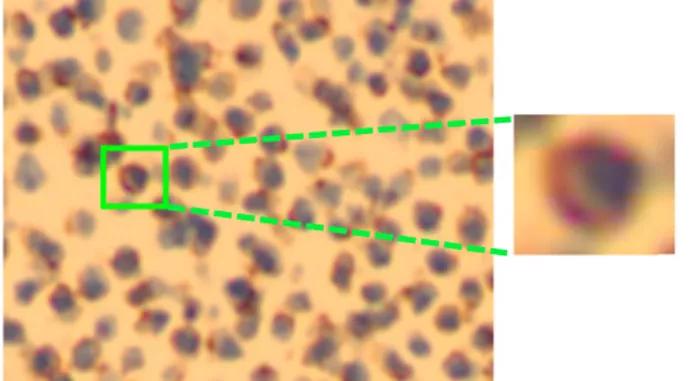
Image content: This image is available to view online.
View image online (https://assets.clevelandclinic.org/transform/2388f387-d951-4cdd-87b4-aec919702e63/Figure-1_690x380_jpg)
Figure-1_690x380
More than 60,000 people will be diagnosed with non-Hodgkin’s lymphoma this year and of these people, about 20,000 will die from it. Diffuse large B-cell lymphoma (DLBCL), one type of non-Hodgkin’s lymphoma, is particularly aggressive and accounts for about 25 percent to 35 percent of yearly diagnoses. While people’s responses to treatment vary greatly, if left untreated, DLBCL lessens survival and people live anywhere from a few weeks to a few months. A new study published in the journal Leukemia shows that a new treatment works well in mouse models and might provide new options to patients with DLBCL.
Advertisement
Cleveland Clinic is a non-profit academic medical center. Advertising on our site helps support our mission. We do not endorse non-Cleveland Clinic products or services. Policy
Neetu Gupta, PhD, has been examining B lymphocytes and trying to identify what spurs their growth and survival. While normal B cells play an important role in the immune system by providing antibody-mediated protection, aberrantly functioning B cells can contribute to aggressive lymphomas and autoimmune disorders, such as lupus.
“I am interested in figuring out what activates B cells and what keeps them alive in health and disease,” says Dr. Gupta, of the Department of Immunology at Cleveland Clinic’s Lerner Research Institute.
To this end, she examined samples of primary tumor biopsy samples from DLBCL patients and patient-derived cell lines. “The lymphomas contain sheets and sheets of B cells that continuously grow and survive,” she says. “Interestingly, these cells have high levels of phosphorylated ezrin-radixin-moesin proteins.”
She suspected that ERMs played a role in the proliferation of the unhealthy B cells. To gain a better understanding, she looked at their role both in cell culture and in mouse models. The results from these studies reinforced her belief: ERMs enable the growth of cancerous B cells.
Armed with an understanding of the role that ERMs play in B cell function, Dr. Gupta looked at ways to inhibit their function. She employed genetic mutants and knockdown approaches, as well as a novel small molecule that binds directly to ezrin. In her paper in Leukemia, she demonstrates that all three approaches abrogate lymphoma growth and that the small molecule inhibition approach is highly effective in mouse models.
Advertisement
“Utilizing in vitro and in vivo assays, we have identified that a small molecule inhibitor of ezrin disrupts DLBCL growth. We transplanted DLBCL cell line xenografts in mice to test the utility and efficacy of inhibiting ezrin as a target for DLBCL,” she says.
What’s exciting is that targeting ezrin to treat cancer might provide a much more efficient, safer therapy.
“These cancer cells are smart: They have a lot of different signaling pathways that allow them to survive. The ERM proteins act really upstream of these pathways. When you target so upstream, many of those pathways that are downstream will be simultaneously deactivated,” she says.
The small molecule inhibitor disrupts the survival of the cancerous B cells and causes them to die, without affecting healthy cells.
“It is exciting because most of the existing treatment regimen kill both good and bad cells,” she says.
While the results with this lead molecule seem promising, Dr. Gupta is modifying it to improve its efficiency and potency. She is also testing different routes of availability of this molecule in animal models so that patients can take it orally or intravenously.
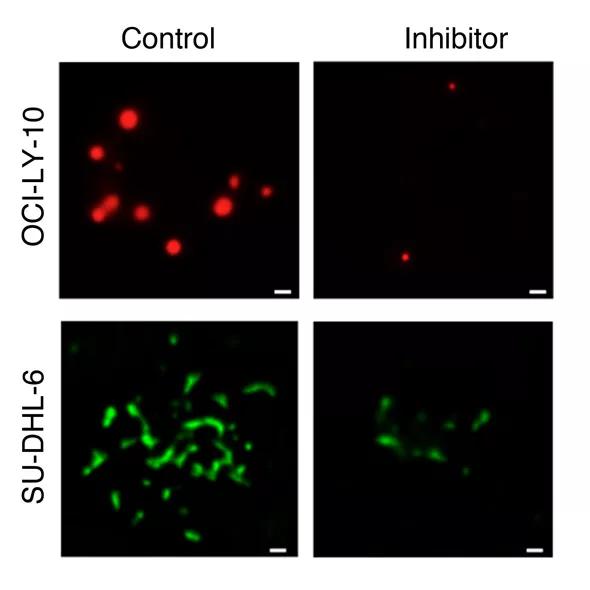
Image content: This image is available to view online.
View image online (https://assets.clevelandclinic.org/transform/be7954bb-c72b-4278-8fa8-1c7391768043/Figure-2_inset_jpg)
Immunochemistry images of DLBCL cells treated using antibodies.
Cancer cells want to survive and often adapt to hostile environments to thrive. The current treatment, a combination of rituximab, cyclophosphamide, doxorubicin, vincristine and prednisone (R-CHOP), works effectively for less than 50 percent of DLBCL patients. Additionally, R-CHOP kills both cancerous cells and functional immune cells, leaving patients with weakened immune systems. This means that if people experience an infection their bodies are less adept at fighting it off. Moreover, R-CHOP does not work in relapsed disease, meaning that the need for new and improved therapies is great. Finding that small molecules bind to ezrin and inhibit lymphoma growth means new treatments are on the horizon.
Advertisement
“The identification of novel therapies is imperative to improve prognosis and survival of these patients,” says Dr. Gupta.
While this new small molecule treatment is not immediately available for clinical trials, Dr. Gupta believes it represents a strong option for cancer management in the near future.
“This would be a novel way in which to target these aggressive lymphomas without a lot of the toxic side effects,” she says. “A lot of work remains. It’s sort of in its infancy right now [but] there is a lot of potential.”
Advertisement
Advertisement

Understanding expanding treatment options and potential advances

Adding 177Lu-PSMA-617 to ADT plus an ARPI cut the risk of radiographic progression or mortality by 28%

New program will help patients improve fitness and manage weight after cancer treatment

Cleveland Clinic hematologist highlights new guidelines and treatment advances in immune thrombocytopenia
NIMBLE replaces weekly tumor board delays with same-day multidisciplinary recommendations
Cleveland Clinic study provides validation for the test, which combines AI and pathological data to predict outcomes in postoperative patients
Advanced imaging technology catches metastases much earlier, allowing treatment with fewer side effects

Reduced radiation for lymph node areas reduces side effects
 Search