Locations:





They generally depend on the mutated gene, clone size and clinical setting

Image content: This image is available to view online.
View image online (https://assets.clevelandclinic.org/transform/3deca054-5c3a-4c4a-95f7-7e5a0c5ddd2b/ohad-oren-cqd)
physician pointing to a heart model and speaking to a woman
Clonal hematopoiesis of indeterminate potential (CHIP) is increasingly identified in a variety of clinical settings, with patients often referred to a specialized cardiologist to assess and manage cardiovascular risk. Guidance should depend on the setting in which the abnormality was detected, the specific mutation and clone size, and individual clinical factors.
Advertisement
Cleveland Clinic is a non-profit academic medical center. Advertising on our site helps support our mission. We do not endorse non-Cleveland Clinic products or services. Policy
So advise experts in a review paper describing the range of patients with CHIP who are referred to cardiovascular clinicians. The article presents four prototypical CHIP cases, using representative clinical scenarios to translate current evidence into practical recommendations for cardiovascular management. It was recently published in Circulation: Genomic and Precision Medicine (2026:19[3]:e005544).
“The categories of patients we describe emerged from our clinical observations and increasing understanding of the biological underpinnings and cardiovascular implications of CHIP,” says Cleveland Clinic cardiologist and hematologist-oncologist Ohad Oren, MD, MPH. “The classification is helpful to inform personalized management of this heterogeneous population.”
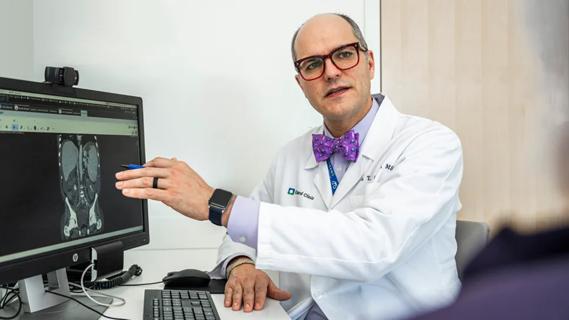
Dr. Oren (shown in the photo above with a patient) co-authored the review with Dr. Peter Libby of the Massachusetts General Brigham in Boston; both are pioneers in the field of clonal hematopoiesis.
CHIP stem cell mutations give rise to abnormal cell clones that are detectable in the peripheral blood. These somatic mutations are acquired with age: They are rare before age 40, have a prevalence of less than 8% in individuals in their 60s and are present in about one in four people in their 80s. A CHIP mutation is more likely to arise in people who use tobacco or have other mutagenic exposures during their lifetime.
Known primarily as a precursor of hematologic malignancies, CHIP is now also understood to be an important cardiovascular risk factor, likely owing to ramping up of inflammatory processes.
Advertisement
More than 45 different CHIP mutations have been identified. Some are associated with increased cardiovascular risk, especially TET2, ASXL1, TP53, PPM1D and JAK2 variants. Some have been linked to accelerated atherosclerosis, atrial fibrillation, venous thromboembolism and peripheral arterial disease. Clone size is measured as variant allele frequency: At least 2% is the threshold used to define the presence of CHIP, and at least 10% is considered large.
While testing for CHIP is not widespread and not recommended for the general population, certain situations warrant genomic investigation. The review describes four types of patients identified with CHIP — some of whom are otherwise healthy — who may be referred to a cardiologist for evaluation and management of cardiovascular risk.
About one-quarter of patients who undergo investigation of a low blood cell count have clonal cytopenia of unknown significance (CCUS). Similar to CHIP, CCUS is a potential precursor for myeloid neoplasms with distinct genetic profiles. The most common mutations are DNMT3A, TET2 and SRSF2. High-risk CCUS is associated with significant cardiovascular morbidity.
Individuals at high risk for cancer because of family history or other predisposing factors often are evaluated with a multicancer gene panel to test for germline variants. Likely pathogenic germline mutations – especially in the APC, CHEK2 and ATM genes – have been identified as risk factors for developing CH. Additionally, some CH genotypes occur more often in patients with certain germline mutations. Among patients with mosaic chromosomal alterations, rates of CH have been found to be about 50%.
Advertisement
Because patients with cancer often undergo genetic testing to identify therapeutic targets, acquired somatic mutations may be incidentally discovered. The frequency of CH varies widely by cancer type; those with high cellular turnover (e.g., gastrointestinal and lung cancers) are more likely to develop CHIP variants.
CHIP variants may be discovered years after cancer therapy. Cytotoxic radiation and chemotherapy increase the risk of developing CH mutations, especially in DNA damage-response genes (e.g., TP53, PPM1D and CHEK2). The PPM1D variant has been linked to accelerated multiarterial atherosclerosis, as well as to atrial fibrillation, and TP53 mutations are associated with increased mortality.
“Clonal hematopoiesis is revealing important connections between cancer biology, aging and cardiovascular disease,” notes Jame Abraham, MD, Chair of Hematology and Medical Oncology in Cleveland Clinic Cancer Institute. “Insights like those from Dr. Oren’s review paper are helping us move toward a more proactive, personalized approach to patient care.”
Indeed, Dr. Oren emphasizes that cardiovascular management of patients with CHIP should be individualized, as clinical implications vary according to the mutated gene, clone size and overall clinical context. He assesses cardiovascular risk in patients with CH by considering the following high-risk features:
Advertisement
“In addition, understanding the context in which CHIP was identified is important when assessing risk,” he explains. “The patient’s hematologic picture, cancer history and cardiovascular history, on top of the genomic data, all influence management strategy when determining how intensively to pursue cardiovascular risk reduction.”
As an example, he notes that for a patient at very elevated risk, such as having CCUS with a TET2 mutation with variant allele frequency greater than 10%, he treats aggressively to tightly control cardiovascular risk factors, such as aiming for an LDL cholesterol target below 55 mg/dL.
No guidelines exist for regular surveillance of CH, but repeat sequencing is often performed in patients with CCUS, cytotoxic exposure or worsening blood abnormalities.
Dr. Oren is one of a small number of cardiologists studying the implications of CHIP for cardiovascular health. “We are privileged to have easy access to Dr. Oren’s highly specialized expertise at Cleveland Clinic through the new CHIP Cardiology Clinic he has established here,” notes Venu Menon, MD, Section Head of Clinical Cardiology. “His fellowship training in both hematology-oncology and cardiology positions him as a colleague we can refer patients to with confidence regardless of when or how their clonal hematopoiesis may be identified.”
For his part, Dr. Oren emphasizes the need for more data — facilitated by collaboration among large academic cancer centers — to further characterize CHIP variants and management strategies.
Advertisement
“Cardiologists don’t usually get much training about bone marrow and somatic mutations, but we cannot escape their impact,” Dr. Oren concludes. “We are just beginning to understand the effects of somatic variants on cardiovascular health, and we expect this field to expand exponentially as genetic testing becomes more available.”
Advertisement

Cleveland Clinic’s new dedicated program offers nuanced care for a newly recognized cardiovascular risk factor
What’s coming up at ASH and beyond

Practical takeaways for the reality of overlapping cardiovascular, kidney and metabolic disease

Diagnosis and treatment of malnutrition and cachexia are key to improving cardiac outcomes
Why Cleveland Clinic is launching its cardioimmunology center

Cleveland Clinic pioneers a new paradigm in cardiovascular care delivery

Site visits offer firsthand lessons in clinical and operational excellence in cardiovascular care

Combination therapy doubles the number of meaningful spleen volume responses over monotherapy
 Search