Locations:





Cleveland Clinic’s new dedicated program offers nuanced care for a newly recognized cardiovascular risk factor

Image content: This image is available to view online.
View image online (https://assets.clevelandclinic.org/transform/4b8d8e52-531f-436c-b5d9-94cbdad03803/967x544-chip-clinic-oren-1)
red blood cells floating around a DNA double helix
As the role of genetics in cardiovascular disease becomes increasingly understood, clonal hematopoiesis of indeterminate potential, or CHIP, has emerged as a significant, common and complex risk factor. In response, Cleveland Clinic is enhancing the care of patients with CHIP mutations through its new CHIP Cardiology Clinic.
Advertisement
Cleveland Clinic is a non-profit academic medical center. Advertising on our site helps support our mission. We do not endorse non-Cleveland Clinic products or services. Policy
“Management of CHIP requires the understanding of multiple worlds,” says Cleveland Clinic cardiologist and hematologist-oncologist Ohad Oren, MD, MPH, who heads the CHIP Cardiology Clinic. Critical to providing that understanding, he adds, is a multidisciplinary team of “CHIP champions” who focus their clinical and academic work on CHIP. “An aging population, more cancer survivors and more affordable testing means that we are seeing increasing numbers of individuals diagnosed with CHIP. This will have tremendous public health implications from a cardiovascular perspective.”
CHIP is a preleukemic state in which hematopoietic stem cells acquire a single leukemia driver mutation that leads to expansion of that clone. In affected individuals, CHIP has been shown to have a causal role in the development of atherosclerotic and other cardiovascular diseases, including heart failure and arrhythmias. Despite this recognition, CHIP has not become part of standard cardiovascular risk assessment.
Launched in September 2025, Cleveland Clinic’s CHIP Cardiology Clinic coordinates care between Dr. Oren and Cleveland Clinic hematologist-oncologists Hetty Carraway, MD, and Abhay Singh, MD, MPH. The goal is for every CHIP patient diagnosed in hematology settings to be referred to the clinic for follow-up. While Dr. Oren currently dedicates one day a week to seeing these patients, he expects volumes to increase.
Assessing a patient’s individual cardiovascular risk is complex and requires an understanding of genetics (there are more than 45 possible CHIP mutations), a spectrum of cardiovascular conditions and the overlapping biology of the heart, blood and bone marrow. A common mistake is applying a singular label to all CHIP patients and delivering interventions as if they are all the same, Dr. Oren says.
Advertisement
In fact, different CHIP mutations seem to cause different problems, with some triggering inflammation that accelerates plaque buildup, others increasing risk of venous clots and still others associated with immune changes and higher risk of peripheral artery disease. Traditional cardiovascular risk factors, such as cholesterol, blood pressure and smoking, must also be considered.
“It’s not just ‘CHIP — yes or no?’” Dr. Oren explains. “There’s a lot of nuance here. This is a rapidly moving field, and most cardiologists do not have the training or the bandwidth to keep up to speed with fast-evolving genetic insights.”
In addition to testing and risk assessment, the new clinic provides education and counseling to help patients understand how their mutation affects their health. Shared decision-making is used to determine appropriate interventions based on each patient’s individual risk (see sidebar table).
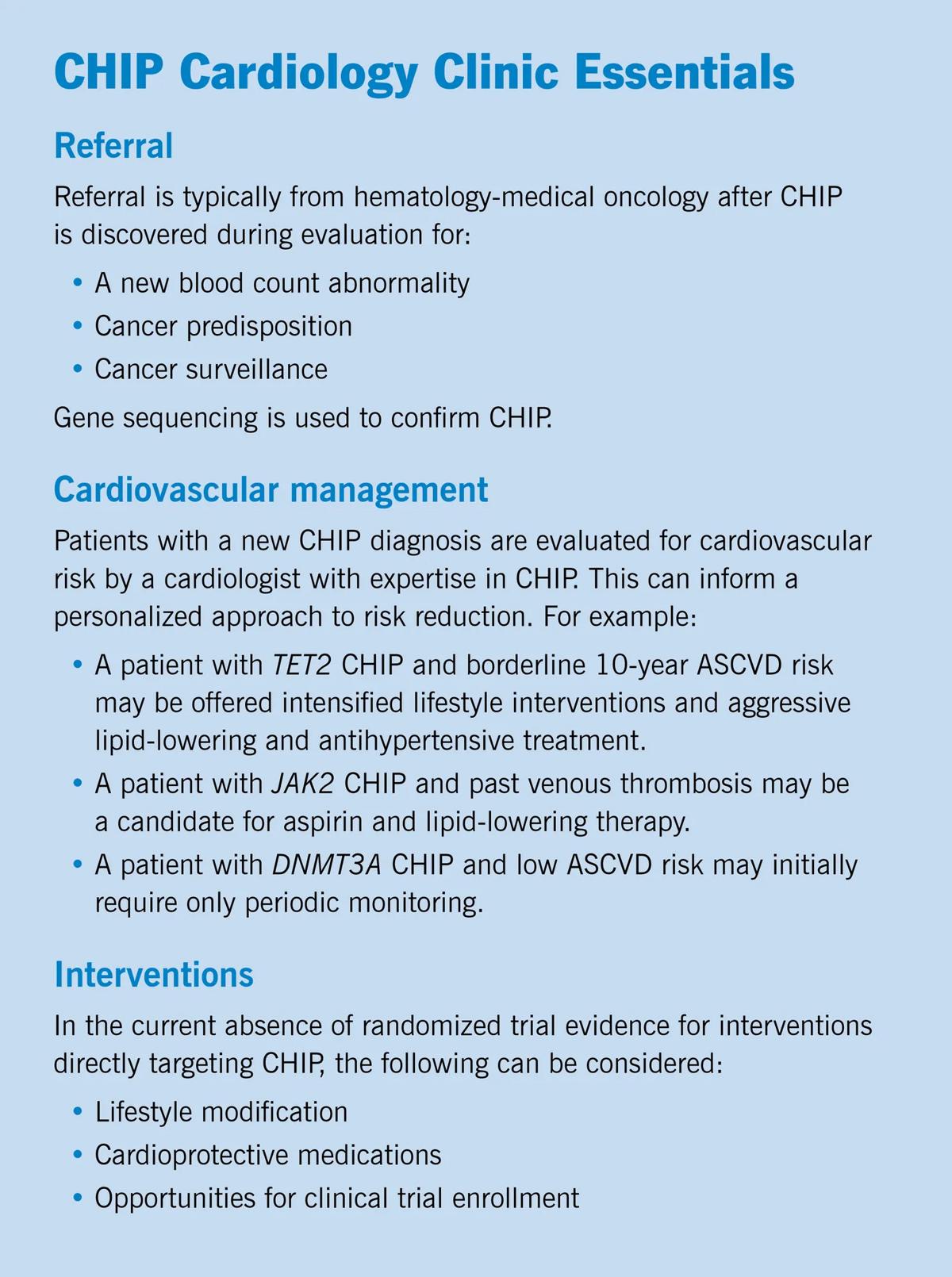
Image content: This image is available to view online.
View image online (https://assets.clevelandclinic.org/transform/028c0250-f6d1-4855-a23b-c05a0928790b/25-HVI-7219160-CQD-Inset)
Matching a patient to the right therapy is key, Dr. Oren notes, as research on treatments is still ongoing. Early studies have supported the use of aspirin, vitamin C and the gout medication colchicine in certain patients with CHIP, although randomized trials are needed, he says. And new therapies targeting CHIP-related inflammation or the CHIP mutations themselves are in development.
As the new clinic grows, Dr. Oren expects it to participate in CHIP trials, giving patients opportunities to enroll in such investigations.
In addition to CHIP treatment, more research is needed to guide CHIP screening, says Dr. Oren, who has been a national leader in cardiovascular-related CHIP practice, recently publishing a paper in Circulation (2025;152[14]:975-977) discussing the rationale for, and best practices in, establishing a CHIP cardiology clinic. He also has published a first-of-its-kind paper (JACC CardioOncol. 2025;7[5]:496-500) outlining best practices for the cardiovascular management of patients with CHIP, providing a structured approach for clinicians as the field continues to grow.
Advertisement
Most CHIP diagnoses are currently made in hematology settings, often incidentally as part of leukemia evaluation or management.
“There is no guideline-endorsed indication, so the question I get when I give talks to cardiologists is ‘Which patients should I check for CHIP? What should I look for?’” Dr. Oren says. “I think this is the future, but we need more data to identify individuals who are at particularly high risk and who may benefit from such testing.”
“Dr. Oren has unique experience based on his completion of fellowship programs in both hematology-oncology and cardiology,” notes Venu Menon, MD, Section Head of Clinical Cardiology at Cleveland Clinic. “We are fortunate to have him spearhead our efforts on this new frontier. His insights and our research in this area will potentially help identify interventions that modify the disease course for patients identified with the vulnerability of CHIP.”
The potential benefits are broad, notes Cleveland Clinic preventive cardiologist Ashish Sarraju, MD. “Early identification and optimization of cardiovascular risk is crucial to effective cardiovascular disease prevention,” he says. “A novel, emerging risk factor like CHIP can lead to new pathways to identify cardiovascular risk and implement risk factor control in individuals who may not have otherwise thought about their cardiovascular risk. This new clinic enables us to do so in partnership with our hematology colleagues.”
For Dr. Oren, as improved testing and diagnosis captures more patients, a key imperative is for health systems to establish the clinical infrastructure now for a wave of CHIP patients that is already underway. “Every hematologist-oncologist is now encountering patients with CHIP in their practice,” he says. “We have to put the mechanisms in place today, not wait five or 10 years, because there’s going be a tsunami of patients and we must be one step ahead.”
Advertisement
Advertisement

They generally depend on the mutated gene, clone size and clinical setting
What’s coming up at ASH and beyond

Structured interventions enhance sleep, safety and caregiver resiliency in high-acuity units

Lutheran Hospital team brings emerging treatments to community setting

Combination therapy doubles the number of meaningful spleen volume responses over monotherapy
Combination therapy may help address underlying disease
Novel approaches are available for patients at all stages of coronary artery disease
Strategies and risk models are evolving for this asymptomatic condition
 Search