Locations:





Specialized care for a neonate with a rare condition
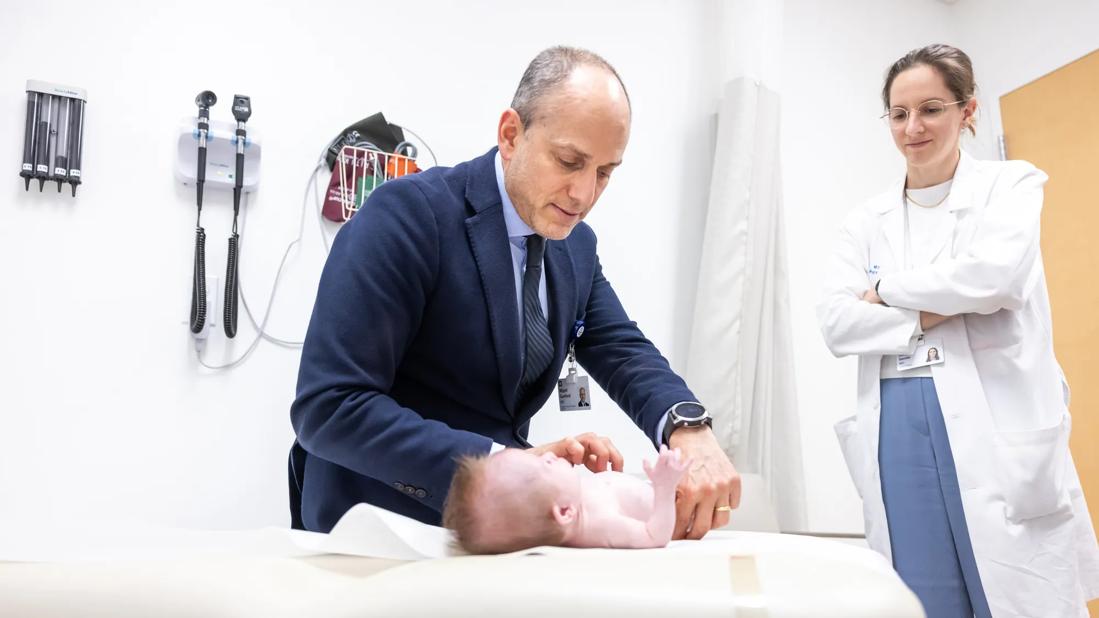
Image content: This image is available to view online.
View image online (https://assets.clevelandclinic.org/transform/e735c4c7-d6f9-4add-9dc2-48926f349957/Guelfand-Congenital-Duodenal-Obstruction)
Physician leads clinical exam for neonate patient
A pregnant patient received a prenatal diagnosis indicating that her fetus had Down syndrome along with a malformation of the intestine. The family was referred to Cleveland Clinic’s Special Delivery Unit for the birth.
Advertisement
Cleveland Clinic is a non-profit academic medical center. Advertising on our site helps support our mission. We do not endorse non-Cleveland Clinic products or services. Policy
After the baby was born, an abdominal X-ray confirmed a diagnosis of duodenal obstruction. The scan revealed a telltale “double bubble” sign — one bubble at the stomach and a second at the duodenum.
“You see two bubbles that shouldn’t be there in a normal baby, and if the bubbles persist for a couple of hours, the diagnosis is very clear,” explains Miguel Guelfand, MD, Section Head for Pediatric General and Thoracic Surgery at Cleveland Clinic.
This rare condition, which prevents the baby from eating normally, occurs in approximately one in 6,000 newborns and is often associated with other complications or conditions, including Down syndrome.
While the majority of such cases in the United States are repaired through open surgery, a minimally invasive approach is more common in other parts of the world, notes Dr. Guelfand.
“The benefits of minimally invasive surgery are immense in terms of reduced pain, faster recovery time, quicker resumption of feeding, less blood loss — and there’s no scar,” he says.
Dr. Guelfand performed the surgery laparoscopically, making three small incisions of just 3 mm each. The procedure involved creating a bypass around the obstruction to allow food to pass through the duodenum. In this case the final diagnosis was an annular pancreas, a rare form of congenital duodenal obstruction.The surgery took approximately one hour and went exactly as planned. The baby was extubated within 12 hours of surgery and required minimal pain medication.
“Within 24 hours, she was happy and comfortable, like nothing had happened,” Dr. Guelfand shares. Three days after surgery, the baby began small feedings and was feeding normally within the first week.
Advertisement
Now, at 8 months old, the baby is developing normally without any complications or additional concerns related to the surgery.
Dr. Guelfand highlights that long-term outcomes for duodenal obstruction are generally better with minimally invasive surgery. Up to 15% of patients undergoing open surgery may experience bowel obstruction later, but almost no patients treated with minimally invasive surgery encounter this complication.
He also noted that nearly all neonatal surgeries at Cleveland Clinic Children’s are now performed minimally invasively.
“We now have the expertise, experience, and resources to perform almost any type of neonatal surgery minimally invasively — with amazing outcomes,” he concludes.
Advertisement
Advertisement
How evolving medical therapies and more precise patient selection are reshaping the role of intestinal transplantation
Study demonstrates superior visualization of occult primary lesions

Navigating a complex case during a national copper shortage

Survey and focus group findings highlight key concerns among PHM leaders

Common misconceptions about perioperative management and strategies to improve care

Introducing Prajwal Rajappa, MD, MS, Director of Pediatric Precision Oncology

AHA statement provides the latest comprehensive, evidence-based information

Types and presentation may differ from adults, but early recognition and intervention are just as key
 Search