Locations:





Goal-of-care discussions drive earlier hospice access
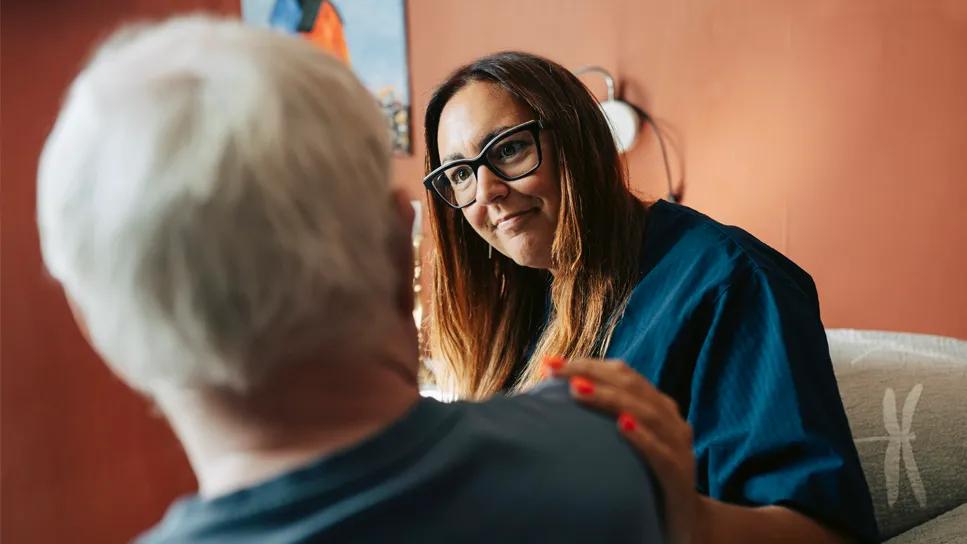
Image content: This image is available to view online.
View image online (https://assets.clevelandclinic.org/transform/3b82af88-f0f6-4b1d-9b82-b4d0d45696a5/hospice-nurse-with-older-patient-2224135571)
Hospice nurse with patient
Hospice experts help those with incurable disease maintain autonomy, reduce trauma and gain symptom relief. Yet studies show that the median length of stay in hospice before death is roughly 19 days. What can care teams do to ensure that patients and their families have access to this appropriate end-of-life care?
Advertisement
Cleveland Clinic is a non-profit academic medical center. Advertising on our site helps support our mission. We do not endorse non-Cleveland Clinic products or services. Policy
As the Medical Director of Cleveland Clinic Hospice, Laura Hoeksema, MD, MPH, FAAHPM, and her team support physicians and patients in navigating this journey.
Perhaps the first step is recognizing the difference between palliative and hospice care and when each is warranted.
Palliative care can benefit anyone with a serious illness at any point in their treatment to support them physically, emotionally and socially. This specialized medical care is intended to:
Recognizing that serious illness affects the entire person and their family, it can be advantageous to engage palliative medicine at the time of diagnosis to provide unique insight and an extra layer of support throughout their illness. Some patients may receive palliative care for weeks and others for years.
Hospice care is engaged when a patient’s prognosis is six months or less if their disease takes its normal course. This care is generally warranted if the patient is no longer benefiting from curative treatment or when the treatment is becoming too burdensome without offering them significant benefit.
The goal of hospice care is comfort focused. “We manage symptoms so patients can be fully present,” says Dr. Hoeksema. “The emphasis is on enabling patients to feel control over their life. When time is precious, patients may make different decisions about how to spend their days. Our goal is to learn what’s important to each patient and discover what questions or concerns they have so they can make fully informed decisions. In this way we can help patients spend that time in a way that’s most meaningful to them.”
Advertisement
When there is no viable means to stave off disease, patients may still be subjected to emergency room visits and myriad tests. Hospice care ensures patients receive the care and comfort they need while minimizing these distressing experiences.
As Dr. Hoeksema explains, the decision about whether hospice is appropriate should be with the patient. Two patients may be the exact same medically but make different decisions. One may have been in and out of the hospital and now wants to stay at home and be comfortable and spend time watching their grandson play, while another wants to continue receiving chemotherapy.
In the first case, hospice would be recommended. In the second, it would not because a comfort-focused plan of care isn’t aligned with the patient’s goals.
“Having that conversation with patients is crucial so that they have the choice,” says Dr. Hoeksema.
Broaching the subject of end of life is never easy. Physicians may worry that their patient may feel like they’re giving up hope. “I think the question becomes, what are we hoping for? There are times when a cure or restoring the patient to physical health is no longer possible. In that case, we shift what we’re hoping for and focus on patients’ comfort and priorities,” says Dr. Hoeksema.
Being honest with patients at this stage is one way to preserve their dignity. “If we recognize that each of us will die one day, the question becomes how can we support each patient in the best way possible as they near the end of life,” says Dr. Hoeksema.
Advertisement
It’s not uncommon for patients and families to keep silent amid their fears of what’s to come with a terminal illness. It doesn’t have to be this way.
“My colleague Dr. Nadia Tremonti explains that while death is sad and there’s nothing we can do to change that, it doesn’t have to be scary,” says Dr. Hoeksema. “A huge part of what our hospice team does is help to take that fear out of the dying process and out of death. We provide support, guidance and education so they can be prepared; control any symptoms a patient might have and support patients and their families spiritually and emotionally.”
Giving patients autonomy and choice in terms of how they spend time is crucial. “Sometimes when patients have a serious illness, it feels like control can be taken away from them. Their body may not be cooperating with them, and they may feel like they don't have as much control as they did earlier in their life,” says Dr. Hoeksema. “It’s about giving patients choices and informing them of all their options.”
Just as an oncology team has expertise in caring for patients with cancer, the hospice team has expertise in caring for patients in their last months of life. The hospice team consists of nurses, physicians, social workers and chaplains, who act as guides and attend to the physical, emotional and spiritual needs of patients and their loved ones.
Volunteers provide companionship as well as animal-assisted therapy. Bereavement specialists provide support to a patient’s family through the first anniversary of the patients’ death. Dr. Hoeksema says, “Our team supports patients in celebrating what’s present and grieving what’s lost.”
Advertisement
With Cleveland Clinic Hospice, care is provided wherever the patient calls home – their own home, assisted living, skilled nursing facility or the Justin T. Rogers Hospice Care Center in Fairlawn. If patients require intensive symptom control, care can be provided at Cleveland Clinic Hospitals or the Hospice Care Center.
Patients at home can receive care in a facility for up to five days at a time to provide their family with respite. This is often used if a family is traveling and the loved one isn’t able to travel with them.
As Dr. Hoeksema explains, each care plan is unique. “A lot of times, it can feel like everything revolves around the illness and patients’ other needs take a backseat. With hospice, the disease fades into the background, and the patient – the whole person – returns to the center. For our team, it’s about valuing the uniqueness about each individual.”
Dr. Hoeksema says “It's a privilege to be invited into patients’ lives at such a challenging time, to surround them with support and make a really difficult time a little easier.”
Advertisement
Advertisement

Findings reinforce the benefits of long-term high physical activity, lower smoking rates and better baseline health

Caring for patients through the end of their journey
Timely referral to hospice care reduces emergency room admissions

Palliative nurses improve quality of life

Nurse case manager shares her passion and experience providing end-of-life care

Cleveland Clinic hematologist highlights new guidelines and treatment advances in immune thrombocytopenia
NIMBLE replaces weekly tumor board delays with same-day multidisciplinary recommendations

Cleveland Clinic study provides validation for the test, which combines AI and pathological data to predict outcomes in postoperative patients
 Search