Locations:





Study serves as ‘cautionary tale’ for physicians tempted to rely on liquid biopsy results alone
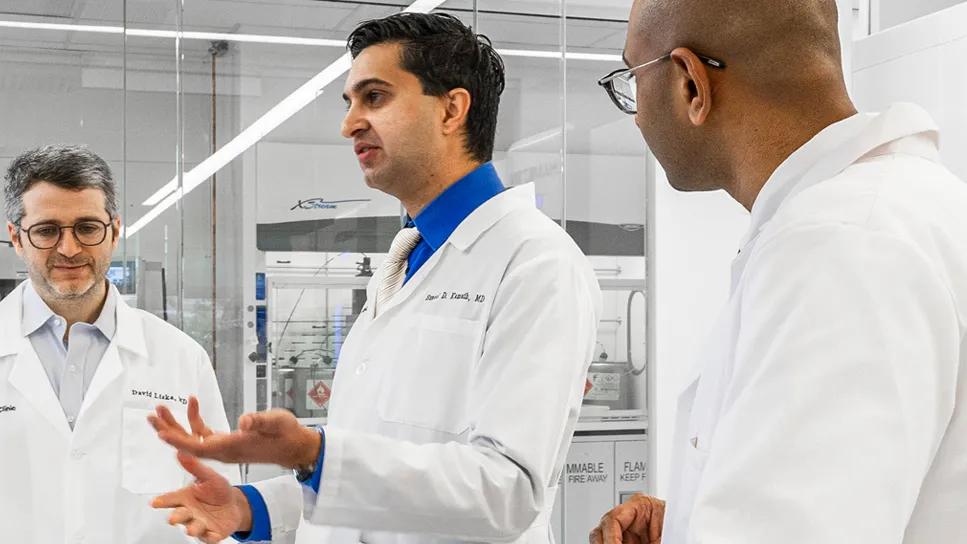
Image content: This image is available to view online.
View image online (https://assets.clevelandclinic.org/transform/ea8c7806-3b63-4c4e-9867-e57a3b35b3a4/doctors-liska-kamath-javakrishnan-in-lab)
Dr. Kamath & colleagues in the lab
A new Cleveland Clinic study confirms that tissue-derived tumor mutation burden (TMB) remains the more reliable predictor of immunotherapy response in patients with solid tumors. Results were presented at the 2026 annual meeting of the American Society of Clinical Oncology (ASCO).
Advertisement
Cleveland Clinic is a non-profit academic medical center. Advertising on our site helps support our mission. We do not endorse non-Cleveland Clinic products or services. Policy
“This is really a cautionary tale,” says Suneel Kamath, MD, staff oncologist in the Department of Hematology and Medical Oncology at Cleveland Clinic Cancer Institute and senior author of the abstract. “The bottom line is that if you have a tumor-agnostic indication for high TMB, you should rely on tissue TMB (tTMB) to guide immunotherapy decisions — even if you’re tempted to use blood TMB (bTMB) as a last resort.”
TMB measures the total number of somatic mutations present in tumor DNA. Tumors with high mutation counts are considered more recognizable to the immune system, making them likelier to respond to immune checkpoint inhibitors (ICIs) such as pembrolizumab. The FDA has approved a tTMB threshold of 10 or more mutations per megabase (mut/Mb) as a tumor-agnostic biomarker for pembrolizumab.
Blood-based TMB, which is derived from circulating tumor DNA through a liquid biopsy, has been proposed as a less invasive alternative, particularly for patients who cannot easily undergo repeat tissue biopsies. However, current ASCO guidelines recommend against using blood-based TMB alone, in part because the two measurements don’t always agree.
Researchers analyzed 221 patients with solid tumors from the Cleveland Clinic genomics repository who had at least one tTMB and one bTMB result between July 2019 and July 2025. Among those patients, 80 received ICIs and were included in the outcomes analysis.
The study confirmed that bTMB runs consistently higher than tTMB, a median of 2.3 times higher in matched samples. This is consistent with prior reports. Despite that gap, the two measurements showed a strong positive correlation across both the full cohort and the ICI-treated subgroup (R² = 0.82 and 0.85, respectively).
Advertisement
“The more clinically significant finding was what we saw when the two tests disagreed,” says Dr. Kamath. Patients with high tTMB but low bTMB had a median time-to-treatment failure of 21.3 months, which was by far the best outcome of any subgroup. Patients with high bTMB but low tTMB fared considerably worse, with a median of just seven months, even after raising the bTMB threshold from 10 to 16 mut/Mb.
“A high tissue TMB is what truly matters for predicting a positive outcome with immunotherapy,” Dr. Kamath explains. “When we looked at people with high tissue TMB but low blood TMB, they had better outcomes than even the group with both high blood and high tissue TMB. That was unexpected.”
Raising the bTMB threshold from 10 to 16 mut/Mb did improve median time-to-treatment failure from 3.5 to 7 months among patients with low tTMB, but those results still lagged significantly behind outcomes in high tTMB patients.
Dr. Kamath notes that liquid biopsies are often ordered late in a patient’s treatment journey, when standard options have been exhausted and the original tissue sample may be several years old. That clinical scenario can make bTMB appealing as a decision-making shortcut. The study’s findings, however, suggest that shortcut may mislead more than it guides.
“Relying solely on a high blood TMB without a high tissue TMB does not yield a significant benefit,” he says. “Even when you raise the cutoff for blood TMB, you’re still not capturing the patients who truly respond well.”
Advertisement
Dr. Kamath and his team plan to expand the study by partnering with larger next-generation sequencing companies to analyze paired blood and tissue TMB data across a significantly larger patient population. Crucially, the next phase will examine results by individual tumor type rather than across multiple solid tumor types.
“These findings may not be a monolithic tale that applies to every cancer,” Dr. Kamath notes. “The vision in precision oncology is to treat tumors based on their mutations regardless of where they originate. But the evidence, including these differential TMB cutoffs, tells us we’re not quite there yet.”
Until larger, tumor-specific studies are completed, Dr. Kamath’s clinical message is straightforward: When tTMB is available, use it.
Advertisement
Advertisement

Adding 177Lu-PSMA-617 to ADT plus an ARPI cut the risk of radiographic progression or mortality by 28%

New program will help patients improve fitness and manage weight after cancer treatment

Cleveland Clinic hematologist highlights new guidelines and treatment advances in immune thrombocytopenia
NIMBLE replaces weekly tumor board delays with same-day multidisciplinary recommendations

Cleveland Clinic study provides validation for the test, which combines AI and pathological data to predict outcomes in postoperative patients
Advanced imaging technology catches metastases much earlier, allowing treatment with fewer side effects

Reduced radiation for lymph node areas reduces side effects
Large Cleveland Clinic analysis may help resolve a longstanding question over optimal fractionation
 Search