Locations:





A Cleveland Clinic model combining clinical staging, genomics and AI predicts survival with 18% greater accuracy — and could help match patients to more effective treatments.
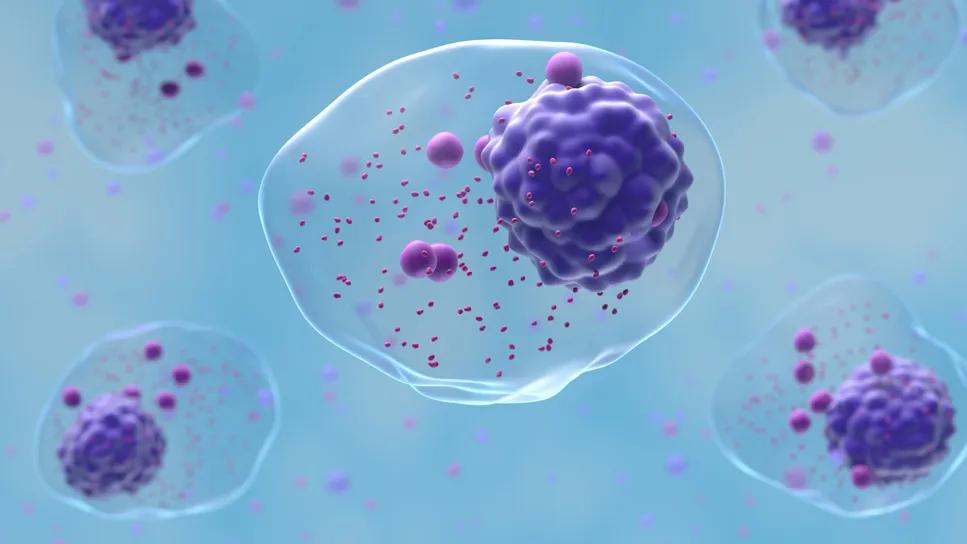
Image content: This image is available to view online.
View image online (https://assets.clevelandclinic.org/transform/c285f04f-db64-41a3-9903-839a729891c1/multiple-myeloma-mm-cells-2273181153)
Multiple myeloma cells
Current approaches to assessing risk for patients with multiple myeloma rely on clinical variables like the patient’s age and disease stage, but these models generally don’t do a good job of predicting outcomes. A new approach developed by Cleveland Clinic researchers outperforms these old models by combining clinical staging, genomics and machine learning to better predict survival.
Advertisement
Cleveland Clinic is a non-profit academic medical center. Advertising on our site helps support our mission. We do not endorse non-Cleveland Clinic products or services. Policy
The model represents a step toward precision medicine for multiple myeloma patients, helping oncologists more precisely target treatments based on individual patients’ disease and risks, said senior author Shahzad Raza, MD, a hematologist-oncologist at Cleveland Clinic Cancer Institute. It could also be a tool to help researchers better understand multiple myeloma itself, the pathways of its development and why some patients still have much worse outcomes than others.
“We have advanced a lot in the past several years, and treatments for multiple myeloma have dramatically improved, but despite all this progress, not everyone has a good outcome,” Raza said. “We’re missing something, and the answer lies in understanding the basics.”
Multiple myeloma makes up around 10% to 15% of blood cancers. While recent advances in treatments have allowed some patients to survive for years or even decades with the disease, a small subset of patients still have significantly worse outcomes.
Previous research has shown that a gene mutation called TP53, seen in around 5% of newly diagnosed patients and 25% of patients whose cancer has progressed, are more likely to have aggressive disease with rapid progression, treatment resistance and worse survival. However, even within this group there is variation, Raza noted, with some “ultra high risk” patients experiencing significantly worse outcomes.
“The behavior of the disease is quite different between two high-risk patients,” he says. “So why is this happening and how can we accurately predict outcomes in the setting of artificial intelligence? That’s the goal of our model.”
Advertisement
The new model was developed by a high school student, Sriram Subramanian, working in Dr. Raza’s lab. It grew out of an effort to find better tools to identify these patients and make a more accurate prognosis.
“Two people can get the exact same diagnosis but have totally different outcomes, and we wanted to see whether machine learning could find patterns in their gene expression that explain why,” says Subramanian. “When the six genes we found lined up with how long patients lived — and even with how cancer cells reacted to different drugs — it showed me the model could help doctors choose treatments."
The team analyzed data from a previous Multiple Myeloma Research Foundation treatment response study, with a total cohort of around 753 patients, of whom 36 carried the TP53 mutation that put them at higher risk. Using machine learning, the team then compared gene expression between the two groups and identified a six-gene signature that helps predict how a patient's disease is likely to progress.
“It’s not just TP53 alone,” he explains. To develop the new model, the team combined factors, including clinical staging, TP53 mutation and thee six gene signature. They then used the CoxBoost machine learning algorithm to predict outcomes with 18% greater accuracy than current risk stratification approaches.
Researchers then used the model to investigate drug sensitivity, applying different drugs to cells from patients with different risk levels. While more work needs to be done to validate findings, the team found that certain drugs seemed to be more effective in cells from high-risk patients, while others worked better in those from the lower risk group.
Advertisement
“It’s a cool concept,” Raza said. “It means that we could potentially incorporate this model in human trials to find drugs that are more effective for individual patients, allowing us to move toward precision oncology.”
“Our model is a better predictor of survival,” Dr. Raza adds. In addition to prognosis, the model could be another tool to study the pathways of multiple myeloma and the mechanisms that cause it to become so aggressive in some patients. “I’m interested in understanding why some patients continue to have a poor outcome despite us doing everything possible."
The project, “A machine learning (ML)-based six-gene signature for risk stratification and therapeutic target identification in multiple myeloma,” was presented at the annual meeting of the American Society of Clinical Oncology.
Advertisement
Advertisement

Adding 177Lu-PSMA-617 to ADT plus an ARPI cut the risk of radiographic progression or mortality by 28%

New program will help patients improve fitness and manage weight after cancer treatment

Cleveland Clinic hematologist highlights new guidelines and treatment advances in immune thrombocytopenia
NIMBLE replaces weekly tumor board delays with same-day multidisciplinary recommendations

Cleveland Clinic study provides validation for the test, which combines AI and pathological data to predict outcomes in postoperative patients
Advanced imaging technology catches metastases much earlier, allowing treatment with fewer side effects

Reduced radiation for lymph node areas reduces side effects
Large Cleveland Clinic analysis may help resolve a longstanding question over optimal fractionation
 Search