Locations:





Care paths and research initiatives aim to answer unmet clinical needs
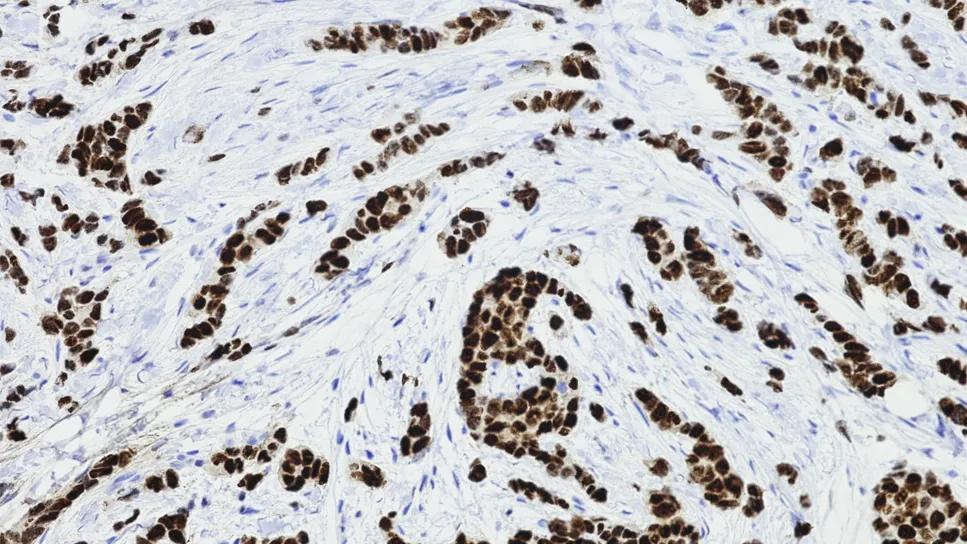
Image content: This image is available to view online.
View image online (https://assets.clevelandclinic.org/transform/f80fa779-fbf0-47c4-8ea2-cb8f7b4a420c/lobular-breast-cancer-program-686786476)
Lobular breast cancer cells
There is a wealth of knowledge about treating most breast cancer, but major gaps remain when it comes to diagnosing and treating lobular breast cancer. This disease is often not detectable on a mammogram, so it tends to be much more difficult to diagnose. There is also a misconception that the biology of lobular breast cancer isn’t different from other types of breast cancer.
Advertisement
Cleveland Clinic is a non-profit academic medical center. Advertising on our site helps support our mission. We do not endorse non-Cleveland Clinic products or services. Policy
Breast oncologist Megan L. Kruse, MD, led efforts to create a Comprehensive Lobular Breast Cancer Program to advance care in this field and to bring more awareness of its distinct features. Dr. Kruse is the Director of Breast Medical Oncology and Co-Leader of the Breast Cancer Program.
“I and my medical colleagues have been struck by the unique issues that arise for patients with lobular breast cancer in terms of frustration at the time of diagnosis and stumbling points in treatment where there’s a lot of uncertainty,” says Dr. Kruse. “It’s a tough to treat disease that is often highly symptomatic, and there’s limited published research to go on.”
Since there are no national standards specifically for lobular breast cancer, a team of Cleveland Clinic breast medical oncologists developed care paths to bring standards to its diagnosis and treatment. In 2021, the oncologists used a combination of published data and real-world case histories to create standards that ensure consistent care across the enterprise.
“Whether a patient is receiving care in downtown Cleveland, the Cleveland suburbs, Florida or Abu Dhabi, they’re getting the same approach to care,” explains Dr. Kruse.
Pathologists can review samples collected at other Cleveland Clinic sites, and clinicians across the organization can consult with one another about cases.
In addition, by standardizing processes, the team will be able to look back over time and reflect on the management of these patients. The hope is that this data will help address questions such as:
Advertisement
The team of oncologists continues to seek ways to improve diagnosis and treatment.
Lobular breast cancer doesn’t typically emerge as a standard lump like other forms of the disease. Patients often have subtle symptoms, such as breast heaviness, thickening or discomfort. In addition, dense breasts may hide inconspicuous changes that occur as lobular breast cancer starts to form.
Cleveland Clinic recommends that patients with dense breasts talk with their doctor about whether supplemental screening such as a breast MRI is warranted. For most women with dense breasts who would be a candidate for surgery if cancer was found, it is worthwhile to ask for supplemental screening.
Another area of distinction with lobular breast cancer is the aggressiveness of the disease. Many women with very small early-stage hormone-positive breast cancer who have negative axillary ultrasounds don't have axillary lymph node removal. However, in cases of lobular breast cancer, identifying lymph node involvement is challenging with current imaging modalities. In an estimated 30% of cases, breast MRI fails to identify positive axillary lymph nodes.
Due to this concern – and the potential aggressive nature of disease – Cleveland Clinic has revised its institutional guidelines to specify that patients with lobular cancers may not be good candidates for omitting surgical axillary staging and encourage multidisciplinary tumor boards to discuss those cases.
Clinicians are hopeful that research into technologies like 18F-fluoroestradiol (FES) PET scans will improve detection of nodal involvement before patients go to surgery. This imaging modality has the potential to detect hormone receptor positive breast cancers in a novel way that is promising for lobular cancers as over 95% of these cancers are hormone receptor positive.
Advertisement
With all the unknowns facing patients with this disease, there is a pressing need for more research endeavors.
As part of the Great Lakes Breast Cancer Consortium, Dr. Kruse and her team are undertaking trials to analyze patient outcomes. Lobular breast cancer can recur 15 or even 20 years after initial diagnosis. Thus, long-term tracking of patient data is crucial. Currently, the team is routinely collecting data about patients’ genomics, imaging and treatment for this purpose.
In terms of prospective clinical trials, Cleveland Clinic is collecting circulating tumor DNA from patients with lobular breast cancer who receive neoadjuvant therapy. By collecting blood samples at defined points during the patients’ treatment journey, they hope to better predict which patients will respond to specific treatments. Additionally, they’re studying whether the blood test results correlate with breast MRIs taken before and after treatment.
Similarly, the team is looking to address a known challenge with managing metastatic disease. Currently, conventional radiographic scans often underestimate disease burden. By analyzing circulating tumor DNA samples and imaging studies at routine time points in treatment, the researchers are hoping to better interpret what’s occurring with patients’ cancer control.
“Patients have been so enthusiastic about sharing their data,” says Dr. Kruse. “They’re an extremely altruistic group of women. Their hope is that 10 years down the line there will be answers for women like them. It’s really been a partnership between all of the clinicians that treat breast cancer care and patients to try to get these answers.”
Advertisement
A number of Cleveland Clinic patients also serve as patient advocates for the Lobular Breast Cancer Alliance. In addition to providing patient outreach, they review clinical trials to lend a firsthand patient perspective. “The women I’ve met with lobular cancer want better options for themselves and their peers, so they’re very, very giving with their time,” says Dr. Kruse.
Although many big questions remain in treating this condition, clinicians in the Comprehensive Lobular Breast Cancer Program have learned quite a bit in treating these patients. Dr. Kruse shared several takeaways:
Pathology second opinions are essential. “When we have a patient with lobular breast cancer, we need to get as accurate of staging as possible,” she says. “This is where early incorporation of breast MRI and awareness of technology like FES PET scans comes into play.”
Have a heightened sense of awareness about recurrence. “These cancers can be very subtle when they recur – and may recur many years after the initial diagnosis,” Dr. Kruse explains. “If I have a patient treated for early-stage lobular breast cancer and they return with odd symptoms, whether it’s gastrointestinal distress, some kind or pain that doesn't really make sense with what's been going on in their everyday life, visual changes or headaches, these are all things that I take very seriously as it could be a sign of cancer recurrence.”
For patients with lobular cancer, it may be helpful to continue to follow up until more than the 10-year mark due to the risk of late recurrence. “It's a fine balance to strike to allow patients to make sure they're living their life and not thinking about cancer every moment of every day,” she says.
Advertisement
Community support is advantageous. Many women with this diagnosis don’t know anyone else who has this type of breast cancer. To that end, the team is encouraging patients with lobular breast cancer to join its 4th Angel mentoring program as mentors or participants. The team also directs Lobular Breast Cancer Alliance for access to publications on lobular cancer as well as clinical trials.
Advertisement

Adding 177Lu-PSMA-617 to ADT plus an ARPI cut the risk of radiographic progression or mortality by 28%

New program will help patients improve fitness and manage weight after cancer treatment

Cleveland Clinic hematologist highlights new guidelines and treatment advances in immune thrombocytopenia
NIMBLE replaces weekly tumor board delays with same-day multidisciplinary recommendations

Cleveland Clinic study provides validation for the test, which combines AI and pathological data to predict outcomes in postoperative patients

Advanced imaging technology catches metastases much earlier, allowing treatment with fewer side effects

Reduced radiation for lymph node areas reduces side effects

Large Cleveland Clinic analysis may help resolve a longstanding question over optimal fractionation
 Search