Locations:





Combination therapy improves outcomes, but lobular patients still do worse overall than ductal counterparts
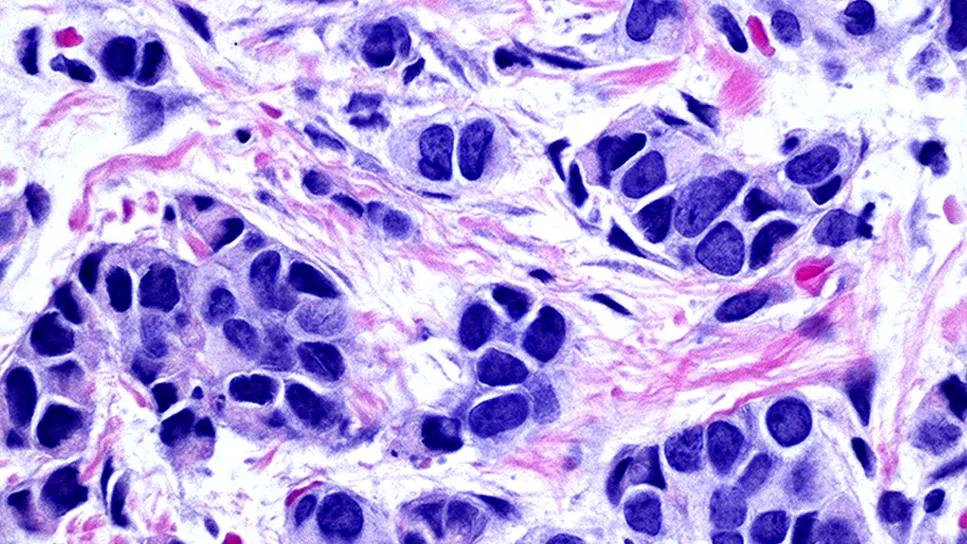
Image content: This image is available to view online.
View image online (https://assets.clevelandclinic.org/transform/0924602e-275e-4462-83b4-0b17cf3c5d6a/lobular-carcinoma-of-the-breast-686786502)
Lobular breast cancer cells
Patients with invasive lobular carcinoma have better outcomes with a combination therapy of ribociclib and fulvestrant than when they receive fulvestrant alone. However, their outcomes are not quite as good as those in the larger population of HR+/HER2- metastatic breast cancer patients.
Advertisement
Cleveland Clinic is a non-profit academic medical center. Advertising on our site helps support our mission. We do not endorse non-Cleveland Clinic products or services. Policy
The findings confirm that this standard of care is the best approach for these patients, says co-author Megan Kruse, MD, Director of Breast Medical Oncology and Co-Leader of the Breast Cancer Program at Cleveland Clinic. It’s one of few studies to provide a breakout analysis of data for patients with lobular breast cancer, filling a critical information gap.
“Now we know that lobular breast cancer patients do benefit from this treatment, but maybe not for as long as their counterparts with ductal breast cancer,” says Dr. Kruse.
The study analyzed data from the phase-3 MONALEESA-3 trial, which previously showed that ribociclib/fulvestrant outperformed fulvestrant alone in HR+/HER2-negative metastatic breast cancer, establishing it as the new standard of care.
“This trial made a big impact on how we manage hormone receptor positive breast cancer patients in general, and we wanted to make sure that we can have the same confidence in that treatment for patients with lobular cancer," says Dr. Kruse.
The analysis supports that confidence. Progression-free survival was 20.5 months for patients who received the combination therapy, compared with 9.4 months for those who received fulvestrant alone. Overall survival was 51.2 months with combination therapy versus 30.8 months with fulvestrant alone.
“Overwhelmingly, this analysis reinforces what we already do, and it’s nice to have a lobular-specific piece of data that clinicians can use to help guide their patients,” says Dr. Kruse.
Even with the improved outcomes, patients with lobular breast cancer had slightly shorter progression-free survival and overall survival compared to the overall study population.
Advertisement
This was an unexpected finding, since lobular cancers are typically very hormone-sensitive, so researchers expected these patients might actually respond better to hormone-based treatments. The fact that the opposite was true suggests that invasive lobular carcinoma may have a different biology that warrants further investigation.
The findings suggest that the perception of lobular disease as typically having a better prognosis than other breast cancers may be a myth. “Some providers may hesitate to give more aggressive therapy because the assumption is that patients with lobular cancer are going to do well, but that might not be the case,” says Dr. Kruse.
The findings shed light on other potential misconceptions, she added, noting that many patients had organ involvement, contradicting the assumption that lobular breast cancer mainly affects bones and lymph nodes. Researchers also saw that 17% of patients presented with metastatic disease from the start, a higher-than-expected number, suggesting that lobular breast cancer may go undetected for longer than other types.
The study underscores the need for more research that breaks out data on patients with invasive lobular carcinoma. Only around 10% of breast cancer studies provide data on this subgroup.
“We make decisions about managing these patients based on what we know about the larger group of hormone receptor positive metastatic breast cancer patients, but we don’t always know if our treatments work the same in the lobular subgroup,” says Dr. Kruse. “Future research could take a closer look at patients with the best and worst responses, to identify characteristics that might help them better select patients for different therapies.”
Advertisement
The study, “Progression-free survival (PFS) and overall survival (OS) results from the phase 3 MONALEESA-3 trial of postmenopausal patients with hormone receptor-positive (HR+)/HER2-negative (HER2-) advanced breast cancer (ABC) treated with ribociclib (RIB) + fulvestrant (FUL): a subgroup analysis of patients with invasive lobular carcinoma (ILC), was presented at the San Antonio Breast Cancer Symposium in December 2025.
Advertisement
Advertisement

Patients with ER-positive invasive lobular cancer face worse disease-free survival and overall survival

Adding 177Lu-PSMA-617 to ADT plus an ARPI cut the risk of radiographic progression or mortality by 28%

New program will help patients improve fitness and manage weight after cancer treatment

Cleveland Clinic hematologist highlights new guidelines and treatment advances in immune thrombocytopenia
NIMBLE replaces weekly tumor board delays with same-day multidisciplinary recommendations

Cleveland Clinic study provides validation for the test, which combines AI and pathological data to predict outcomes in postoperative patients

Advanced imaging technology catches metastases much earlier, allowing treatment with fewer side effects

Reduced radiation for lymph node areas reduces side effects
 Search