Locations:


Study analyzes creative approaches to support people facing housing insecurity
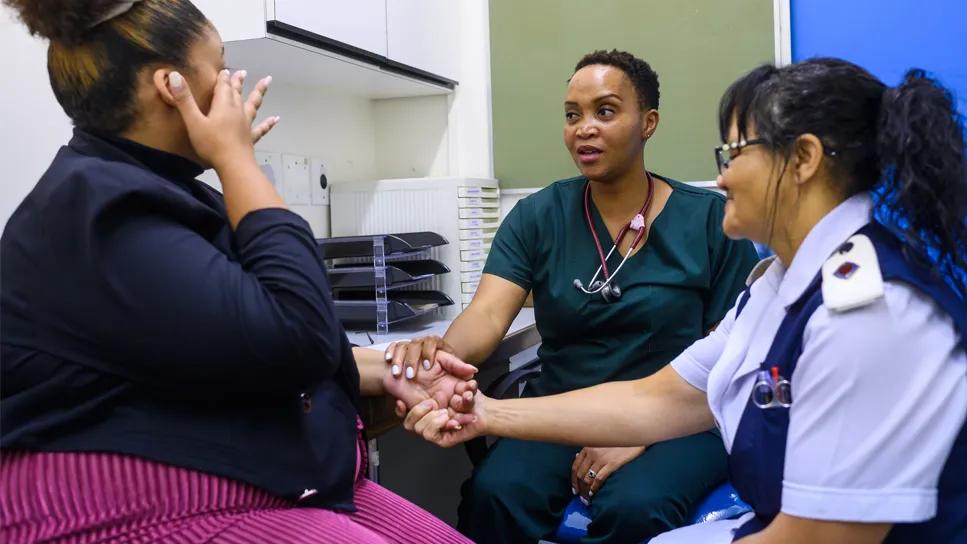
Image content: This image is available to view online.
View image online (https://assets.clevelandclinic.org/transform/052879a5-86bc-49f5-9a1a-823f201547ce/black-female-patient-emotional-consultation-caregivers-2216046416)
Patient and healthcare providers
People experiencing homelessness have a much higher rate of cancer mortality, often due to late diagnosis. Collaborating with community organizations and providing multiple modes of communication helps support the needs of this often difficult-to-reach population. According to a new Cleveland Clinic Cancer Institute study published in BMC Primary Care, findings imply that primary care providers can promote earlier diagnosis and intervention through deliberate screening strategies to engage these patients.
Advertisement
Cleveland Clinic is a non-profit academic medical center. Advertising on our site helps support our mission. We do not endorse non-Cleveland Clinic products or services. Policy
Since 2005, the Cancer Institute’s outreach team has worked across Northeast Ohio to support people with the highest need, including those who are uninsured or who lack stable housing. “We partner with community organizations that serve people experiencing housing insecurity or homelessness, as these individuals’ everyday needs for shelter, food and finances may take priority over preventative healthcare,” says Heather McKee Hurwitz, PhD, Project Staff with Cleveland Clinic’s Department of Hematology & Medical Oncology. “This population often has transportation barriers and scheduling barriers that may limit their engagement with screening programs.”
In 2022, the Outreach team piloted an initiative termed “Homeless Women Receiving Onsite Mammography, Patient Navigation and Education (HOPE)” to offer 3D mammography screening as well as language translation services and support for addressing transportation and scheduling barriers for people experiencing homelessness or housing insecurity. Community members received screening either through mobile mammography or by receiving an Uber Health ride to a preventative screening event at one of Cleveland Clinic’s regional hospitals.
To gain insights about further supporting this population, the Outreach group conducted both quantitative and qualitative analysis of this initiative. They studied the views, attitudes and experiences of participants about the screening process and about cancer screening in general. In addition, the researchers analyzed notes from patient navigators who were supporting participants during screening and screening follow-up.
Advertisement
The analysis included 124 participants in the Cleveland area who completed mammograms and follow-up surveys about preventative screening between 2023-2024. Participants were 40+ years old or 35-39 years old with an immediate family history of breast cancer who had not completed a mammogram in the past year.
Of those 124 participants, 86.3% received normal screening results and 13.7% received abnormal results indicating a need for additional testing. The latter then received extensive support from patient navigators, who reached out between 3-19 times.
The quantitative data results aligned with broader literature that this population has a positive attitude toward primary care and also values screening. “In addition, we wanted to learn how our patient navigators were successfully helping people from initial cancer screening through follow-up, and what elements could be adopted in a primary care setting,” explains Hurwitz. “From our analysis, we were able to glean three salient themes that were key to success: Relationship building, persistence and collaboration.”
Advertisement
The Outreach team continues to find ways to remove hurdles to early detection of cancer among housing insecure populations. Although most medical practices may not have the resources to engage a community outreach team or even a patient navigator to ensure that housing insecure patients complete cancer screenings, the study authors suggest that healthcare professionals adapt some practices from HOPE to find ways to address barriers for housing insecure patients. Speaking to the study’s impact, Dr. Hurwitz commented: “I am continually inspired by how strong participants’ desire was to care for themselves. With strategies learned from patient navigators, we can continue to improve care for housing insecure individuals.”
Advertisement
Advertisement

Evaluating AI initiatives and their impact on operations and care delivery

Study reinforces the importance of genetic testing prior to local therapy decisions

Understanding expanding treatment options and potential advances

Adding 177Lu-PSMA-617 to ADT plus an ARPI cut the risk of radiographic progression or mortality by 28%

New program will help patients improve fitness and manage weight after cancer treatment

Cleveland Clinic hematologist highlights new guidelines and treatment advances in immune thrombocytopenia
NIMBLE replaces weekly tumor board delays with same-day multidisciplinary recommendations

Cleveland Clinic study provides validation for the test, which combines AI and pathological data to predict outcomes in postoperative patients
 Search