Locations:





The FEAD Clinic combines dermatology and allergy visits for infants with atopic dermatitis
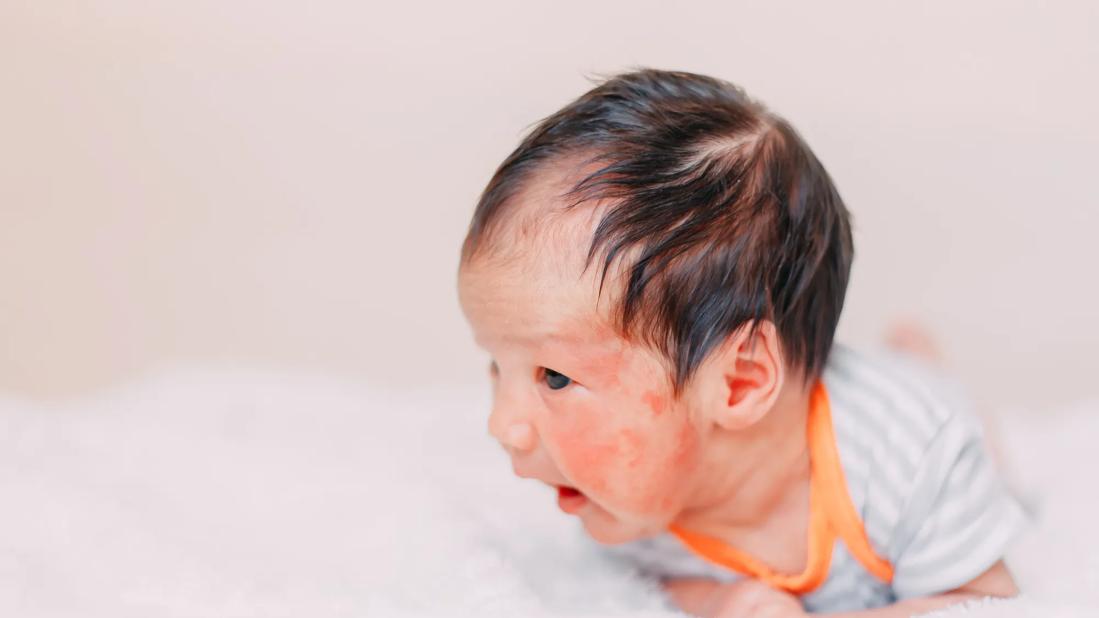
Image content: This image is available to view online.
View image online (https://assets.clevelandclinic.org/transform/4f494c56-50ec-4196-832a-0ebad019a685/peds-eczema)
Infant with eczema rash on face
An estimated 30% of infants with severe atopic dermatitis will go on to develop food allergies. Emerging evidence suggests that an impaired skin barrier contributes to allergic sensitization through the skin.
Advertisement
Cleveland Clinic is a non-profit academic medical center. Advertising on our site helps support our mission. We do not endorse non-Cleveland Clinic products or services. Policy
Cleveland Clinic Children’s allergist and immunologist Bridget Wilson, MD, explains: “Perhaps some peanut protein remains on a parent’s hand after eating a peanut butter sandwich. When they touch their child who has eczema, that may become a sensitizing exposure, triggering the child’s immune system to create an allergic response. Later, when the child eats peanut, they may have an allergic reaction.”
Initial allergen exposure through inflamed skin appears to induce a Th2 immune response, whereas initial exposure through the gastrointestinal tract is more likely to induce tolerance, she says.
This evolving understanding — along with findings from the landmark 2015 LEAP (Learning Early About Peanut Allergy) trial showing the benefit of early peanut introduction in high-risk infants — is reshaping how pediatricians approach both eczema and allergy prevention.
“Early intervention is becoming a clinical priority,” says Cleveland Clinic Children’s dermatologist Joan Tamburro, DO. “Prompt treatment to improve the skin barrier and timely introduction of allergenic foods may help reduce food allergy risk in this vulnerable population.”
Although evidence supports early introduction of allergenic foods for many high-risk infants, families often hesitate.
“They want to protect their child from eczema flares or allergic reactions, so they avoid certain foods,” Dr. Tamburro says. “However, delaying introduction may not be in the child’s best long-term interest.”
To help families, Cleveland Clinic Children’s developed the Feed Early Atopic Dermatitis (FEAD) Clinic for infants with moderate to severe eczema. The clinic brings pediatric dermatology and allergy expertise together in a single visit.
Advertisement
Services include:
“We encourage many families to introduce foods at home, but we also can do it in clinic, where the child can be monitored closely and treated if a reaction occurs,” Dr. Wilson says.
Foods are introduced one at a time. Peanut is the most common food introduced in the FEAD Clinic, although egg and other common allergens may also be considered, including tree nuts, cow’s milk, wheat, soy and sesame.
The clinical team mixes a small amount of the food protein into puree, formula or breast milk. After the infant ingests the initial dose, the team observes for symptoms. If no reaction occurs after 10 minutes, the infant is given a larger, age-appropriate serving and monitored for one hour.
Signs of an allergic reaction may include:
Treatment may include epinephrine or antihistamine, depending on the severity of the reaction.
“Often, the food introduction is successful and there is no reaction,” Dr. Wilson says. “That can give families the confidence to continue offering the food regularly at home. Other times, it’s helpful for families to observe what an allergic reaction looks like and what to do if it happens. That experience also can build confidence and alleviate anxiety for families.”
Advertisement
Food introduction is recommended only when infants are developmentally ready. Infants should have good head control, be able to sit steadily in a highchair and show interest in eating soft foods.
For general pediatricians, the FEAD Clinic team emphasizes early identification and timely action. Infants with moderate to severe eczema should be recognized and managed promptly, with referral when needed — ideally before 4 to 6 months of age — to avoid delays in allergen introduction.
“Regardless of age, if a child has bright red, open skin or extensive lesions over much of the body, they should be evaluated by a pediatric dermatologist,” Dr. Tamburro says.
It is also important to frame eczema and food allergy as related but distinct conditions. Food avoidance alone is unlikely to resolve atopic dermatitis, and eczema treatment alone does not eliminate food allergy risk.
Pediatricians should anticipate parental anxiety. Even with growing awareness of early allergen introduction, fear of triggering a reaction often leads families to delay. Clear guidance, reassurance and referral when appropriate can help families move forward safely.
Advertisement
Advertisement
Key takeaways from the newest STS-Pedimacs report

Pediatric Syncope Clinic helps rule out serious disease and guide next steps
Cleveland Clinic findings highlight gains in stability, chest wall contouring and correction

What the discovery means for clinicians and patients
Why preparedness matters right now

Early diagnosis, specialized assessment and high-frequency motor-based therapy can improve outcomes

Transplant centers vary substantially in how they assess, document and follow patients after allogeneic transplantation

Helping pediatricians and families make safer, more individualized activity decisions
 Search