Locations:





Heart Rhythm Society calls for nationwide CPR and AED education for high school students
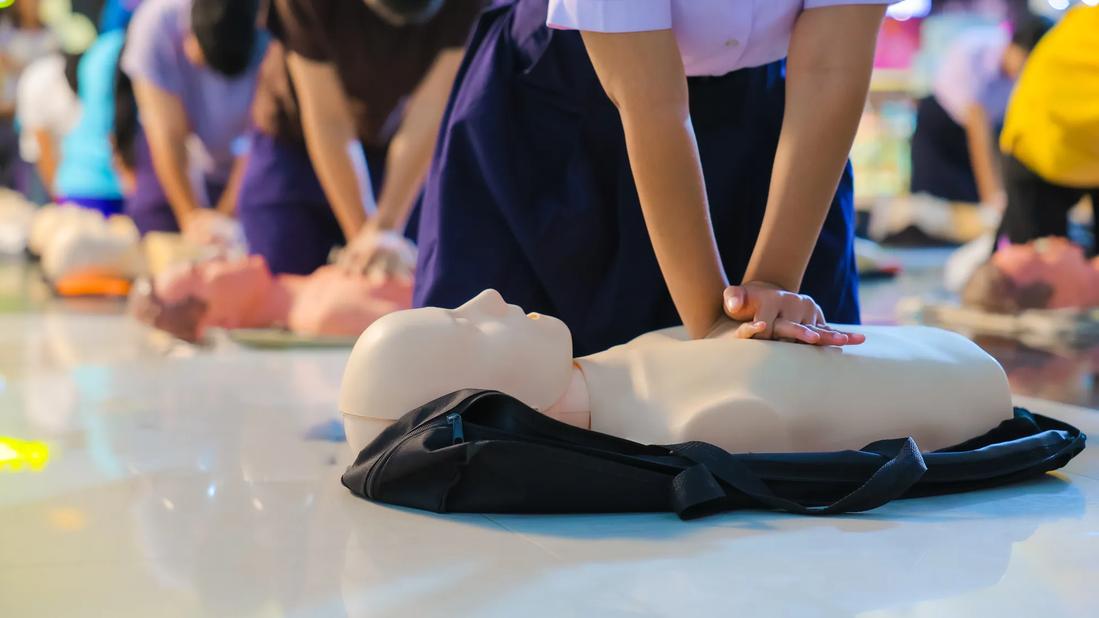
Image content: This image is available to view online.
View image online (https://assets.clevelandclinic.org/transform/657fc96f-e942-4226-9a65-e594c83c8c48/cpr-training)
Children practicing CPR
Sudden cardiac arrest is far less common in children than in adults, but it remains an important pediatric health concern. An estimated 15,000 to 23,000 cardiac arrests occur in children each year.
Advertisement
Cleveland Clinic is a non-profit academic medical center. Advertising on our site helps support our mission. We do not endorse non-Cleveland Clinic products or services. Policy
Just as concerning, children having cardiac arrest often do not receive timely bystander intervention, such as cardiopulmonary resuscitation (CPR) or use of an automated external defibrillator (AED). In one 2018 study of nearly 1,400 pediatric out-of-hospital cardiac arrests, an AED was applied before EMS arrival in only 28% of cases, and just 19% of patients survived to hospital discharge.
“One major reason is recognition,” says Peter Aziz, MD, Director of the Inherited Arrhythmia Clinic at Cleveland Clinic Children’s. “Many people do not immediately think ‘cardiac arrest’ when a child collapses. Education is an opportunity here.”
A new position statement from the Heart Rhythm Society argues that the U.S. needs a more uniform approach to CPR and AED education — and that high schools are best positioned to provide it.
“This really isn’t just a school safety or public health issue,” says Dr. Aziz, a coauthor of the statement. “Pediatricians should view CPR and AED education in schools as a pediatric health issue. Even when screening is done well, some children at risk of cardiac arrest will still be missed. That’s why rapid recognition, CPR and AED use are essential. Improving response after arrest may be one of the most cost-effective and scalable opportunities to save lives.”
Forty-three states already have laws addressing CPR and AED education in high schools, but requirements vary widely and enforcement is inconsistent. The HEARTS Act, signed into law in 2024, was intended to standardize CPR training and AED readiness in schools nationwide, but funding and implementation have lagged.
Advertisement
According to the Heart Rhythm Society statement, high schools offer the best opportunity to train an entire generation of potential responders. Roughly 17 million U.S. students attend high school, making it one of the few settings with both broad reach and a captive audience.
“Students as early as sixth grade can be trained to perform CPR effectively,” Dr. Aziz says. “So, teens in high school certainly have the maturity and capacity to respond to cardiac emergencies at home, at sporting events or in other public settings.”
In other words, school-based training could do more than protect students on campus. It could also improve readiness in homes and communities.
The statement argues that simply requiring CPR instruction is not enough. High-quality school-based education should include:
That last point may be especially important in pediatrics. According to Dr. Aziz, a child who collapses and has seizure-like activity may not immediately be recognized as being in cardiac arrest, delaying CPR and defibrillation when minutes matter most.
Although a fully packaged national program is not yet in place, Dr. Aziz says pediatricians can still help build awareness and momentum now.
That role may include:
Advertisement
“Our primary care providers are the front line,” Dr. Aziz says. “They see a broad population and can help identify children at risk. They also can be champions in the community and with government to express the importance of CPR and AED education.”
Even the best training program will not eliminate pediatric cardiac arrest, but Dr. Aziz says it could improve what happens next:
“There aren’t many opportunities in medicine where the problem is this big and the solution is this actionable,” Dr. Aziz says. “We know there’s a gap in CPR and AED readiness, we know outcomes improve when people respond quickly, and we know we can train students to do it. That makes this an opportunity we shouldn’t ignore.”
Advertisement
Advertisement
For severe cases, complete unroofing of the bridge is imperative

Even seemingly healthy athletes can be at risk for SCD, making prevention a complex challenge

Consortium makes key recommendations to improve prevention practices
Guidance on the often-fatal condition through an interventional cardiology lens
Collaborative citywide initiative reshapes protocols to boost cardiac arrest survival

Helping pediatricians and families make safer, more individualized activity decisions
Caregivers rely on cross-hospital collaboration to guide critical response
Lead dwell time and manufacturer emerge as independent predictors of success in registry study
 Search