Locations:





Cleveland Clinic welcomes world-leading chest wall surgeon Dr. Hyung Joo Park
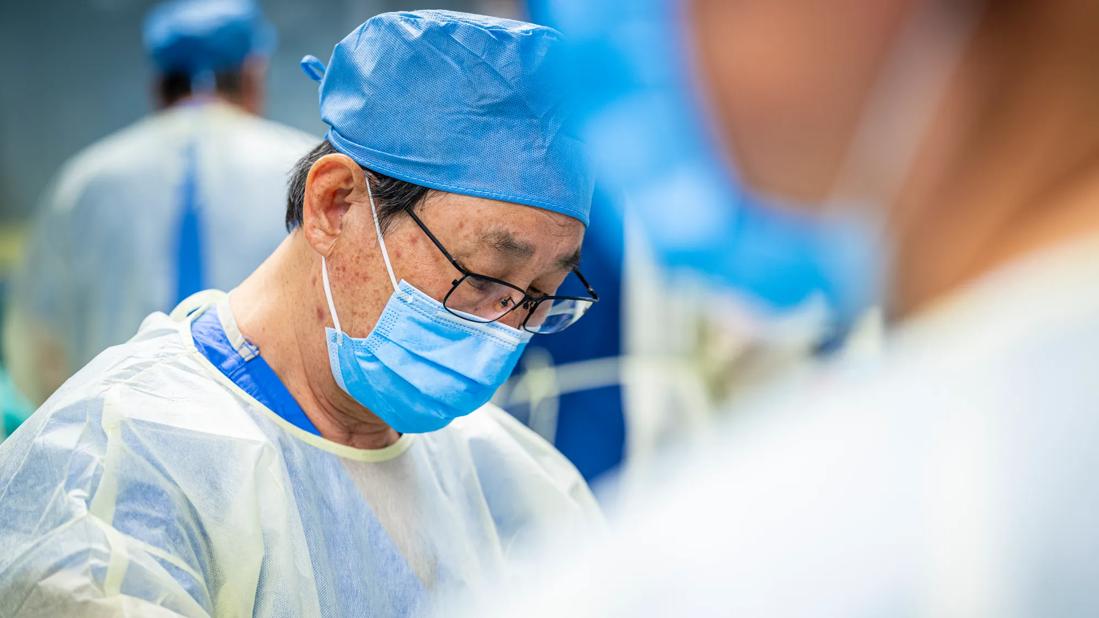
Image content: This image is available to view online.
View image online (https://assets.clevelandclinic.org/transform/880232d6-739f-424f-aa46-5256bbcbff25/CHP_5904858_04-1025_122_SCG)
Dr. Park in the operating room
When the Nuss procedure emerged in the late 1990s, it transformed repair of pectus excavatum by avoiding the cartilage resection used in older open operations. The technique immediately caught the attention of Hyung Joo Park, MD, PhD, then a congenital cardiac and thoracic surgeon in South Korea.
Advertisement
Cleveland Clinic is a non-profit academic medical center. Advertising on our site helps support our mission. We do not endorse non-Cleveland Clinic products or services. Policy
After his first successful case, referrals surged. Within six months, Dr. Park had performed more than 100 repairs and realized something that would shape his career: Many chest wall deformities were too complex for a one-size-fits-all approach.
That set him on course to improve the safety, effectiveness and reproducibility of surgery for pectus excavatum, pectus carinatum and other chest wall deformities.
Over the past two decades, Dr. Park has become the world’s most experienced surgeon in pectus repair, with approximately 7,000 cases to date. He has developed nearly 40 innovations, from surgical techniques and medical devices to entirely new concepts of chest wall repair. He has published more than 100 peer-reviewed publications, given more than 100 international lectures, led live surgery workshops worldwide and helped pioneer the livestreaming of surgical demonstrations on YouTube.
In 2025, Dr. Park joined Cleveland Clinic. He was drawn by John DiFiore, MD, the Director of Cleveland Clinic’s Pectus Excavatum Program, who had spent nearly two weeks in South Korea, training in Dr. Park’s operating room. Thanks to Dr. DiFiore, Cleveland Clinic had been the first to bring Dr. Park’s NeoPectus surgical techniques to the U.S. in 2023.
Dr. Park says, “My goal is not only to bring my personal technique to Cleveland Clinic, but to help create a center where advanced chest wall surgery can grow, be studied, be taught and be shared with the world.”
He explains more about his trailblazing experience and his plans at Cleveland Clinic in this Q&A.
Advertisement
A: My first innovation came from recognizing that pectus excavatum is not a single deformity. As I treated more patients, I was surprised by how diverse pectus excavatum really was. I saw a wide range of morphologies, from simple symmetrical depression to severe asymmetry and complex mixed deformities.
The original Nuss procedure worked well for some patients, particularly those with simple symmetrical anatomy, but it could not fully correct many of the asymmetric or complex cases I was seeing.
After my first 100 cases, I started organizing these patterns. That led to my first major innovation: a morphological classification of pectus excavatum. That changed the way I operated. Once I understood that different shapes required different solutions, I developed tailored techniques such as the Asymmetric Bar Technique, Seagull Bar Technique, Crest Compression Technique and other morphology-based modifications.
A: It is difficult to name only one. Each innovation was born out of a pressing clinical need. Over time, several of them — including crane-powered elevation, entire chest wall remodeling, multiple-bar strategy, bridge fixation and formula-based reproducibility — came together in what I call NeoPectus Surgery.
The key distinction is that NeoPectus Surgery does not simply force the chest wall upward by rotating a bar. It first elevates the chest wall to a normal anatomic level using crane power, then uses bars as supporting and remodeling structures.
That matters because pectus excavatum often involves more than a depressed sternum. It can affect the entire chest wall, including the ribs, costal cartilage, asymmetry, costal flare and overall thoracic shape. NeoPectus Surgery is designed to restore the whole deformity, not just lift one area. It represents a shift from elevation to restoration.
Advertisement
For pectus carinatum, I developed the Sandwich Technique, allowing the protruding chest wall to be compressed and remodeled in a minimally invasive way. Before that, many pectus carinatum patients had limited surgical options.
A: When I started performing pectus surgery, many surgeons had to learn on their own, and that carried great risk. I have always believed that surgical education is essential, and that there is no better way to teach an operation than to show it in real time.
Surgeons need to see not only the planned steps, but also the difficult moments, the intraoperative decisions and the unexpected problems. Those are difficult to learn from papers or textbooks alone.
That is why I began conducting live surgery workshops and later expanded to YouTube livestreaming, so surgeons around the world could observe these operations more directly. Live surgery is demanding because there is no editing and no second take, but that is exactly what makes it valuable.
A: After more than 25 years of developing techniques, devices and concepts in chest wall surgery, I felt the next stage of my career should be broader than performing more operations myself. I wanted to help build a program that could influence the future of chest wall surgery worldwide.
Cleveland Clinic offers the global platform, clinical infrastructure and culture of innovation needed to build that kind of program. My goal is to help create a center where patients can receive advanced care, surgeons can come to learn, and new ideas can be studied, refined and shared.
Advertisement
My priorities here are to expand access for both pediatric and adult patients, build a comprehensive chest wall deformity center, continue advancing surgical innovation and establish a global training hub for visiting surgeons and fellows. Just as important, I want to strengthen the multidisciplinary teamwork required to build a truly world-class pectus program.
A: The biggest misconception is that pectus excavatum is merely cosmetic. It is not. It is a structural chest wall disorder, and the visible depression is only one part of the condition.
In many patients, the deformity can be associated with cardiac compression, limited lung expansion, reduced exercise tolerance, impaired posture and substantial psychosocial burden, particularly during adolescence and young adulthood.
I also think there is a misunderstanding about what successful surgery should achieve. The goal is not simply to make the depression disappear. It is to restore chest wall anatomy as fully as possible — decompress the heart safely, improve thoracic contour, correct asymmetry, stabilize the repair and ultimately improve quality of life.
Pectus surgery is not just correction of a dent. It is anatomic restoration, and it can change a patient’s life.
Advertisement
Advertisement
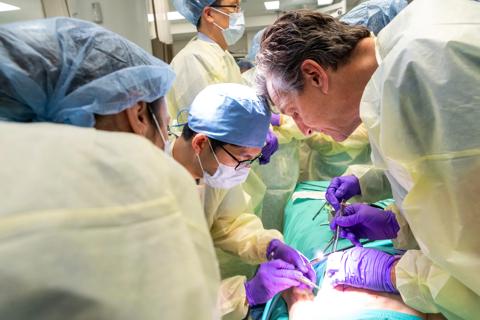
Cleveland Clinic findings highlight gains in stability, chest wall contouring and correction

Pediatric Syncope Clinic helps rule out serious disease and guide next steps

What the discovery means for clinicians and patients

Why preparedness matters right now

Early diagnosis, specialized assessment and high-frequency motor-based therapy can improve outcomes

Transplant centers vary substantially in how they assess, document and follow patients after allogeneic transplantation

Helping pediatricians and families make safer, more individualized activity decisions

Study finds exome sequencing can uncover additional diagnoses after nondiagnostic panel testing
 Search