Locations:





Fixed-dose single-pill combinations and future therapies

Image content: This image is available to view online.
View image online (https://assets.clevelandclinic.org/transform/6ab201af-e766-438a-89de-acc3beebb816/25-URL-7446108CQD-hypertension-management)
Dr. Thomas with a patient
Editor's note: This article originally appeared in the Cleveland Clinic Journal of Medicine and was republished with permission.
Advertisement
Cleveland Clinic is a non-profit academic medical center. Advertising on our site helps support our mission. We do not endorse non-Cleveland Clinic products or services. Policy
Hypertension management has evolved over the years, with shifting goals for blood pressure (BP) control and changes in medication strategies. The current treatment paradigm emphasizes a combination of lifestyle modifications and pharmacologic therapy, with first-line medications typically including angiotensin-converting enzyme inhibitors or angiotensin receptor blockers, calcium channel blockers, and diuretics (preferably thiazide-like diuretics). Beta-blockers are first-line if there are compelling indications, and mineralocorticoid receptor antagonists (like spironolactone) serve as fourth-line add-on therapy for resistant hypertension.
Despite the availability of effective medications, BP control rates have declined over the past decade—a trend exacerbated by the COVID-19 pandemic.1,2 This underscores the need for improved treatment approaches, including newer therapies and more effective use of existing medications.
Traditionally, pharmacologic therapy has followed a step-up approach, where treatment begins with a single medication, titrated to the maximally tolerated dose before more agents are added in a stepwise manner over weeks or months. However, as Volk et al3 outline in this issue of the Journal, fixed-dose single-pill combination (SPC) therapy—which combines two or more medications with complementary mechanisms of action into a single pill—has been shown to improve adherence, enhance BP control, and mitigate therapeutic inertia.
Clinical guidelines support the use of SPC therapy for hypertension. The 2017 American Society of Cardiology/American Heart Association guidelines4 recommend starting treatment with two medications for stage 2 hypertension (BP > 140/90 mm Hg), either as a SPC or free equivalents, and the more recent 2024 European Society of Cardiology guidelines5 emphasize SPC therapy as the preferred approach for most hypertensive patients with BP greater than 140/90 mm Hg.
Advertisement
Despite these endorsements and the availability of generic SPC formulations, real-world utilization remains low. Only 39% of US adults on at least 2 anti-hypertensive medications use SPCs.6 In an analysis of Medicare and Medicaid claims, SPCs accounted for only 9.4% of first-line antihypertensive prescriptions, with a declining trend from 2016 to 2020.7
Although no qualitative studies have systematically explored barriers to SPC use, potential reasons for underutilization include ingrained prescribing patterns, limited familiarity with SPCs, and concerns about distinguishing side effects when multiple agents are combined. Additionally, while most SPCs are available in generic formulations, gaps exist, particularly in the availability of triple-drug formulations and SPCs incorporating preferred thiazide-like diuretics such as chlorthalidone.
Broader SPC adoption and expanded formulations could improve hypertension management. Recent research into low-dose SPC therapy is promising, with evidence showing that combining lower doses of antihypertensive medications can achieve optimal efficacy while minimizing adverse effects. Studies have shown superior BP control with triple and quadruple low-dose combinations, supporting a potential shift in treatment strategies.8,9
A notable development is GMRx2, a novel low-dose triple-drug SPC that contains a thiazide-like diuretic. Because current triple-drug SPCs do not include a thiazide-like diuretic and are not recommended for initial treatment, GMRx2 could provide an effective option for earlier intervention in patients with hypertension. The formulation, recently approved by the US Food and Drug Administration (FDA), combines telmisartan, amlodipine, and indapamide and comes in quarter-dose (telmisartan 10 mg, amlodipine 1.25 mg, and indapamide 0.625 mg) and half-dose (telmisartan 20 mg, amlodipine 2.5 mg, and indapamide 1.25 mg) versions.
Advertisement
Manufacturer-funded studies of GMRx2 showed good tolerability and BP reductions in both dosage forms compared with placebo in patients with mild to moderate hypertension.10 Further, GMRx2 showed better BP control over its dual-drug-component combinations and was well tolerated in patients taking 0 to 3 antihypertensive medications.11
Taken together, there is growing evidence that low-dose SPC therapy has the potential to become a key first-line treatment for hypertension. Certainly, it remains to be seen whether significant concerns about hypotension or distinguishing side effects will emerge with routine use in clinical practice.
Dual endothelin receptor antagonists. Beyond leveraging existing therapies, novel antihypertensive agents with unique mechanisms of action are being studied, particularly for resistant hypertension. Aprocitentan, a dual endothelin receptor antagonist, was approved by the FDA in 2024, the first approval of an antihypertensive medication in nearly 17 years. A phase 3 trial showed modest (but consistent) BP reduction in patients with resistant hypertension, though edema was a concern.12 The FDA-approved dose is 12.5 mg once daily for patients with an estimated glomerular filtration rate (eGFR) of 15 mL/min/m2 or greater. Whether aprocitentan can replace spironolactone as the fourth-line medication for resistant hypertension, especially in patients with eGFR less than 45 mL/min/m2 and a higher risk of hyperkalemia, remains to be seen.
Aldosterone synthase inhibitors. Growing recognition of autonomous aldosterone production as a contributor to hypertension has led to evaluation of agents beyond traditional steroidal mineralocorticoid receptor antagonists. Aldosterone synthase inhibitors, which block adrenal aldosterone synthesis, are currently under study. Trials of baxdrostat and lorundrostat in uncontrolled and resistant hypertension showed significant BP reductions.13,14 Although severe hyperkalemia (≥ 6 mmol/L) was rare, these trials were of short duration, and the mean eGFR in them was 80 to 83 mL/min/m2; the real-world incidence of hyperkalemia could be higher, particularly in those with lower eGFR. Results of ongoing studies of aldosterone synthase inhibitors combined with sodium-glucose cotransporter-2 inhibitors in chronic kidney disease are awaited.
Advertisement
Hepatic angiotensinogen attenuators. Hepatic angiotensinogen attenuators are among the more intriguing novel therapies, including small interfering RNA and antisense oligonucleotides designed to suppress hepatic angiotensinogen. In theory, targeting the most upstream component of the renin-angiotensin-aldosterone axis could decrease escape mechanisms that counteract angiotensin II lowering. Zilebesiran, a first-in-class small interfering RNA therapeutic, showed sustained BP reduction in a phase 2 study when administered subcutaneously every 3 to 6 months and effectively suppressed angiotensinogen levels.15 The potential for improved adherence with a once-every-6-month dosing schedule is appealing, but key questions remain, including concern for refractory hypotension, particularly in states like shock. Although no severe adverse events related to hypotension or orthostasis were noted in trials, the follow-up in these trials was relatively short and long-term safety data will be needed.
Device-based adjuncts. Device-based treatments, particularly renal denervation, have reemerged as a potential adjunct for hypertension management. More recent studies with newer catheter designs show modest but significant BP reductions, and renal denervation (specifically using radiofrequency and ultrasound) is now FDA approved for clinical use. A more detailed review of renal denervation was recently published in the Journal.16
Measurement innovations. From a measurement perspective, cuffless BP measurement devices are innovative technologies that can provide a more comfortable, continuous monitoring alternative to traditional cuff-based methods using photoplethysmography, pulse wave analysis, and other parameters. Improved algorithms and enhanced sensor technology hold potential to enhance accuracy and real-time monitoring. Additional research is needed to confirm the accuracy and validity of these devices before they can be widely adopted.17
Advertisement
Innovation is key, but don’t forget fundamentals. This is an exciting era for hypertension management, driven by advances in existing treatments, innovative technology, emerging drug classes, and device-based approaches. While continued innovation is crucial, reinforcing fundamental principles of proper BP measurement, adherence to lifestyle modifications, and equitable access to care remain essential. Figure 1 summarizes the potential transition from current to evolving and future treatment paradigms. As the landscape of hypertension treatment evolves, the challenge will be not only to develop novel therapies but also to implement them to benefit the populations that need them most.
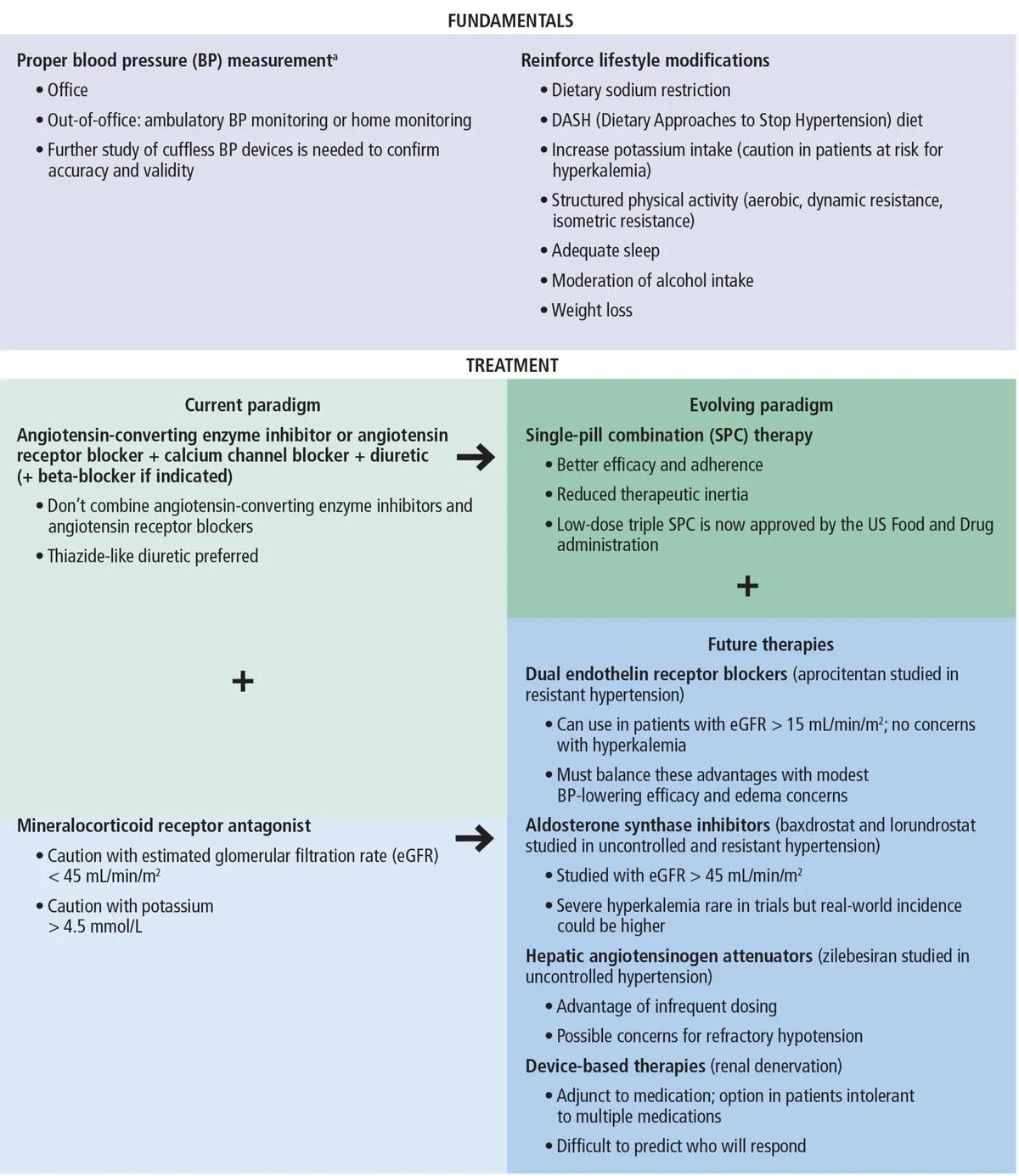
Image content: This image is available to view online.
View image online (https://assets.clevelandclinic.org/transform/a443fdab-7e93-4df0-af9d-efc259569f99/CQD-hypertension-management-inset)
Figure. Instructions for proper BP measurement: no talking during rest period and between measurements; apply cuff to bare upper arm about 2–3 cm above the elbow crease; arm should be resting with the midarm at heart level, back should be supported, and feet should be flat on the floor.
Advertisement

Blood pressure decreases equally in study groups receiving monthly or one-time doses

Clinicians should individualize dosing practices based on patient risk factors and preferences

General principles for use of the long-awaited new therapy approach
Results inform dose selection for further trials of the aldosterone synthase inhibitor

Phase 2b trial of aldosterone synthase inhibitor also finds no benefit from dose escalation

Insights for diagnosing, assessing and treating

Getting patients to their goal blood pressure

Device may offer a practical middle-ground option for some patients
 Search