Locations:





Podcast content: This podcast is available to listen to online.
Listen to podcast online (https://www.buzzsprout.com/2256206/18783620)
Cleveland Clinic oncology nurse Tim Tibbitts, BSN, RN, began his professional life as an English teacher before stepping away from the classroom to raise his children and pursue freelance writing. As managing editor of a nursing school alumni magazine, he interviewed caregivers across a wide range of specialties — from flight nurses to rural practitioners. The experience stayed with him.
Advertisement
Cleveland Clinic is a non-profit academic medical center. Advertising on our site helps support our mission. We do not endorse non-Cleveland Clinic products or services. Policy
Not long after celebrating his 50th birthday, Tibbitts began to think more seriously about ways to support and better the lives of others. The idea of becoming a nurse surfaced, and he quickly recognized it as the right path.
In this inspiring episode of Nurse Essentials, Tibbitts reflects on his unconventional life path by highlighting the value of entering healthcare with broader life experience, describing his deep empathy for patients and families, and reinforcing the nursing profession's commitment to lifelong learning and service.
Click the podcast player above to listen to the episode now, or read on for a short, edited excerpt. Check out more Nurse Essentials episodes at my.clevelandclinic.org/podcasts/nurse-essentials or wherever you get your podcasts.
Podcast host Carol Pehotsky, DNP, RN, NEA-BC: Were there any specific challenges you faced when returning to school?
Tibbitts: Well, I was 52 years old when I started nursing school. On the first day of class, I got out my notebook and pen, and the other 30 students took out their laptops. I thought: This is gonna be a little different, but that's okay. They can do things their way, and I'll do things my way. But then the teacher says, ‘I assume everyone's downloaded the PowerPoint. You can take notes right on the slides!’ I turned to my neighbor and asked, ‘Can you help?’ And they did. [My fellow students] were warmly supportive, which was great. I hadn't taken a science class since high school and didn't take science classes in college…so, yeah, it was a big learning curve.
Advertisement
Pehotsky: How did you end up in oncology?
Tibbitts: I'm a broadly curious person, so I thought darn near every subject that came up in nursing school was cool. I’d always think: Yeah, I could really see myself doing this.
We didn't have any coursework related to oncology – maybe one chapter in a med-surg textbook or something – but when I started my job search the summer before my final semester (3.5 years ago), I became interested in [the specialty].
When I was in college, my grandmother died in our home of cancer. It was hard, obviously, but it was really special to have her there. It made a big impact. I'm a writer, so for years I wrote about the experience in one form or another. In fact, I wrote a novel, Echo Still, which is about a boy who's on the precipice of becoming 13. His grandmother has to move in with the family for a while 'cause she's come to a fictional version of Cleveland for cancer treatment. So, it obviously took me a long time to get that year out of my system.
I originally thought I was interested in adolescent and young adult oncology, but I didn't find any [job openings] that felt like [the right fit]. And thank goodness, because [that field] is just too hard. It should be illegal to have cancer when you're that young, you know?
I eventually talked to a recruiter at Cleveland Clinic and decided I wanted to work on Main Campus. I live only a mile from here and love being so close. I ultimately ended up working in an inpatient solid tumor oncology unit. Most cancer treatments are performed on an outpatient basis…so the folks on our floor, by and large, are dealing with metastatic cancer and the complications that come with it: infection, spinal cord compression and other challenges that require an inpatient stay. It's emotionally heavy work, but my family remains very supportive. My wife and kids have seen me cry at the dinner table more than a few times.
Advertisement
Advertisement
Helping patients understand their options while navigating uncertainty
Nurse manager turns a patient safety concern into a data-driven effort to improve protocols and inspire innovation
Nurse draws on frontline experience and an engineering background to develop a new approach to incontinence management
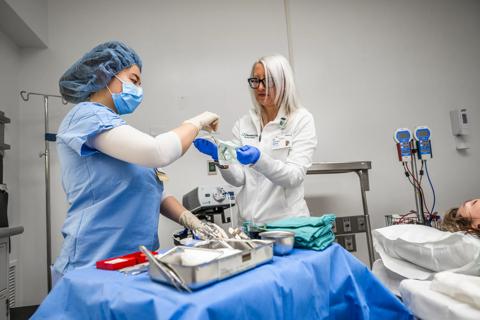
Plastic surgery nurses uniquely help patients meet medical, functional and aesthetic goals
Harnessing digital innovations to enhance nurse confidence and clinical outcomes
Regional organizations collaborate to address nurse faculty shortage
How wellness habits help nurses flourish
Planning continues with critical, patient-focused input from nursing teams
 Search