Locations:





Plastic surgery nurses uniquely help patients meet medical, functional and aesthetic goals
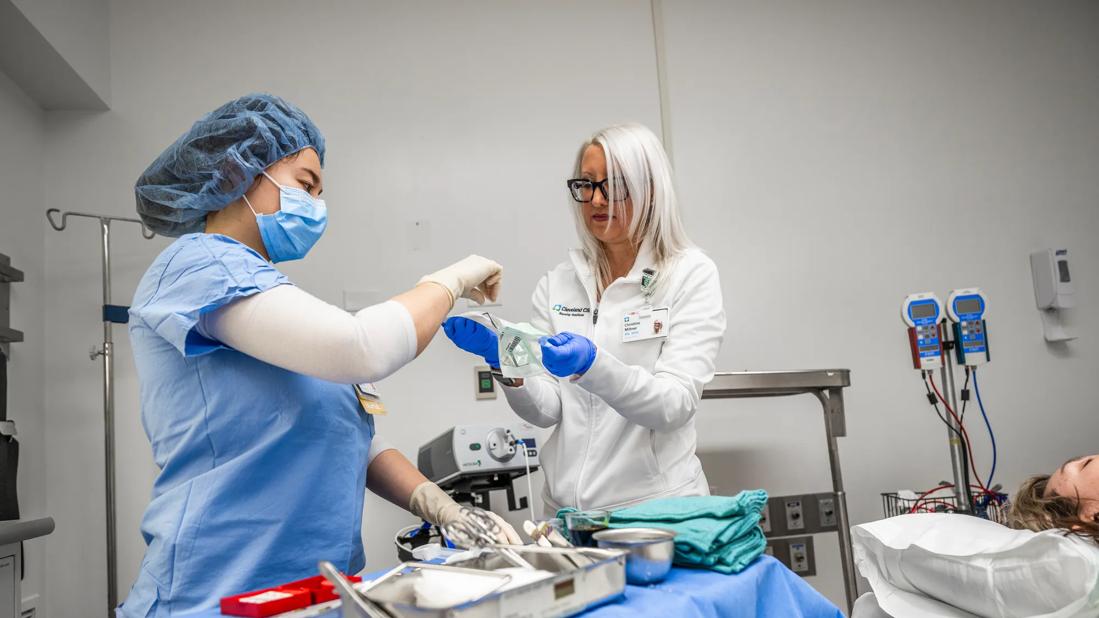
Image content: This image is available to view online.
View image online (https://assets.clevelandclinic.org/transform/dbf4ed60-49e1-4718-8007-607e3256d128/NUR_7663708_1-28-26_023_MLC)
Nurses in plastic surgery
When Christine Miltner, MSN, RN, CAPA, nurse manager for Cleveland Clinic’s Department of Plastic Surgery, reflects on her path to plastic surgery nursing she admits it was somewhat unexpected.
Advertisement
Cleveland Clinic is a non-profit academic medical center. Advertising on our site helps support our mission. We do not endorse non-Cleveland Clinic products or services. Policy
“A colleague suggested I consider it,” she says. “At the time, I was working as an assistant nurse manager in the Imaging Institute so I had experience in pre- and post-op settings. Pursuing the recommendation was one of the best decisions I’ve ever made. Plastic surgery nursing is fascinating.”
Miltner and her colleagues work for one of the largest plastic surgery departments in the U.S. and are experts in their field. “Cleveland Clinic is leading the way with our surgeons performing cutting-edge surgeries,” she shares.
However, the plastic surgery specialty is one that Miltner says is often misunderstood. “People generally think of this specialty as only cosmetic or aesthetic, but it’s so much more,” she explains. “Plastic surgery is reconstruction to improve function and appearance.”
Within plastic surgery nursing are a vast number of subspecialties. Nurses may choose to hone their practice to areas such as facial cosmetic surgery, cosmetic and reconstructive breast surgery, craniofacial surgery, upper extremity surgery, reconstructive microsurgery, invasive skin cancer reconstruction or lymphedema.
Kristen Lee, MSN, RN, is a member of Cleveland Clinic’s reconstructive breast surgery team. “I was surprised coming into plastic surgery because I didn’t realize there were so many specialties within the specialty,” she says. “There’s a lot of versatility.”
Plastic surgery nurses at Cleveland Clinic have a unique hybrid model where they may work as content experts within a subspecialty team, or they can care for patients across all plastic surgery specialties. Nurses support patients in clinic, pre-operative, post-operative and ambulatory settings. Their responsibilities include triaging and educating patients, providing pre- and post-operative clinical care and procedure support, assisting with wound care and any other discomforts, preparing patients for home and follow-up, and more.
Advertisement
“Our nurses don’t work in the operating room, but we cover all other areas, supporting providers with a lot of patient assessment,” explains Miltner.
There are a multitude of reasons why a patient may need reconstruction. Some common medical and functional examples include congenital disorders, breast cancer, bone or tissue grafting for chronic wounds, surgical wound closures and skin grafting.
Every plastic surgery patient receives an individualized plan of care. “All patients have different goals,” says Miltner. “We work with each person to support their journey.”
A breast reconstruction patient, for example, may seek results that marry function and aesthetic appearance. Achieving this can necessitate multiple phases over several years. For nurses like Lee, creating long-term patient relationships is what drew her to plastic surgery nursing.
“I liked the appeal of a more restorative specialty, but also to have the opportunity to follow patients along and really meet them where they are,” she says. “We can follow up with these patients for years and I love that I can develop those connections with them in that unique way.”
On the cosmetic side of the specialty, patients may receive minor procedures, such as chemical peels, platelet-rich plasma (PRP) therapy, or laser procedures or more complex surgeries like tummy tucks, mommy makeovers and breast augmentations.
“Cosmetic reconstruction can be pretty fun and is just as fulfilling as the medical side of plastic surgery,” shares Miltner. “Patients are excited about the changes they are making.”
Advertisement
Reconstructive care might be needed throughout a person’s lifetime. “How someone’s body looks for an initial reconstruction at age 20 or 30 isn’t how their body will look at 50 or 60 so we may reconstruct again later in life,” explains Miltner.
Cleveland Clinic’s Department of Plastic Surgery works closely with other medical and surgical teams. “It’s very multidisciplinary,” states Miltner. “For example, our plastic surgeons work with oncology and the breast surgeons, our hand team works with ENT, for our cleft palate patients, we work with our partners in the cleft palate clinic and so on.”
She adds, “When we did a total face transplant we had surgeons on that team from each of our plastics subspecialties to provide the patient with the most comprehensive care. The physicians collaborated with our nurses — we were a known and trusted part of that team.”
For decades, the plastic surgery field has seen rapid advancement of technologies and procedures. Recently, Cleveland Clinic has focused on minimally invasive techniques in facial cosmetic surgery, including alternatives to face and neck lift surgery, short scar facelifts and minimally invasive facelift techniques.
“Our surgeons are highly specialized, and their experience and knowledge are vast,” states Lee. “They keep up with current practice, follow the literature and adapt to new innovations. Even the way they do breast reconstruction has come a long way. They used to take muscle to create your breast and now they do free flaps with the tissue from your abdomen. It’s an incredible opportunity to learn and be part of this level of innovation.”
Advertisement
Miltner and Lee say there are several ways for nurses to stay abreast of advancements, emerging knowledge and best practices, including obtaining professional certification, maintaining membership in organizations like the International Society of Plastic and Aesthetic Nurses (ISPAN), and participating in shared governance and other internal committees.
“When comparing plastic surgery to other areas of nursing, it’s the restorative nature of this specialty that is the real standout,” shares Lee. “To make people feel whole is so rewarding and patients are so grateful for their outcomes.”
Advertisement
Advertisement

Helping patients understand their options while navigating uncertainty
Nurse manager turns a patient safety concern into a data-driven effort to improve protocols and inspire innovation

Nurse draws on frontline experience and an engineering background to develop a new approach to incontinence management

How life experience, storytelling and a passion for service sparked a midlife nursing career

Harnessing digital innovations to enhance nurse confidence and clinical outcomes
Regional organizations collaborate to address nurse faculty shortage

How wellness habits help nurses flourish

Planning continues with critical, patient-focused input from nursing teams
 Search