Locations:





Strengthening care through targeted resources and frontline voices
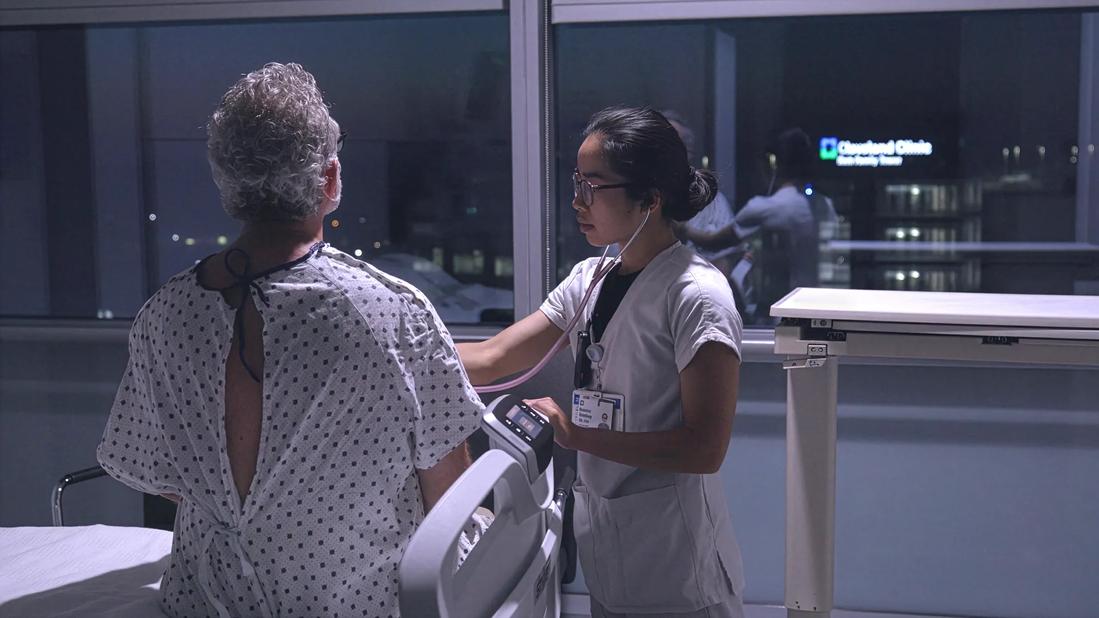
Image content: This image is available to view online.
View image online (https://assets.clevelandclinic.org/transform/f992afb1-53f4-4cc4-a110-c4214d8c34b7/NightNurse-patientBack-close_5396-video)
Night shift nurse
Night-shift caregivers commonly manage higher patient-to-nurse ratios with fewer ancillary resources and limited provider availability. In an effort to change that narrative, nurses at Cleveland Clinic Akron General are finding new ways to better support their colleagues who care for patients after dark.
Advertisement
Cleveland Clinic is a non-profit academic medical center. Advertising on our site helps support our mission. We do not endorse non-Cleveland Clinic products or services. Policy
For Cynthia Johnson-Smyth, BSN, RN, Assistant Nurse Manager of the hospital’s cardiovascular and neuroscience intensive care units, the night shift was never meant to be a permanent arrangement.
“When I first took the night-shift job, my plan was to switch to days as soon as a position opened up,” she says. Much to her surprise, however, she found that working after dark provided an appealing mix of clinical challenges and professional support that met her needs.
Because on-site resources become more limited after dark, nurses must rely heavily on their own assessment skills and clinical judgment. Although this requisite independence can be stressful, especially for novice caregivers, Johnson-Smyth says her own skills have been sharpened significantly by working nights.
“When you’re working when the rest of the world is sleeping, you really learn to rely on your own best instincts and those of your colleagues,” she explains. “Before long, you’ve developed the confidence you need to manage unexpected situations.”
Although she is grateful for the personal flexibility the night shift provides, Johnson-Smyth is keenly aware of how an “upside down” schedule can compromise sleep, health and relationships. To avoid the obvious pitfalls, she has developed several creative workarounds, including blackout curtains, white noise and firm boundaries, to ensure proper rest between shifts. Because toggling between night and day schedules can be difficult, especially when trying to align with family routines, she also emphasizes the importance of intentional self-care, healthy eating and physical activity.
Advertisement
Jodie Lynch, MSN, RN, a Nursing Professional Development Specialist at Akron General, echoes this perspective.
“Eating a healthy diet and working out regularly are essential to my well-being, especially when I’m working nights,” she says. “On my days off, I’ve found that waking up early with my spouse helps normalize my routine.”
Although Johnson-Smyth says many of her colleagues value the slower pace of overnight care – “when patient interactions can be more focused and individualized” – working with a smaller crew poses several unique challenges. Basic logistics, such as accessing meals, obtaining supplies and coordinating care with colleagues, can be more complicated with fewer providers and resources immediately available.
Lynch adds that “even something as simple as the kitchen being closed affects both staff and patients,” especially when patients who have been NPO for hours are cleared to eat overnight.
Recognizing the common challenges that can arise, Akron General launched a hospital-wide initiative to better meet the unique needs of night-shift staff. Central to this effort was the 2018 creation of the Night Shift Council (NSC), a forum designed to give nurses a formal voice.
To boost engagement in the NSC and better understand the needs of its members, council leaders recently conducted a needs assessment, which identified several ongoing concerns among night-shift nurses: scarce availability of food for caregivers and patients, lack of assistance with difficult IV insertions and communication challenges between nurses and providers overnight.
Advertisement
“An estimated 40% of hospital nurses work nights, yet their needs have historically been underrecognized,” explains Corbin Wade, BSN, RN, an Akron General nurse who helped lead the project. “We designed our survey to elicit honest feedback from caregivers about any barriers that were making their jobs more difficult.”
In response to the feedback they received, nurse leaders implemented several targeted, practical changes designed to improve the satisfaction and safety of both patients and caregivers. The hospital kitchen added new options for patients and staff, including Bento boxes and a wider variety of premade sandwiches. In addition, food trucks were made available during evening hours, and hospital restaurant hours were extended to better meet the needs of overnight staff.
A guide for difficult IV insertions was developed to support clinical practice, and additional ultrasound-guided IV courses were made available. The hospital's vascular access team also expanded its availability to accommodate the needs of night-shift caregivers. The hospital’s leadership also became more actively involved in the NSC, and new processes were created to minimize communication breakdowns between providers and nurses.
Johnson-Smyth says she has seen the impact of these efforts firsthand, crediting the NSC with driving meaningful change, particularly around lab access and interdisciplinary collaboration. She notes that the NSC regularly rounds on nursing units, giving leaders an opportunity to discuss any concerns with night-shift staff.
Advertisement
“The NSC has provided great opportunities for nurses to build relationships with hospital leaders and other clinical teams to resolve many of the issues night-shift caregivers have faced,” she says. “The council has helped give nurses a voice for themselves and their patients.”
As Akron General continues to adapt based on the expressed needs of its night-shift nurses, early feedback has been positive. Wade says clinical nurses report satisfaction with many of the implemented changes, and the NSC is proving to be an effective platform for ongoing improvement.
“Together, these efforts demonstrate a growing recognition that supporting night-shift nurses — through resources, education and shared governance — is essential to patient safety, nurse retention and professional growth across the entire hospital,” Wade adds.
Advertisement
Advertisement

Helping patients understand their options while navigating uncertainty
Nurse manager turns a patient safety concern into a data-driven effort to improve protocols and inspire innovation

Nurse draws on frontline experience and an engineering background to develop a new approach to incontinence management

How life experience, storytelling and a passion for service sparked a midlife nursing career
Plastic surgery nurses uniquely help patients meet medical, functional and aesthetic goals

Harnessing digital innovations to enhance nurse confidence and clinical outcomes
Regional organizations collaborate to address nurse faculty shortage

How wellness habits help nurses flourish
 Search