Locations:





Study challenges assumptions about risk evaluation in total hip revision

Image content: This image is available to view online.
View image online (https://assets.clevelandclinic.org/transform/6aff0f58-ecb4-496c-86c8-0bbcad06fded/obese-hip-pain-2164578416)
Woman with obesity and hip pain
Modular fluted tapered (MFT) stems are a mainstay in revision total hip arthroplasty (rTHA). They can be especially valuable when surgeons need flexibility to restore version, offset and leg length in the setting of proximal femoral bone loss or deformity.
Advertisement
Cleveland Clinic is a non-profit academic medical center. Advertising on our site helps support our mission. We do not endorse non-Cleveland Clinic products or services. Policy
But one concern has been constant: femoral stem subsidence.
Many surgeons have attributed subsidence to inadequate canal fill or insufficient distal fixation. New research from Cleveland Clinic suggests the issue may be less about the implant-bone fit and more about patient-related loading.
In a retrospective study of 316 patients who had aseptic rTHA with an MFT stem, investigators found that higher body mass index (BMI) was more strongly associated with clinically relevant subsidence than canal fill.
“Common belief is that MFT stems migrate downward in the femur because they’re not secured tightly enough inside the bone,” says orthopaedic surgeon Matthew Deren, MD, Director of the Adult Reconstruction Fellowship at Cleveland Clinic. “However, in our cohort, BMI was the factor most consistently associated with meaningful subsidence. This finding may have implications for risk assessment before and after rTHA.”
Dr. Deren presented these findings at the American Association of Hip and Knee Surgeons 2025 Annual Meeting.
The study drew on Cleveland Clinic’s Outcomes Management and Evaluation (OME) database and included patients treated between 2015 and 2024. Key characteristics of the cohort included:
The research team studied stem subsidence, cortical bone index, proximal body canal fill and distal femoral stem canal fill.
Among 256 patients with measurable subsidence, 42 (16%) had subsidence greater than 5 mm, a threshold generally considered clinically relevant. Subsidence greater than 5 mm may indicate instability, aseptic loosening or pain.
Advertisement
To better assess distal fixation, the team measured canal fill in 5 cm (50 mm) increments along the length of the stem rather than at a single point.
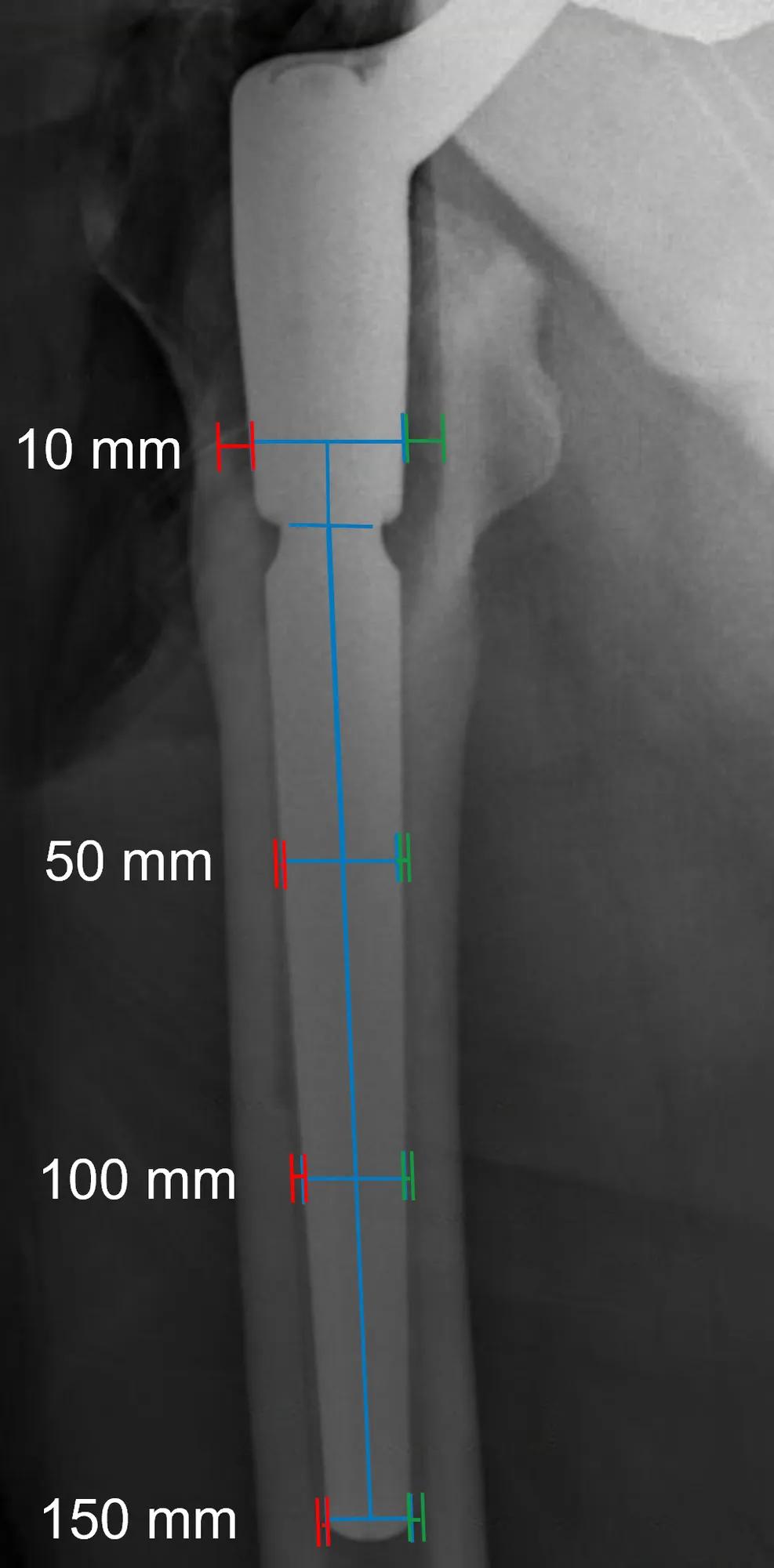
Image content: This image is available to view online.
View image online (https://assets.clevelandclinic.org/transform/2fe24810-6398-4ed4-8260-59e90e80c098/25-ORI-7404460-CQD-Measurements)
X-ray of modular fluted tapered stem with measurement markings
“Measuring fill at one point could be misleading,” Dr. Deren says. “We wanted to assess fixation down the full length of the stem. That rigor is what made this such a strong study.”
Overall mean femoral stem canal fill was 0.784, or about 80%.
At five years, the reoperation rate was 17% (n = 52) and the re-revision rate was 10% (n = 32).
The most common reasons for reoperation were infection (n = 17, 33%), fracture (n = 17, 33%) and instability (n = 11, 21%). The most common reasons for re-revision were also infection (n = 14, 44%), instability (n = 9, 28%) and fracture (n = 5, 16%). Subsidence was not a major driver of either outcome.
“The orthopaedic community has long viewed subsidence as one of the main causes of failure of these stems,” Dr. Deren says. “What we found was that when failure occurred, it was usually due to other complications.”
On multivariable analysis, BMI was associated with both reoperation and re-revision risk.
Patients with subsidence greater than 5 mm were more likely to have longer constructs and slightly less canal fill at 5 cm and 10 cm. However, the strongest association with clinically relevant subsidence was again BMI. The odds of subsidence greater than 5 mm increased 5.5% per 1 kg/m2 increase in BMI.
Advertisement
“Even though many surgeons focus on canal fill as a marker of fixation quality and stability, it was not directly associated with reoperation or revision or stem subsidence in our study,” Dr. Deren says. “Having canal fill of approximately 80% seems to be sufficient for a stable construct.”
This investigation supports the use of MFT stems as a reliable option in aseptic rTHA and challenges the idea that subsidence is primarily a canal fill problem.
According to Dr. Deren, orthopaedic surgeons should know that:
That may affect preoperative counseling, postoperative surveillance and weight-bearing protocols.
“Based on our data, surgeons may want to consider more protective postoperative management in patients with a BMI over 30,” Dr. Deren says. “Limiting weight-bearing early may allow more time for bony ingrowth and improve implant stability.”
Advertisement
Advertisement

Study highlights the need for objective functional measures as value-based care expands

Reduces likelihood of achieving CMS-defined substantial clinical benefit at one year

How it’s similar but different from the direct anterior approach
Should surgeons forgo posterior and lateral approaches?

Multidisciplinary care can make arthroplasty a safe option even for patients with low ejection fraction

High-risk procedure prepares patient for lifesaving heart surgery
Cleveland Clinic is among the first in the U.S. to perform the procedure

Insights to help orthopaedic practices comply with the 2025 CMS mandate
 Search