Locations:





 Search
Nurses welcome machines as newest member of care team
Image content: This image is available to view online.
View image online (https://assets.clevelandclinic.org/transform/c851bea1-b673-4cbf-9719-d7709672ce1b/20-NUR-1882443-Nelita-AI2_650x450_jpg)
20-NUR-1882443-Nelita-AI2_650x450
Today, clinical information is vast, complex, constantly changing and requires a refined skillset for practical application during patient care.
Advertisement
Cleveland Clinic is a non-profit academic medical center. Advertising on our site helps support our mission. We do not endorse non-Cleveland Clinic products or services. Policy
Now more than ever, high-quality nursing care depends on instantaneous processing and decisive action when interacting with abundant volumes of data. In fact, the continual demand for real-time analysis, consumption and action against volumes of clinical information has become a new standard in nursing care.
With this new standard, artificial intelligence (AI) offers a promising road ahead for the practice of nursing. AI has applications in virtually all specialties and nursing work settings so learning how to productively engage with this technology presents huge opportunity.
AI is a broad category of emerging technologies that aim to investigate, synthesize, learn, take action and deduce intelligence from various clinical systems and information sources. The technology helps support, and in some cases, even supplement human tasks.
The goal of AI is to learn and adapt by providing responses and predictions over time that are faster and as relevant (or more relevant) than human computing power.
A few examples of developing technologies that leverage AI, include:
AI uses complex logic and programming to learn about a topic rapidly and provide support, answers and action. The result is just-in-time informational synthesizing, suggested actions and even task completion.
Throughout the last two decades, nurses have learned to adapt their workload and practice to the influx of data that has resulted from the introduction of clinical information systems, electronic medical records and integrated medical equipment and support systems.
Advertisement
Whether these systems require manual data entry or have integrated components, the goal has always been the same – to collect clinical information. However, an evolutional shift is occurring. The technology focus is moving beyond implementing new systems to capture clinical data to establishing a whole new type of relationship between clinicians and machines.
Computer processing now has the ability to interrogate these clinical data collection systems and surface answers to questions that are waiting to be asked – or, in some cases, that haven’t even been considered. These systems can predict future patient outcomes based on the identification of different trends in patient data.
Herein lies the opportunity for nursing: the ability to augment existing clinical intelligence by quickly processing through multiple sources of information to make recommendations, forecast results and assist with decisions.
Nurses welcome these new technological solutions as collaborators and the newest non-human contributing member to the patient care team.
Nurses impact every facet of patient care – from the cost of care to the overall patient experience. Within this spectrum of responsibility lies the prospect for a number of different technologies to use the computing power of AI to assist with nursing care.
The following chart depicts a selection of AI technologies and the associated opportunities they present within the nursing profession.
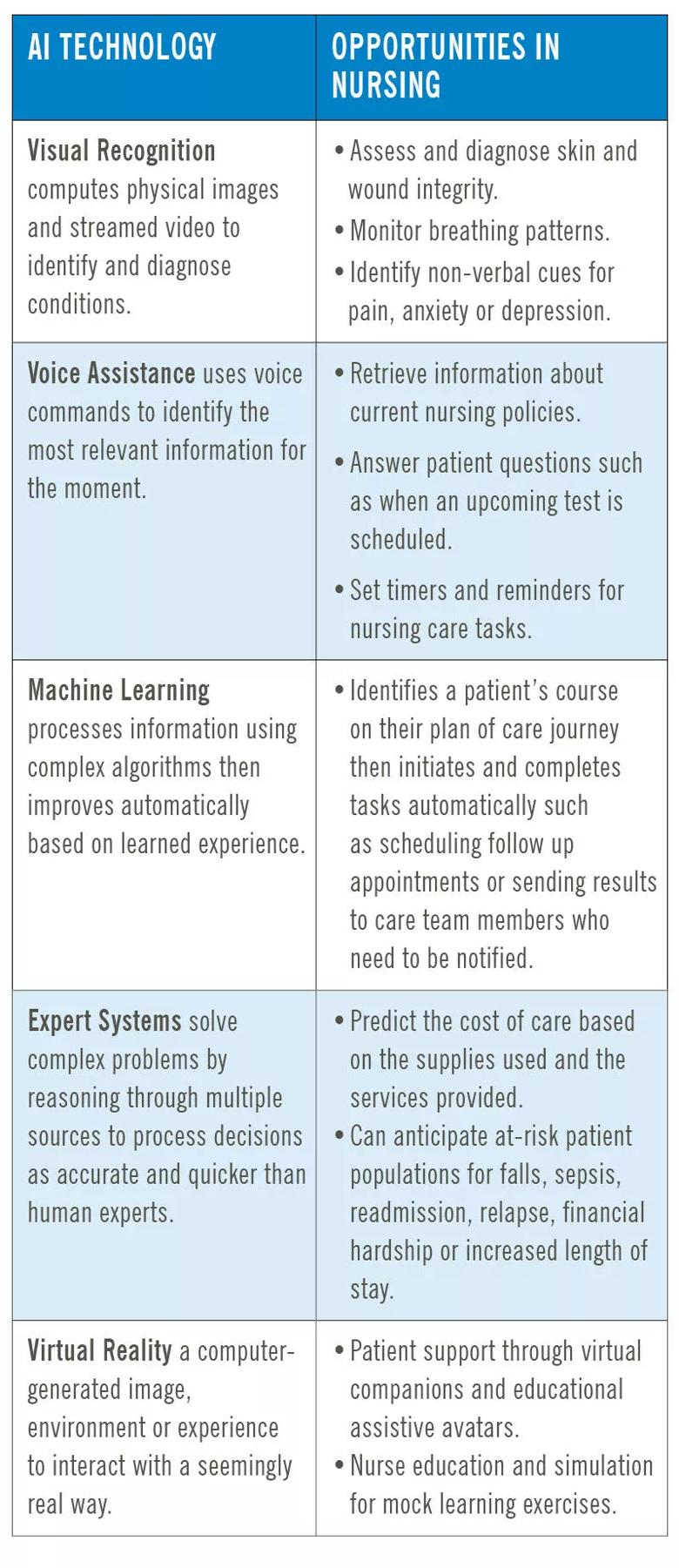
Image content: This image is available to view online.
View image online (https://assets.clevelandclinic.org/transform/5217791a-07a2-4b89-bcf5-5880eca545cb/20-NUR-1882443-Nelita-AI-table_800x1830-1-e1588083807647_jpg)
Nurses have always been uniquely positioned to influence how technology is synthesized at the point of care. A new set of skills and practical knowledge is needed to interact with machines as an additional contributor to the care team.
Advertisement
AI technology is emerging as a partner with nursing to rapidly synthesize information, complete work, assist with clinical decisions and improve patient outcomes. Individually, each of these emerging technologies offers tremendous opportunity to improve care. Combining these solutions and educating nurses on how to best interact with machines will open unlimited solutions for efficiency, capacity, quality and healthcare transformation in the future.
Advertisement
Advertisement

Nurses use flexibility, strong clinical judgment and teamwork to manage increasingly complex patients
Creativity and perseverance help scrub tech transform a simple surgical cup into a patented medical device

Nurse-led program helps patients navigate childbirth, pregnancy loss and the postpartum period

Strategies for strengthening clinical teams by helping unlicensed caregivers build meaningful careers
Dialysis nurses help patients through complex, life-altering conditions

Helping patients understand their options while navigating uncertainty

A bedside encounter with an at-risk patient inspires nurse to reimagine handheld urinals

Bimonthly breakfasts and council meetings foster open dialogue, shared decision-making and meaningful action