Locations:





Three-day program focuses on leadership, safety, operations and change management
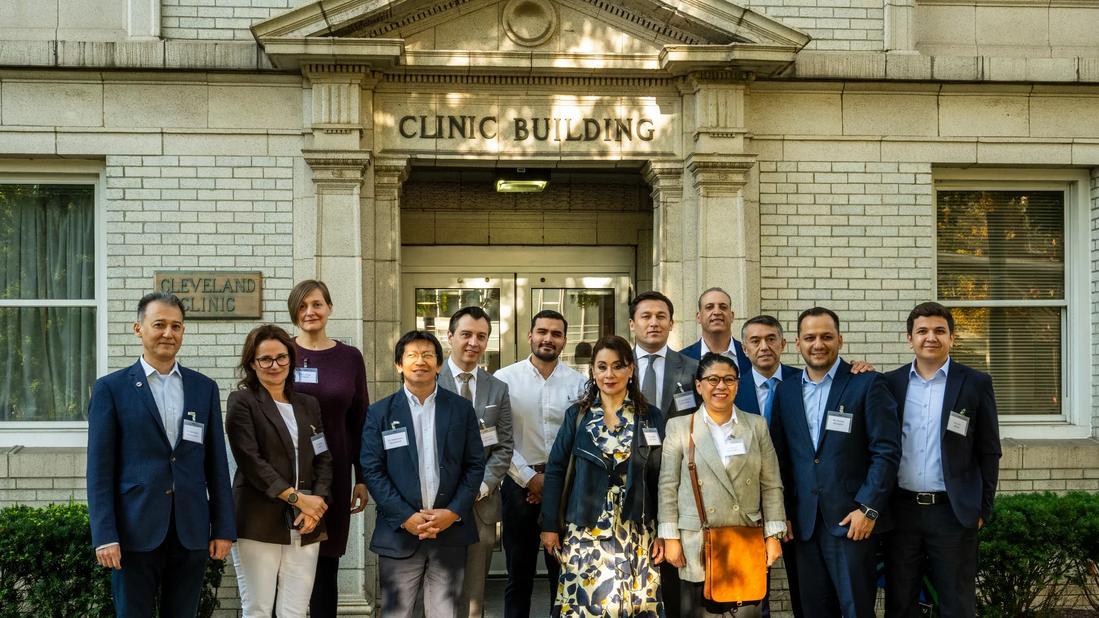
Image content: This image is available to view online.
View image online (https://assets.clevelandclinic.org/transform/5f372806-c20b-4ddb-91d4-8b816fb79de3/Global-Physician-Leadership-Immersion-Hero)
A group of people standing in front of a historic Cleveland Clinic building
For physician leaders around the world, clinical expertise alone is no longer enough. Today’s healthcare environment demands leaders who can communicate effectively, build high-performing teams, manage change, improve patient safety and evaluate emerging technologies responsibly.
Advertisement
Cleveland Clinic is a non-profit academic medical center. Advertising on our site helps support our mission. We do not endorse non-Cleveland Clinic products or services. Policy
Cleveland Clinic’s Global Physician Leadership Immersion Program was created to help international physician leaders, including members of Cleveland Clinic Connected, strengthen those capabilities through a three-day, in-person experience at Cleveland Clinic’s Main Campus.
“Many healthcare leaders from outside the U.S. seek out Cleveland Clinic not only for our clinical expertise, but also for our culture and approach to leadership,” says Keira Williams, manager of the Global Physician Leadership Immersion Program. “Physicians today are expected to improve patient experience, advance quality and safety, steward limited resources, and lead organizational change alongside their clinical responsibilities. We designed this program to show participants how Cleveland Clinic approaches those challenges and to equip them with practical strategies they can adapt in their own organizations.”
Now in its second year, the program is more than a series of lectures. It is immersive executive education led by Cleveland Clinic physician leaders and subject matter experts.
The 2026 program, scheduled for Oct. 20-22, opens with a full day focused on Cleveland Clinic’s team-based leadership model. Interactive modules cover:
“Because optimizing team function, creating a high-performance culture and communicating are core competencies for physician leaders in the current world, a focus on these skills through experiential learning forms a core of the program,” says James K. Stoller, MD, MS, Chief of Education at Cleveland Clinic, who leads the first module.
Advertisement

Image content: This image is available to view online.
View image online (https://assets.clevelandclinic.org/transform/8c935477-7f27-4801-9073-7f88d087b02a/Global-Physician-Leadership-Immersion-Inset-1)
During the 2025 program, Dr. Stoller led a session on team-based culture in healthcare and optimal organizational structures.

Image content: This image is available to view online.
View image online (https://assets.clevelandclinic.org/transform/59eabce4-5b28-429f-a446-929d5c4397ea/Global-Physician-Leadership-Immersion-Inset-2)
Participants from Hospital Angeles in Ciudad Juárez, Mexico, performed a team-building activity on day 1 of the 2025 program.
Days 2 and 3 address topics such as:
Based on participant feedback from the 2025 program, the session on high reliability and cultivating a culture of safety was among the most valuable.
“High reliability is the foundation of safe performance in complex, high-risk industries, including healthcare,” says Margee Pagnucco, MSN, RN, Senior Director of Safety, Quality and Patient Experience at Cleveland Clinic, who co-leads the session. “By creating standardized, resilient systems and a strong culture of safety, organizations can reduce errors, prevent harm and improve patient outcomes. This program provides leaders with practical tools and real-world strategies to strengthen safety culture; accelerate continuous improvement; and sustain focus on safety, quality and patient experience. Last year’s participants consistently cited the actionable insights and peer learning as key drivers for advancing meaningful organizational change.”
This year, a session on AI will examine how Cleveland Clinic evaluated and implemented ambient AI technology to support clinical documentation in the electronic health record.
“There’s no shortage of AI tools today, and many healthcare organizations aren’t sure where to start,” Williams says. “We will walk participants through how Cleveland Clinic assessed, tested and implemented AI with one key question in mind: Does it improve patient care and make life better for caregivers?”
Advertisement
This year’s program also will include new sessions on action planning and organizational problem-solving.
“We are asking participants to submit a leadership or operational challenge in advance, and we will use those real-world issues during the day 3 planning activity,” Williams says. “By the end of the program, participants will leave not only with new ideas, but with a clear plan for how to apply them in their own hospitals and health systems.”
Many physician leadership programs emphasize theory or a single area of focus, such as finance or communication. Building on a decade of prior success with Cleveland Clinic’s Samson Global Leadership Academy, the Global Physician Leadership Immersion Program takes a broader approach, examining how leadership, culture and operations intersect across a health system.
Among the program’s distinguishing features are:
Advertisement
“About one-third of Cleveland Clinic physicians were born or trained outside the U.S.,” Williams says. “That often creates meaningful networking opportunities for participants. When possible, we connect them with Cleveland Clinic physicians who share similar regional backgrounds or clinical interests.”
The Tuesday-through-Thursday schedule is intended to reduce time away from participants’ home institutions while allowing flexibility for additional meetings on Monday or Friday. Last year, for example, two urologists from Uzbekistan met with a Cleveland Clinic urologic surgeon to discuss minimally invasive techniques and observe surgical robotics used in the U.S.
While the program is designed for physician leaders, healthcare executives and administrators are also welcome. Sessions can be especially valuable for leaders working to expand hospitals, integrate acquired facilities or strengthen service lines. English proficiency is recommended.
For more information or to register, email Keira Williams at williak102@ccf.org.
Advertisement
Advertisement
Findings show significant energy savings and no association with increased surgical site infection, mortality or ICU admission

Connecting interactions adds clarity to the full patient story

Building a cohesive data structure delivers trusted insights, inspires innovation
Structured interventions enhance sleep, safety and caregiver resiliency in high-acuity units

Automating routine medical coding tasks removes unnecessary barriers

Digital “tripwires” detect and respond to malicious activity, boosting cybersecurity maturity

Thoughtful collaboration, data-driven decisions and effective change management lead to significant savings

Input from these central stakeholders is leading us to design for healing and hope
 Search