Locations:





National Blood Clot Alliance collaborates with faith-based organizations on first-of-its-kind church bus tour
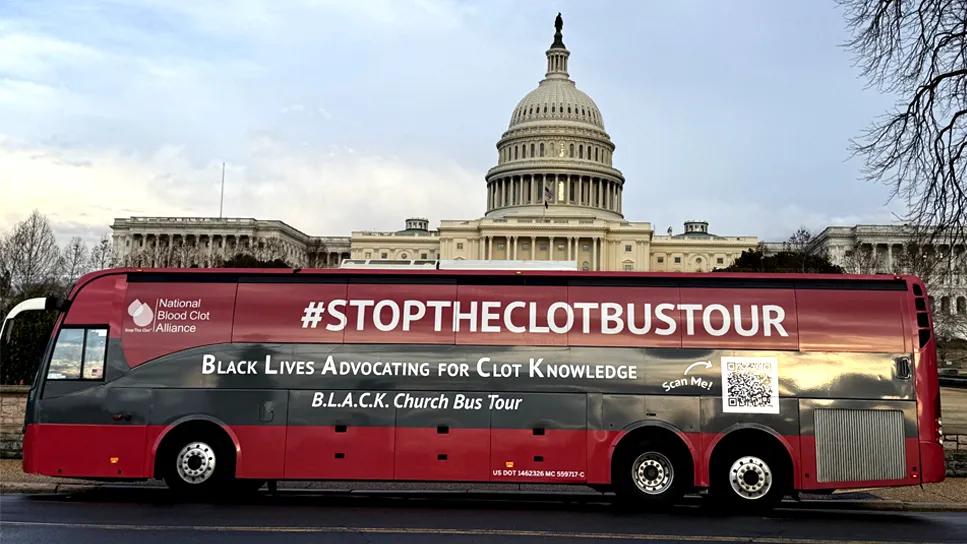
Image content: This image is available to view online.
View image online (https://assets.clevelandclinic.org/transform/b7125370-c1a0-47eb-914f-ac40006128db/black-blood-clot-awareness-church-tour)
church bus tour
Black Americans have a significantly higher incidence, severity and mortality from venous thromboembolism (VTE) compared to other racial and ethnic groups. Despite this elevated risk, awareness and education about VTE remain limited in many Black communities.
Advertisement
Cleveland Clinic is a non-profit academic medical center. Advertising on our site helps support our mission. We do not endorse non-Cleveland Clinic products or services. Policy
To address this knowledge gap, the National Blood Clot Alliance launched the Black Lives Advocating for Clot Knowledge (B.L.A.C.K) Church Bus Tour, which partnered with faith-based institutions in southeastern Black communities. This program aimed to empower individuals to recognize VTE risk factors and symptoms, know when to seek prompt care and learn about preventive actions.
Featuring a bright-red bus with signage describing VTE symptoms, the campaign educated individuals to take steps to reduce the risk of VTE and to recognize the condition when it occurs. The bus tour included four churches in Charlotte, NC, Marietta, GA and Memphis, TN. The tour incorporated educational sessions and the distribution of educational materials.
Researchers collected pre- and post-event surveys to assess changes in knowledge resulting from the program. The findings were presented at the 2025 ASH annual meeting.
“The NBCA bus tour campaign underscores the value of culturally tailored educational interventions in addressing gaps in VTE awareness,” says Dana Angelini, MD, a physician in the Classical Hematology team at Cleveland Clinic Cancer Institute.
More than 450 people participated in the events across the southeastern U.S. The majority of participants were between 61-70 years old, and 73.1% were female. Most participants identified as Black, non-Hispanic.
Roughly 89% participants said they had not personally experienced a blood clot and they did not have a friend or family member who had experienced one.
Advertisement
Wilcoxon signed-rank test was used to compare section and total survey scores before and after the program. Analysis of the pre- and post-surveys found a statistically significant increase in awareness across 16 knowledge domains. In addition to gaining knowledge about symptoms and treatments, the overwhelming majority of participants also strongly agreed to make lifestyle changes to reduce their risk of contracting VTE.
Additionally, most participants reported their intention to share this knowledge in the community. “This finding demonstrates the power that community education has to spread awareness to those who are in front of us and beyond,” says Dr. Angelini.
Based on the success of the program, the National Blood Clot Alliance is working on a “2.0” version of the bus tour, and hopes to make this an annual endeavor. The plan is to continue to raise awareness in the hopes of fostering earlier intervention and risk mitigation and ultimately reduce VTE-associated mortality rates. “This initiative highlights the importance of meeting people where they are, in environments where they feel comfortable, and providing them with trusted health education.,” says Dr. Angelini.
Advertisement
Advertisement

Adding 177Lu-PSMA-617 to ADT plus an ARPI cut the risk of radiographic progression or mortality by 28%

New program will help patients improve fitness and manage weight after cancer treatment

Cleveland Clinic hematologist highlights new guidelines and treatment advances in immune thrombocytopenia
NIMBLE replaces weekly tumor board delays with same-day multidisciplinary recommendations

Cleveland Clinic study provides validation for the test, which combines AI and pathological data to predict outcomes in postoperative patients

Advanced imaging technology catches metastases much earlier, allowing treatment with fewer side effects

Reduced radiation for lymph node areas reduces side effects
Large Cleveland Clinic analysis may help resolve a longstanding question over optimal fractionation
 Search