Locations:





Radiation therapy helped shrink hand nodules and improve functionality
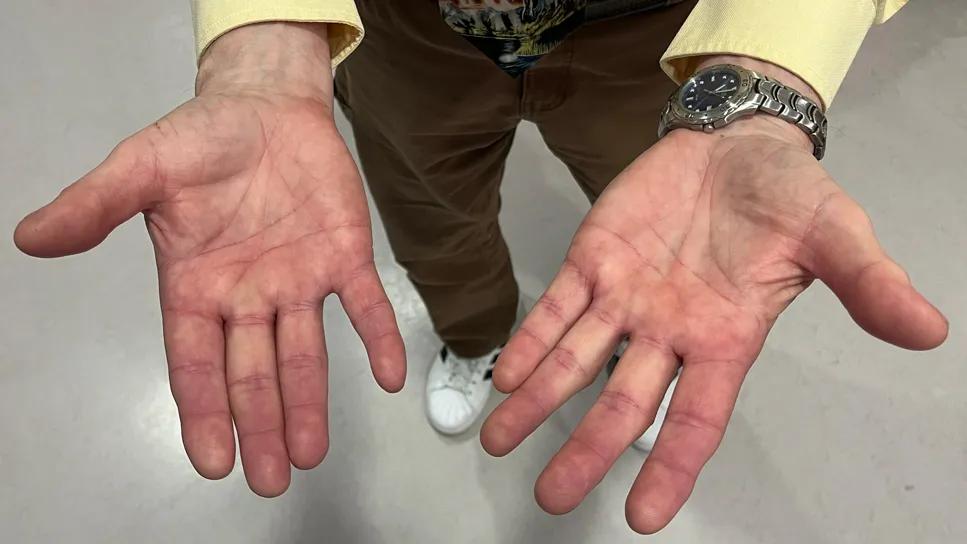
Image content: This image is available to view online.
View image online (https://assets.clevelandclinic.org/transform/90e8c39a-aee3-474e-8a2b-c5de22a90dcb/hands-after-low-dose-radiation-therapy)
Hands after RT
A man in his 70s is among a group of patients who were successfully treated with radiation therapy for the benign condition Dupuytren’s disease. The brief course of treatment reduced the size of nodules on his hands and helped him continue daily activities.
Advertisement
Cleveland Clinic is a non-profit academic medical center. Advertising on our site helps support our mission. We do not endorse non-Cleveland Clinic products or services. Policy
The patient, an avid guitar player in a rock band, noticed a nodule developing on the palm of his left hand, and found a similar growth on his right hand several weeks later. At first he thought it might be due to new handgrips he was using on his motorcycle, but when he began experiencing discomfort, he sought medical advice. He reported what felt like momentary electric shocks coming from the affected area.
As an active person, he was concerned that the issue could affect his ability to perform. He saw an orthopedic surgeon, who diagnosed him with Dupuytren's disease, a disorder that causes the tissue under the skin on extremities to thicken and tighten. If left untreated, Dupuytren’s disease can lead to permanent contracture of the hands and fingers.
The orthopedic surgeon offered three treatment options:
The patient was keen to find another way to address the issue, and when he heard about the possibility of radiation therapy to treat it, he sought a consultation with Rahul Tendulkar, MD, who treats a number of benign and cancerous conditions as part of Cleveland Clinic’s Radiation Oncology team.
“The patient was the ideal candidate for radiation therapy,” explains Dr. Tendulkar. “This treatment is best at the early stage of Dupuytren’s disease when someone has a nodule but their fingers aren't contracted or there is contracture that’s no more than 10 degrees.”
Advertisement
Dupuytren's disease is caused by fibroblasts (connective tissue cells) that go awry and grow abnormally. Fibroblast cells tend to be sensitive to the effects of radiation. Using a moderately low dose of radiation therapy may help to keep these cells from proliferating.
In this case, radiation was a preventative strategy to keep the nodules from progressing so that the patient didn’t lose function in his hands. Treatment for the patient involved electron beam therapy directed at the affected area and a small margin around it. The patient received five treatments over the course of a week, and then another five treatments roughly two months later, directed on each hand.
Like most patients receiving this type of radiation, he tolerated treatment fine with no noticeable side effects.
“In roughly two-thirds of cases, patients experience a positive benefit from radiation in terms of functional improvement, reduction in pain or prevention of progression to a more advanced stage,” says Dr. Tendulkar. “We don't typically expect the nodules to disappear completely, but they may soften or shrink.”
In this case, the patient noticed the nodules had shrunk to roughly half their original size within several weeks after completing treatment. His discomfort and flexibility have improved considerably.
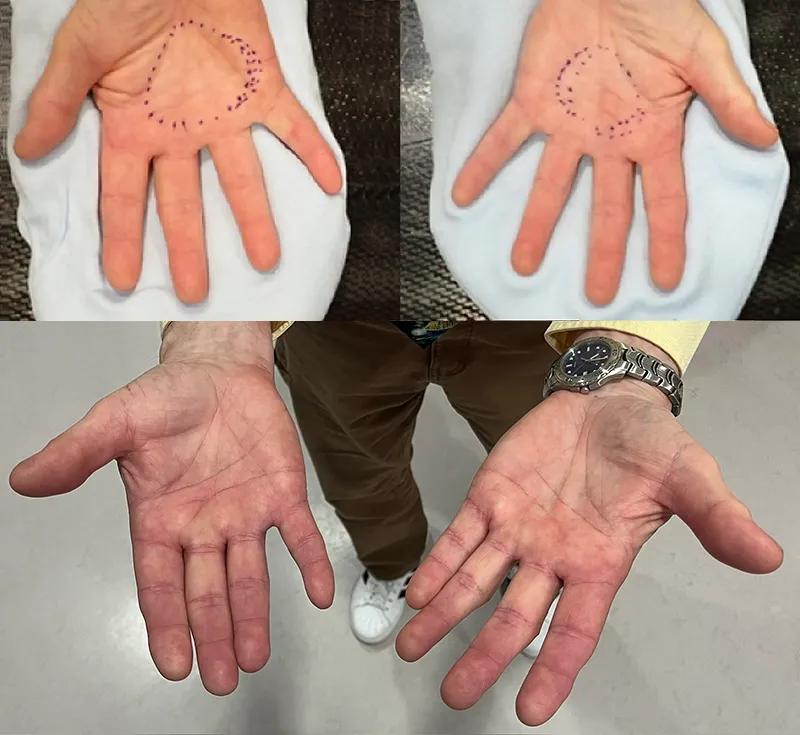
Image content: This image is available to view online.
View image online (https://assets.clevelandclinic.org/transform/bb93a043-f57c-4c19-b428-4340ad315055/hands-before-and-after-low-dose-radiation)
Now one year after radiation therapy, the patient continues to be able to perform daily activities, and hasn’t needed any additional intervention. “It’s very gratifying to see him be able to continue to enjoy guitar and other activities he’s passionate about,” says Dr. Tendulkar.
Advertisement
Based on this case and similar experiences, Dr. Tendulkar shared key points:
It's very helpful to have a multidisciplinary evaluation and assessment of the condition, which is typically diagnosed by a primary care provider or hand surgeon.
“There's not a lot of public knowledge about Dupuytren's disease. It does require a bit of advocacy on the part of physicians and patients who have this condition to raise awareness that these nodules can develop into permanent disabling contractures if left untreated, and that radiation is one potential option to delay or prevent the progression into a contracture,” says Dr. Tendulkar.
The dosage for a benign condition like this is roughly half the amount that someone would receive for treating cancer. “In general, there are some risks associated with radiation therapy, including the possibility of secondary cancer, but I’m not aware of any cancers of the hand that have been reported as a direct result of this type of radiation therapy,” Dr. Tendulkar says.
If you’ve been diagnosed with Dupuytren’s nodules at the early stage, you may want to talk with a radiation oncologist to see if they have experience treating this condition, which can be quite bothersome and may affect quality of life.
Advertisement
Advertisement

Noninvasive treatment may slow progression of Dupuytren's disease and plantar fibromatrosis
Latest concepts in the surgical creation of functional, opposable thumbs in early childhood
Adding 177Lu-PSMA-617 to ADT plus an ARPI cut the risk of radiographic progression or mortality by 28%

New program will help patients improve fitness and manage weight after cancer treatment

Cleveland Clinic hematologist highlights new guidelines and treatment advances in immune thrombocytopenia
NIMBLE replaces weekly tumor board delays with same-day multidisciplinary recommendations

Cleveland Clinic study provides validation for the test, which combines AI and pathological data to predict outcomes in postoperative patients
Advanced imaging technology catches metastases much earlier, allowing treatment with fewer side effects
 Search