Locations:





Creating a safe space for patients

Image content: This image is available to view online.
View image online (https://assets.clevelandclinic.org/transform/6e06125d-ad5e-4c94-a2fb-a0bd5dadf578/male-patient-male-doctor-office-visit-2205706029)
Male patient with doctor
Nearly half of men treated for cancer – as well as up to 90% of those treated for prostate cancer – experience erectile challenges or other sexual dysfunction, but the issue is often not raised in the doctor’s office. Cleveland Clinic psychotherapist Theresa Callard-Moore, PhD, LISW is working with the Cancer Center and Urology teams to create a culture of acceptance in discussing these sensitive topics.
Advertisement
Cleveland Clinic is a non-profit academic medical center. Advertising on our site helps support our mission. We do not endorse non-Cleveland Clinic products or services. Policy
Radiation or surgery for testicular cancer may lower levels of testosterone, which can affect everything from sexual function to muscle mass. Additionally, patients receiving any type of chemotherapy or radiation are likely to feel fatigued or nausea, and a diminished quality of life. “When we’re in pain or discomfort, sexual health takes a back burner. It’s important to bring this up, because it’s often not talked about, to the detriment of patients,” says Dr. Callard-Moore.
Patients often suffer in silence, or worse, may not go forward with their cancer therapy out of fear of losing the ability to have sexual pleasure. The reality is that these issues are often very treatable though. From nerve sparing surgical techniques to erectile dysfunction medications, there are many options to alleviate these symptoms.
“For many patients, it’s really difficult to be vulnerable and ask for help,” says Dr. Callard-Moore. “We’re taught not to talk about these things, and that’s one of the biggest hurdles. Most of us did not receive good sex education growing up, so we didn’t learn about pleasure and our bodies. We’re coming from this taboo topic and often there’s shame and privacy issues on top of that. There’s all these layers that people have to get through to even bring it up.”
Providers may be equally reticent to mention the issue due to time pressures, or if they don’t have all the answers. They don’t need to know everything about sexual health themselves, however. They can raise the topic and refer patients who have questions or concerns to a psychotherapist or sex therapist on staff.
Advertisement
At Cleveland Clinic, providers from urologists and oncologists to sex therapists and pelvic floor physical therapists work together as a team to support patients with issues ranging from erectile dysfunction to urinary incontinence.
“If the doctor doesn't bring up sexual health and the patient is too afraid or embarrassed to do so, then we missed an opportunity to help,” says Dr. Callard-Moore. She encourages providers to follow the PLISSIT model to start the conversation.
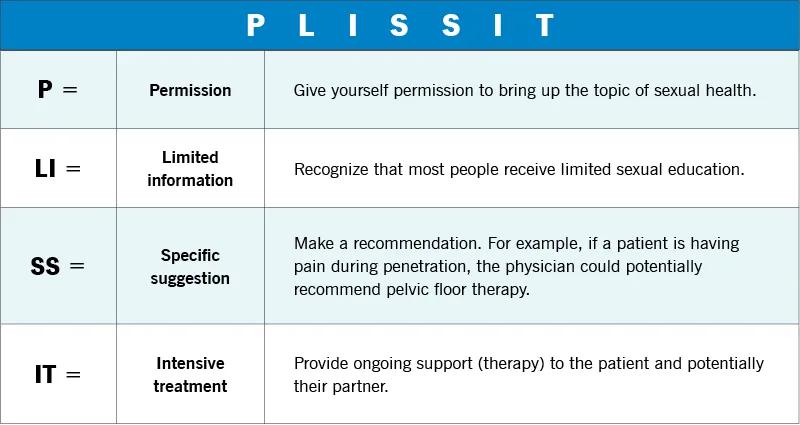
Image content: This image is available to view online.
View image online (https://assets.clevelandclinic.org/transform/5d8b5ccb-3a56-4b13-b705-d3168f2f5594/sexual-health-issues-and-cancer-chart)
PLISSIT communication tool chart
“The permission piece is key,” she says. “Asking open-ended questions like do you have any sexual health concerns can help the patient know this is a safe space to bring it up.” If the patient does have an issue, the doctor can refer them to a sex therapist. The therapist can take it from there and talk directly with the patient, and their partners if they wish, to understand what’s going on and make specific treatment recommendations.”
Providers often aren’t unclear when the right time is to discuss sexual health. Dr. Callard-Moore recommends bringing it up at multiple points in the patient’s cancer journey.
“If the doctor mentions it at the time of diagnosis, this may not necessarily click since the patient is facing something very scary, but it plants a seed so they know it’s ok to bring it up,” she says. “Patients need to be informed so that when they get to survivorship, they have a way to cope with those changes because they knew they were coming.
During treatment, they may not be feeling great, so the chances of sex being top of mind are low, but the patient still gets the message that they can talk about any sexual concerns. It’s usually in survivorship that patients and partners want to understand how to have a pleasurable sex life going forward.”
Advertisement
Today, there are many approaches to helping patients to preserve sexual function.
Educating patients about treatment options and time-to-improvement is advantageous. “We want people to know all their options so that they don’t get frustrated if one thing doesn’t work,” says Dr. Callard-Moore. She notes that:
Advertisement
Sexual dysfunction may involve a combination of medical, emotional and relational issues. “It’s usually a combination of factors influencing the situation,” says Dr. Callard-Moore. “Is the patient worried about disappointing their partner? Are they feeling anxious? This can cause sexual dysfunction because their body is in fight or flight mode. Our goal is to understand the underlying causes and support them in achieving intimacy, connection and pleasure.”
Advertisement
Advertisement

Adding 177Lu-PSMA-617 to ADT plus an ARPI cut the risk of radiographic progression or mortality by 28%

New program will help patients improve fitness and manage weight after cancer treatment

Cleveland Clinic hematologist highlights new guidelines and treatment advances in immune thrombocytopenia
NIMBLE replaces weekly tumor board delays with same-day multidisciplinary recommendations

Cleveland Clinic study provides validation for the test, which combines AI and pathological data to predict outcomes in postoperative patients

Advanced imaging technology catches metastases much earlier, allowing treatment with fewer side effects

Reduced radiation for lymph node areas reduces side effects

Large Cleveland Clinic analysis may help resolve a longstanding question over optimal fractionation
 Search