Locations:





Combination therapy may soon represent new standard of care
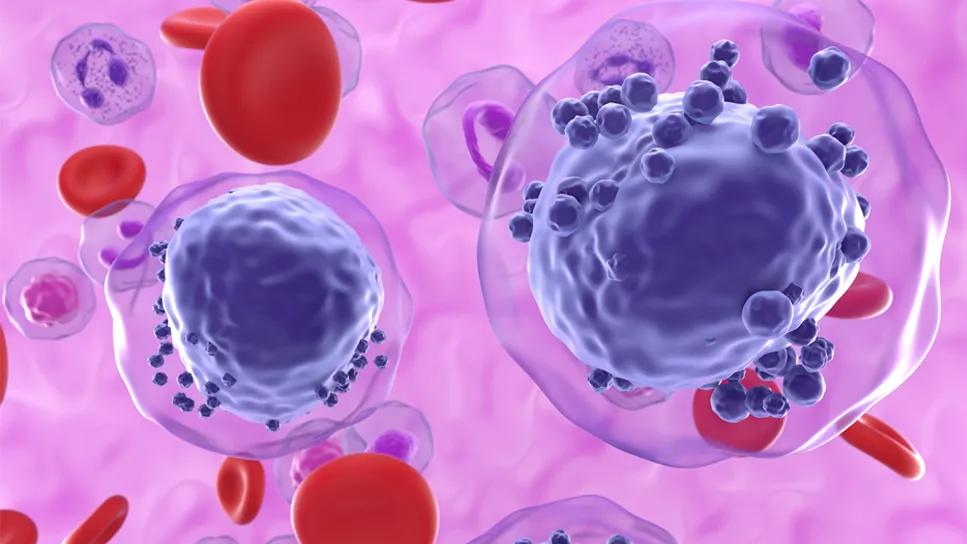
Image content: This image is available to view online.
View image online (https://assets.clevelandclinic.org/transform/1f307afa-ee64-4240-85d3-b9b88657b0f9/illustration-aml-cells-in-blood-flow-2250479883)
AML cells in blood flow
A study of the oral menin inhibitor ziftomenib and intensive induction (7+3) cytarabine and daunorubicin found roughly 80% of patients with newly diagnosed acute myeloid leukemia (AML) achieved remission and MRD negativity. The outcomes were presented at the European Hematology Association Congress.
Advertisement
Cleveland Clinic is a non-profit academic medical center. Advertising on our site helps support our mission. We do not endorse non-Cleveland Clinic products or services. Policy
Intensive chemotherapy with 7+3 represents one standard treatment option for patients with newly diagnosed AML. However, relapse remains a problem. Ziftomenib is FDA-approved for patients with relapsed/ refractory AML with an NPM1 mutation where there is no other satisfactory alternative. This novel therapy essentially prevents menin proteins from attaching to mutant proteins. This action spurs cancer cells to turn off the abnormal protein signaling, allowing the cancer cells to mature and die.
The KOMET-007 study endeavored to determine if adding ziftomenib to intensive induction (7+3) treatment would benefit newly diagnosed patients with NPM1-m or KMT2A-r acute myeloid leukemia. The NPM1-m and KMT2A-r mutations are responsible for roughly 30-40% of AML cases.
In this phase 1 a/b study, adult patients received 600mg of ziftomenib QD on day 8 of induction with 7+3 and continued daily throughout cytarabine consolidation as well as during the maintenance period after consolidation. Primary end points were adverse events and complete remission. Secondary endpoints were composite complete remission (CRc), overall response rate, duration of response and overall survival.
Median follow up was 14.9 months for NPM1-m and 9.3 months for KMT2A-r. As of January 2026, 99 patients were treated. The median age was 53 years.
"Follow-up showed that this combination resulted in notably deep responses in patients with NPM1 and KMT2A rearrangements," says study co-author Adjali Advani, MD, a hematologist/oncologist with Cleveland Clinic Cancer Institute.
Advertisement
CRc rates were 95% in patients with NPM1-m and 90% in patients with KMT2A-r, with local measurably residual disease negativity rates of 83% and 82%, respectively. At data cutoff, the median duration of CRc was 11.2 months in the KMT2A-r group and was not reached in the NPM1-m group.
The overall survival rates were 94% for NPM1-m and 70% for KMT2A-r at one year. The median overall survival was not reached.
The most common grade 3 or lower side effects were:
Fifty-three patients experienced grade 3 or higher side effects such as:
Three patients had grade 3 differentiation syndrome, which resolved through the standard treatment protocol and four patients had QTc prolongation that successfully resolved on its own.
Advertisement
Advertisement

Adding 177Lu-PSMA-617 to ADT plus an ARPI cut the risk of radiographic progression or mortality by 28%

New program will help patients improve fitness and manage weight after cancer treatment

Cleveland Clinic hematologist highlights new guidelines and treatment advances in immune thrombocytopenia
NIMBLE replaces weekly tumor board delays with same-day multidisciplinary recommendations

Cleveland Clinic study provides validation for the test, which combines AI and pathological data to predict outcomes in postoperative patients
Advanced imaging technology catches metastases much earlier, allowing treatment with fewer side effects

Reduced radiation for lymph node areas reduces side effects
Large Cleveland Clinic analysis may help resolve a longstanding question over optimal fractionation
 Search