Locations:





Expert recommendations introduce use of targeted agents
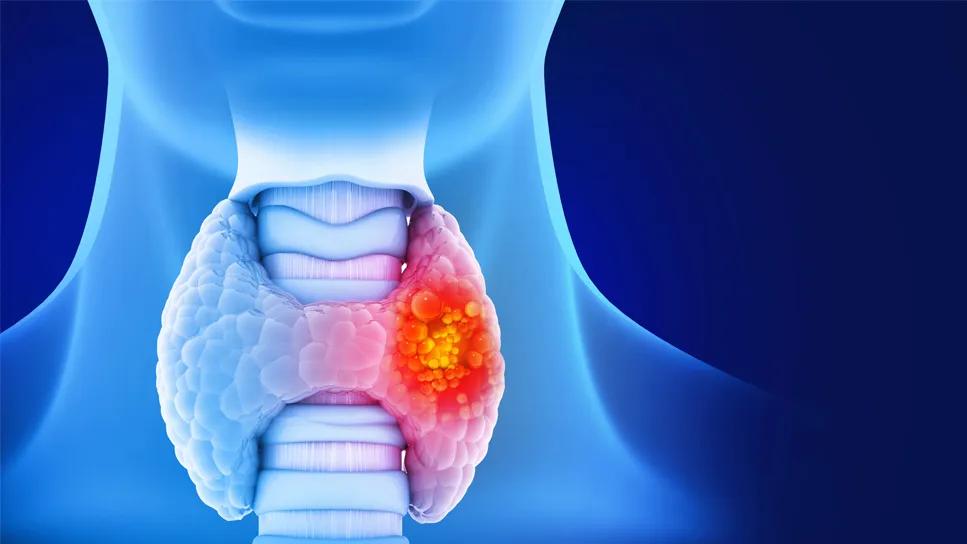
Image content: This image is available to view online.
View image online (https://assets.clevelandclinic.org/transform/266b48f4-63f2-4867-8c34-d1fb0a406a66/illustration-of-thyroid-gland-cancer-2204506785)
Thyroid cancer illustration
The tremendous growth in understanding of the molecular basis of thyroid cancer has brought new opportunities for targeted treatment. Depending on the type of thyroid cancer and mutation involved, patients may have the option of targeted therapy, multikinase inhibitors or immunotherapy in addition to more traditional surgical or radioiodine options. These emerging treatments are reshaping treatment sequencing and disease management.
Advertisement
Cleveland Clinic is a non-profit academic medical center. Advertising on our site helps support our mission. We do not endorse non-Cleveland Clinic products or services. Policy
With myriad options available, it can be confusing for clinicians to know which treatment is most appropriate. In this quickly changing therapeutic landscape, the American Society of Clinical Oncology (ASCO) brought together a multidisciplinary panel to create new recommendations for systemic treatment of the disease. This included recommendations for treating well-differentiated, differentiated high-grade or poorly differentiated, anaplastic and medullary thyroid cancer
“We’re now able to target molecular aberrations and treat thyroid cancer in ways that we never could in the past,” says ASCO panel expert Joseph Scharpf, MD, Director of Head & Neck Endocrine Surgery at Cleveland Clinic. “Traditionally, treatment involved surgery or radioactive iodine but that has shifted. Surgeons, radiation oncologists, medical oncologists and endocrinologists need evidence-based recommendations about the various agents and targets now available and how best to coordinate care.”
Most notably, the panel emphasized that not all immunotherapy is right for each type of thyroid cancer. For example, pembro immunotherapy isn’t intended for patients with medullary thyroid cancer.
The guidelines also highlighted the importance of molecular testing for patients with advanced or aggressive thyroid cancer, ideally in the upfront setting. This testing can help identify potential targeted treatments for many patients, such as those with a RET alteration. Additionally, the panel raised awareness about agents for controlling distant metastases, even for some of the most challenging cases such as anaplastaic thyroid cancer.
Advertisement
Patients with this fast-moving disease often present in the emergency room with trouble breathing or swallowing. “Traditionally, patients with anaplastic thyroid cancer had dismal outcomes, but now agents like dabrafenib and trametinib can target BRAF and MEK mutations in roughly half of these patients,” says Dr. Scharpf. “Together with pembro immunotherapy, many patients are seeing remarkable results. We often treat aggressive disease in my practice, and this approach has been a game changer.”
As noted in the guidelines, treatment selection and sequencing decisions are best made with a multidisciplinary tumor board. Radioiodine still plays an integral role in treating thyroid cancer, but there is a move towards personalizing its use. Some patients with more favorable disease profiles may not need this therapy.
In addition, while surgery is still the standard of care, targeted agents can be used in some instances to lessen the degree of surgical intervention needed. This is particularly beneficial if the surgery involves risk to nerves or the windpipe.
In addition to helping draft the ASCO guidelines, Cleveland Clinic Cancer Institute also participates in research to study potential new thyroid cancer therapies. The Institute collaborated on a recently published study of anaplastic thyroid cancer treatment, and recently entered a trial of the oral tyrosine kinase inhibitor zanzatinib for treating invasive thyroid cancer.
Advertisement
Advertisement

Study reinforces the importance of genetic testing prior to local therapy decisions

Understanding expanding treatment options and potential advances

Adding 177Lu-PSMA-617 to ADT plus an ARPI cut the risk of radiographic progression or mortality by 28%

New program will help patients improve fitness and manage weight after cancer treatment

Cleveland Clinic hematologist highlights new guidelines and treatment advances in immune thrombocytopenia
NIMBLE replaces weekly tumor board delays with same-day multidisciplinary recommendations

Cleveland Clinic study provides validation for the test, which combines AI and pathological data to predict outcomes in postoperative patients
Advanced imaging technology catches metastases much earlier, allowing treatment with fewer side effects
 Search