Locations:





Treatment yields positive results despite late diagnosis and cardiac involvement
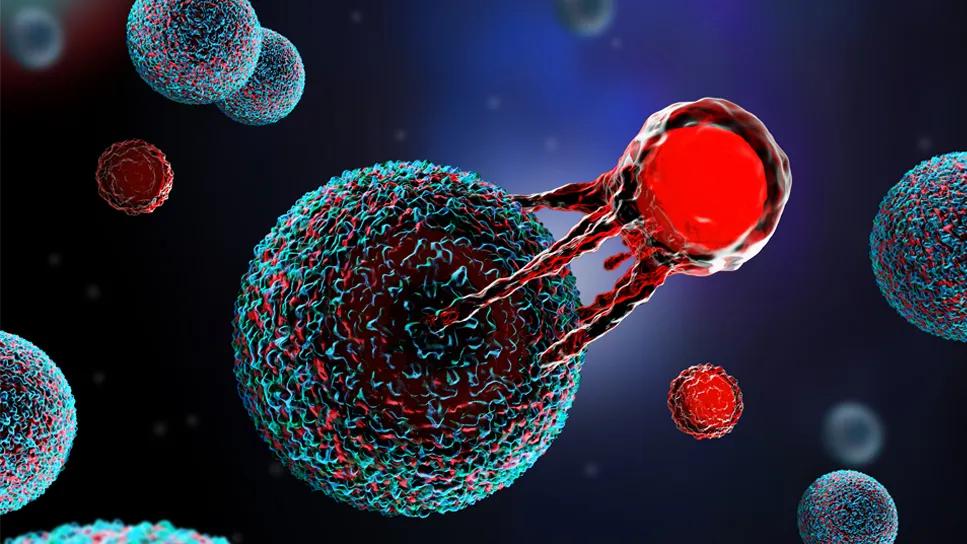
Image content: This image is available to view online.
View image online (https://assets.clevelandclinic.org/transform/e4554861-b703-492e-baeb-c0856fd55601/t-cell-attacking-cancer-cell-1356995981)
T-cell
AL amyloidosis is a complex disease that’s vexing to diagnose. The diagnostic journey can exceed 15 years in some cases.
Advertisement
Cleveland Clinic is a non-profit academic medical center. Advertising on our site helps support our mission. We do not endorse non-Cleveland Clinic products or services. Policy
In this instance, a woman in her 50s had struggled with low blood pressure, neuropathy and issues walking but no doctor had found the underlying cause. Although amyloidosis is less common in people her age, a physician in Indiana recognized the constellation of symptoms as suspicious for the disease. He referred her to Cleveland Clinic Cancer Institute.
Cleveland Clinic has a protocol in place to accelerate the testing needed to confirm the diagnosis. As such, the team was able to swiftly arrange for testing, including mass spectrometry to identify the specific type of amyloidosis as well as a heart biopsy to assess the extent of organ involvement.
“Testing is an art, and at some centers there’s a question about whether to perform a tissue biopsy or a target organ biopsy,” explains hematologist/oncologist Shahzad Raza, MD. “But if the patient is having cardiac issues as in this case, you need to biopsy the heart.”
Within a week, the clinical team confirmed that the patient had smoldering multiple myeloma with systemic light chain (AL) amyloidosis.
The patient’s initial course of treatment was immunotherapy, which drives remission in roughly 60% of cases. However, she was among the subset of patients who had a suboptimal response to this therapy.
Dr. Raza was leading the first-ever human clinical trial of autologous CAR T-cell therapy called Nexicart to treat relapsed/refractory AL amyloidosis and suggested it to his patient. Aside from her heart issues she was relatively healthy, and Dr. Raza felt she would be a good candidate for the trial.
Advertisement
However, at the time she was struggling financially and lacked stable housing. Despite the obstacles, she was motivated and wanted to move forward with joining the research study.
Dr. Raza and his team moved quickly to ensure the patient could be successfully enrolled in the study. As soon as she was enrolled in the study, her T-cells were collected and genetically modified in a lab to target BCMA, which is frequently expressed in cancerous plasma cells. As part of a fast-track manufacturing process to avoid treatment delays, the altered cells were ready for reinfusion within two weeks.
Within one to two weeks, the patient was in complete remission. “It’s been more than a year now and she hasn’t required any other cancer therapy,” says Dr. Raza. “When a patient goes into remission, the production of amyloidosis-causing toxins can damage the heart, liver, kidney or gut. Once you stop the source of the problem, the patient feels better and has a better quality of life.”
Once in remission, the patient’s heart performance began to improve and she regained energy levels. She has undergone several bone marrow biopsies since that time, each showing complete remission.
Early study results are very encouraging. Although ongoing monitoring is needed for this patient and the 19 others in the clinical trial, researchers found the initial results very promising. “I never imagined we would have a treatment that you might be able to give one time and you’re done,” says Dr. Raza. “The deep responses we have seen are quite astonishing.”
Advertisement
Prompt diagnosis is essential. The American Society of Hematology has just published new guidelines for diagnosing amyloidosis. The data from this patient and others helped inform these recommendations.
Collaboration is key. “This is not a disease to be managed by hematologists alone,” says Dr. Raza. “You need a multidisciplinary approach where cardiologists and other specialists care for the patient in parallel.”
Advertisement
Advertisement

Adding 177Lu-PSMA-617 to ADT plus an ARPI cut the risk of radiographic progression or mortality by 28%

New program will help patients improve fitness and manage weight after cancer treatment

Cleveland Clinic hematologist highlights new guidelines and treatment advances in immune thrombocytopenia
NIMBLE replaces weekly tumor board delays with same-day multidisciplinary recommendations

Cleveland Clinic study provides validation for the test, which combines AI and pathological data to predict outcomes in postoperative patients
Advanced imaging technology catches metastases much earlier, allowing treatment with fewer side effects

Reduced radiation for lymph node areas reduces side effects

Large Cleveland Clinic analysis may help resolve a longstanding question over optimal fractionation
 Search