Locations:





This single-port option offers advantages for appropriate patients
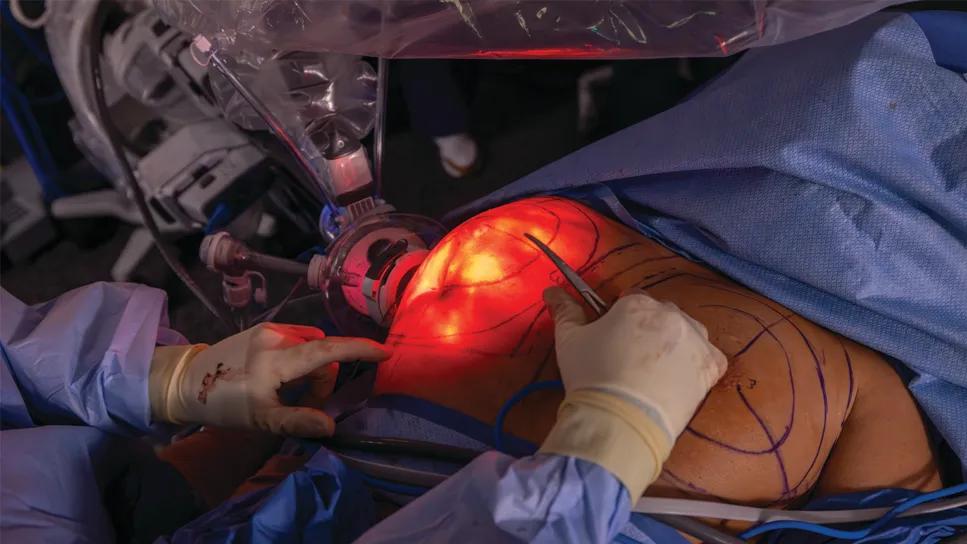
Image content: This image is available to view online.
View image online (https://assets.clevelandclinic.org/transform/95d0ce61-459d-4378-975e-48a55f878cf9/nipple-sparing-mastectomy)
Robotic nipple-sparing mastectomy
Patients who are good candidates for traditional nipple-sparing mastectomy might now also be appropriate candidates for the procedure performed via single-port robot-assisted surgery — an option that could improve certain outcomes:
Advertisement
Cleveland Clinic is a non-profit academic medical center. Advertising on our site helps support our mission. We do not endorse non-Cleveland Clinic products or services. Policy
In June 2026, Stephanie Valente, DO, became the first surgeon in Ohio to perform single-port robot-assisted nipple sparing mastectomy since the U.S. Food and Drug Administration approved the approach in December 2025.
Cleveland Clinic remains among a small number of organizations nationwide that offer it. Dr. Valente performs the procedure for patients with cancer as well as for those with a genetic mutation that puts them at high risk for developing breast cancer.
While robot-assisted surgery has been around for decades, the FDA had issued strong warnings against using it for mastectomy. Eventually, U.S. trial data and international data demonstrated that the single-port (SP) robot platform (DaVinci System, Intuitive Surgical) was comparable to open surgery in terms of oncologic safety, with similarly low complication rates.
Now, Dr. Valente predicts minimally invasive breast surgery will quickly become a preferred option for many candidates who qualify. It allows for a 1-inch laterally placed surgical scar, a magnified 3D visualization of the operative field, potentially better preservation of nipple sensation and potentially improved recovery.
Patients who are candidates for open nipple-sparing surgery are likely to do well with robot-assisted surgery as well. For patients with cancer, that generally means the tumor does not involve the nipple, skin or chest wall. (In selected cases, lymph node surgery can be performed through the same incision.)
Ideal candidates typically have smaller breasts (C-cup or smaller) and are able to have immediate breast reconstruction.
Advertisement
The procedure is done with a port inserted through a 2.5-centimeter lateral incision rather than the large 10-12 cm inframammary-fold incision required for an open procedure.
“You're using small instruments, so you're able to be very precise,” Dr. Valente explains. “And because you're in there with a camera and seeing the area magnified on a screen, you're able to see these nerves and save them. Published data has shown that women are able to maintain more nipple sensation with the robotic approach.”
Additionally, the skin retraction for visualization and dissection required in open procedures can damage skin. During a robot-assisted procedure, the surgical space is inflated with carbon dioxide, so pressure on the skin is evenly distributed and minimal.
The first patient had her breast removal and reconstruction performed at the same time. Reconstructive surgery was performed by Steven Bernard, MD, who modified his typical pre-pectoral direct implant placement technique to allow for the single operation.
Healing from surgery still takes four to six weeks. “That’s just how long it takes the body to heal, whether you do open surgery or not. But you're healing a smaller incision, so we are seeing faster recovery and earlier drain removal,” says Dr. Valente. “Bleeding, bruising and ischemia may all be reduced compared with open surgery. We are collecting our outcomes from this procedure so that we can have objective data to share.”
At Cleveland Clinic, the robotic-assisted approach joins endoscopy-assisted surgery as part of its minimally invasive breast surgery options. Both use a single-entry point, but Dr. Valente says the work is more natural with the robot’s wrist-like range of motion than with the more rigid endoscopic instruments. However, while minimally invasive surgery is generally better than open surgery, the ability to do SP minimally invasive surgery depends on the resources available at each hospital.
Advertisement
Robot-assisted work requires a highly collaborative team, she adds. While the surgeon focuses on the operative field visible at the robot’s console, Dr. Valente controls every movement the robot makes using her hands and fingers in the console. At the same time her physician assistant observes and provides constant feedback at the patient’s bedside.
“When I went to training for the procedure, my physician assistant went with me as well. They're your eyes and other senses because they are standing next to the patient and observing the thickness of the mastectomy flap. The light from the robotic camera transilluminates that skin, and they’re looking for the skin to be the right color. That’s way you know how thick or thin the skin flap is. They also help to change out the robotic instrument arms the surgeon needs.”
For clinicians, being able to sit at a computer console for breast surgery offers a meaningful ergonomic advantage over the hours spent bending over a surgical table using more traditional methods. That can have a significant impact for back and neck pain, especially for high-volume nipple-sparing mastectomy surgeons.
As demand for the procedure grows, physician training must expand, too. Because so few centers currently offer the procedure, collaborative work and remote mentoring could help improve access. One of the potential capabilities of robotic surgery is the opportunity for a specialist at a console in one location to view and advise on surgery in another location in real time.
Advertisement
At this stage, robot-assisted surgery takes slightly longer than traditional open surgery, in part because breast surgeons have only recently been trained on the robot. She expects that time difference to shrink as experience grows.
She also tells her patients and their families that “a longer surgery for breast cancer doesn’t necessarily mean it’s more difficult or requires a longer recovery. It just means that we’re working hard to take our time to do a good job.”
Advertisement
Advertisement
Study analyzes creative approaches to support people facing housing insecurity
Evaluating AI initiatives and their impact on operations and care delivery

Study reinforces the importance of genetic testing prior to local therapy decisions
Understanding expanding treatment options and potential advances
Adding 177Lu-PSMA-617 to ADT plus an ARPI cut the risk of radiographic progression or mortality by 28%

New program will help patients improve fitness and manage weight after cancer treatment

Cleveland Clinic hematologist highlights new guidelines and treatment advances in immune thrombocytopenia
NIMBLE replaces weekly tumor board delays with same-day multidisciplinary recommendations
 Search