Locations:


Therapy eliminates the need for phlebotomies
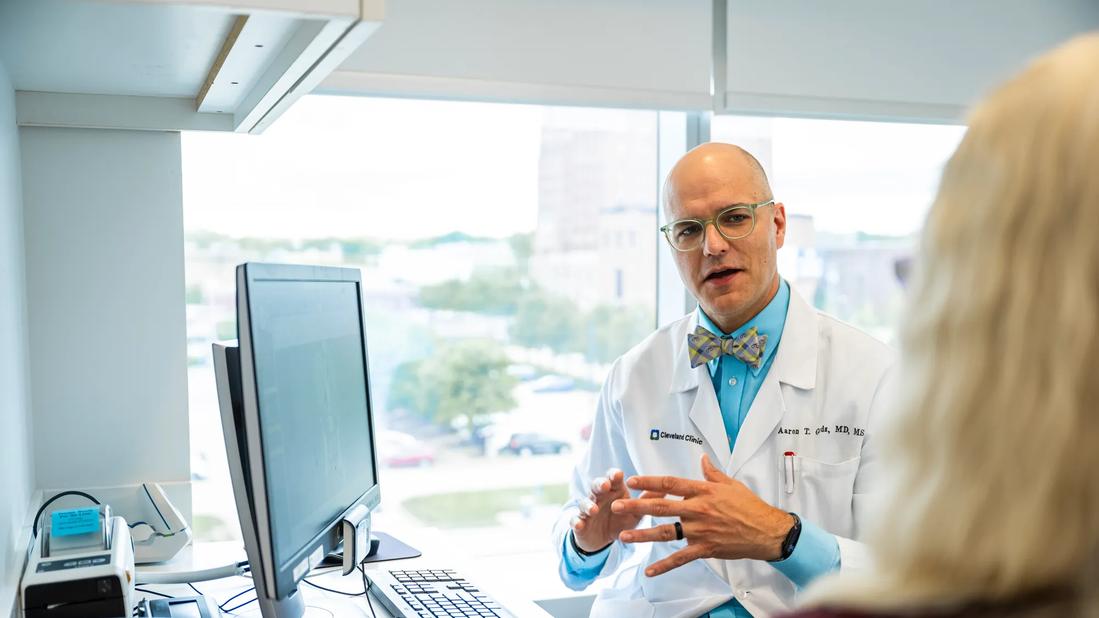
Image content: This image is available to view online.
View image online (https://assets.clevelandclinic.org/transform/c9935359-1bf0-404f-9c92-ec71782d8ee8/CNR_6298158_05-23-25_046_MLC)
Dr. Gerds
A patient with polycythemia vera (PV) experienced severe fatigue due to phlebotomy-induced iron deficiency. After enrolling in a clinical trial studying rusfertide, she was able to forgo phlebotomies and resume her normal daily activities.
Advertisement
Cleveland Clinic is a non-profit academic medical center. Advertising on our site helps support our mission. We do not endorse non-Cleveland Clinic products or services. Policy
After experiencing symptoms she thought were menopause in 2015, a 47-year-old woman visited her ob/gyn. Based on blood test results, the ob/gyn advised her to see her primary care provider immediately, who admitted her to a hospital in Columbus the same day. She was diagnosed with PV and referred to an oncologist.
Her medical team tried multiple medications over the years, but she remained symptomatic and still required weekly phlebotomies to manage her hematocrit levels. This left her feeling so tired that she often couldn’t work. “Phlebotomies are a bit of a double-edged sword,” explains Aaron Gerds, MD, a hematologist at Cleveland Clinic Cancer Institute. “They’re safe and simple to perform but can leave patients with symptoms from the resulting iron deficiency.”
The patient was active on a Facebook support group, where she read about the importance of seeing a myeloproliferative neoplasm (MPN) specialist. She sought out a specialist at another academic medical center, who started her on a new regimen. However, she wanted a provider who could offer more personalized care in terms of improving her quality of life.
She came to Cleveland Clinic Cancer Institute in February of 2018. Together, she and Dr. Gerds arrived at a consensus for her to participate in a clinical trial for the oral MDM2 antagonist idasanutlin. However, she was having significant side effects that outweighed the benefits and she came off study after 15 months of treatment. They discussed next lines of therapy and she decided to go on pegylated interferon. However, it did not control her blood counts and she still required phlebotomies, leading to symptomatic iron deficiency.
Advertisement
As an orphan disease, PV doesn’t have many commercially available treatments. Dr. Gerds continued to stay up on the latest research in search of an option that would be more tolerable and could eliminate the fatigue-causing phlebotomies.
In June 2020, he notified the patient about a study of the hepcidin mimetic medication rusfertide that was available at a medical center in Detroit and helped coordinate her enrolled in the trial. Once the trial opened locally in 2022, she was able to transition her care back to Cleveland Clinic.
“Rusfertide is a rather unique drug in that it induces a state where the bone marrow thinks it’s iron deficient, but iron homeostasis is restored,” explains Dr. Gerds. This master iron regulator acts like a cork to hold onto iron instead of releasing it into the bloodstream. In this patient’s case, the therapy eliminated the need for phlebotomies and vastly improved her quality of life.
As of winter 2026, she remains on the medication. Rusfertide is now FDA approved. Once FDA approval was granted, the patient was able to receive the medication as a commercial agent, which means fewer clinic visits.
The medication continues to keep her disease stable. In the years after starting treatment, she’s had many positive life changes, including getting married and being able to return to work full time.
Dr. Gerds shared several takeaways from this case.
The patient’s motivation for participating in clinical trials was two-fold.
“There were shortcomings in her previous treatment, and the rusfertide trial was a potential opportunity for something better for her. She’s also very active in the online MPN community and wanted to pay it forward to her fellow patients.”
Advertisement
We need to look beyond phlebotomies. “Phlebotomies have been a medical treatment for thousands of years and they have a necessary role. However, cases like this really point out that it’s time for us to do better. Until recently, there were only two FDA approved drugs to treat PV. We’re always excited to get new therapies for our patients.”
Iron deficiency can have a sizeable impact. “We’ve always appreciated that iron deficiency contributed in part to the quality of life for patients with PV who received regular phlebotomies. It’s encouraging to see what a major contribution reversing that iron deficiency can have to help patients feel a lot better.”
Studying orphan drugs is imperative. “When you look at the rusfertide trial data, the impact on patients’ quality of life was tremendous. Patients may live 25 years or more with this disease and our priority is to protect them from decades of treatment-related side effects. Having a new agent that can lessen those impacts is vital.”
Advertisement
Advertisement
Inside Cleveland Clinic’s Quest for an Ovarian Cancer Screening Tool
CELMoD therapy receives approval based primarily on measurable residual disease

Are we missing patients?

Expanding treatment options for patients with advanced and recurrent rectal cancer
Study analyzes creative approaches to support people facing housing insecurity
Evaluating AI initiatives and their impact on operations and care delivery

Study reinforces the importance of genetic testing prior to local therapy decisions

Understanding expanding treatment options and potential advances
 Search