Locations:





Multidisciplinary teams bring pathological and clinical expertise
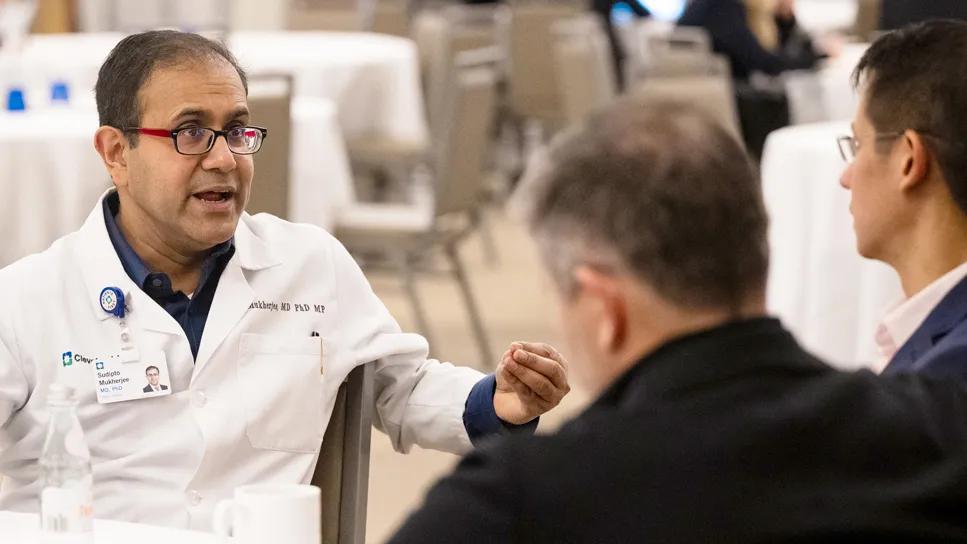
Image content: This image is available to view online.
View image online (https://assets.clevelandclinic.org/transform/1739a7cd-4ed6-4ad9-a3dc-1afba2ad967d/effective-therapy-for-mds-myelodysplastic-syndromes)
Dr. Mukhejee and colleagues
Few things are more vexing for physicians than being stymied in identifying a patient's diagnosis. The Rare Cancers and Blood Diseases team at Cleveland Clinic Cancer Institute supports patients and physicians facing this conundrum.
Advertisement
Cleveland Clinic is a non-profit academic medical center. Advertising on our site helps support our mission. We do not endorse non-Cleveland Clinic products or services. Policy
“If a patient has a constellation of symptoms and there’s been no diagnosis after multiple evaluations, or there are concerns about what to do next, those are the instances where it would be best to reach out to us,” says Program Director Sudipto Mukherjee, MD, PhD, MPH.
The program’s physicians offer diagnosis and management of 84 neoplastic and non-neoplastic conditions.
Caring for patients with rare diseases requires addressing multiple issues simultaneously. To that end, Dr. Mukherjee’s team developed a disease matrix for each of the conditions they treat to seamlessly bring together multiple specialists from across the enterprise with clinical and/or research expertise in that condition. Having this workflow has numerous advantages:
Advertisement
If there’s a suspicion that a patient who’s being referred may have a rare disease, the goal is to have them seen as quickly as possible, usually within a matter of days. Often patients will see multiple specialists, such as an oncologist, pathologist, radiologist and cardiologist, all in the same day so that multiple investigations and evaluations are undertaken concurrently.
Rare cancer diagnosis often starts from a review of the pathology. “In community settings or in non-specialized centers, these diseases may be new to physicians or even pathologists,” explains Dr. Mukherjee. “If you don’t have a certain amount of exposure to these conditions, you may miss the diagnosis. That’s why we almost always request that biopsies performed outside of Cleveland Clinic receive an in-house review here.”
In addition to performing diagnostic confirmation, Mukherjee’s team uses the samples for genomic analysis, which may have important treatment implications.
Providing emotional support is also an essential, particularly for patients who have already undergone a lengthy diagnostic journey. “Even before a diagnosis, sitting down and having a discussion with patients can mean a lot,” says Dr. Mukherjee. “Information is comforting, and gives patients some control over the situation.”
In addition to offering in-patient visits, there are two ways to engage with the program: virtual visits and virtual second opinions. Cleveland Clinic receives requests from around the world for virtual second opinions. For these situations, they review all charts and slides and provide the patient and the locally treating physician with a report summarizing impressions and recommendations for a clinical course.
Advertisement
Many clinicians in the program have licensing privileges in multiple states to make this possible. This way, they can see patients virtually, depending on where the patient resides.
The logistics of rare disease management can be challenging. In instances where there aren’t FDA-approved therapies for a condition, the program physicians may need to repurpose medications for other diseases. Because of this, the program’s nurses are well versed in seeking insurance coverage or tapping into compassionate use or other mechanisms to ensure the patient receives the appropriate medication.
Rare diseases often have very different pathologies and vastly different therapeutic targets, so identifying the right clinical trial can be difficult. When a patient is diagnosed in the program, their case is often accelerated to a clinical trial coordinator who will seek out trials that may be a match. If the trials are open at other institutions, they will connect the patient to that resource as well.
There is a pressing need for more research support to better understand the natural history of rare diseases and identify therapeutic targets to move the field forward. In addition to diagnosis and management of rare diseases, the program team has opened clinical trials, both industry sponsored as well as through an internal pipeline. They aim to develop murine models and advanced computational techniques to test novel treatment strategies.
One study underway involves the development of a symptom burden scale for patients with idiopathic multicentric Castleman disease. “Our hope is that by the middle of next year, we’ll have the first-ever patient reported outcome measure for real-time dynamic monitoring of disease activity, response to treatment and treatment toxicities,” says Dr. Mukherjee.
Advertisement
Supporting patients with rare diseases requires a community effort to bring together knowledge as well as patient experiences. Cleveland Clinic’s Rare Cancers and Blood Diseases team fosters collaborations with organizations such as the CML Cure Consortium (for chronic myeloid leukemia), the Castleman Disease Collaborative Network and the North American Consortium for Histiocytosis (for histiocytic disorders) to expand reach, broaden its knowledge, support new diagnostic strategies and raise awareness about emerging therapies.
Listen to the Cancer Advances podcast to learn more about Cleveland Clinic’s approach to rare cancers.
Advertisement
Advertisement
Findings may have implications for understanding the disorders’ pathophysiology
Genetic variants exist irrespective of family history or other contributing factors

Use of GLP-1s and improving cardiovascular health lowers risk of hematologic malignancies
Leaders of the Pediatric Cancer Committee discuss new accreditation

Slower drug elimination from the body among females may impact safety and efficacy

Integrated program addresses growing need for comprehensive cancer care among adolescents, young adults and adults under 50 with early onset cancers
Study demonstrates potential for improving access

Gene editing technology offers promise for treating multiple myeloma and other hematologic malignancies, as well as solid tumors
 Search