Locations:





With a better understanding of timelines and contributing factors, clinicians can help athletes undergoing TKAs set realistic expectations
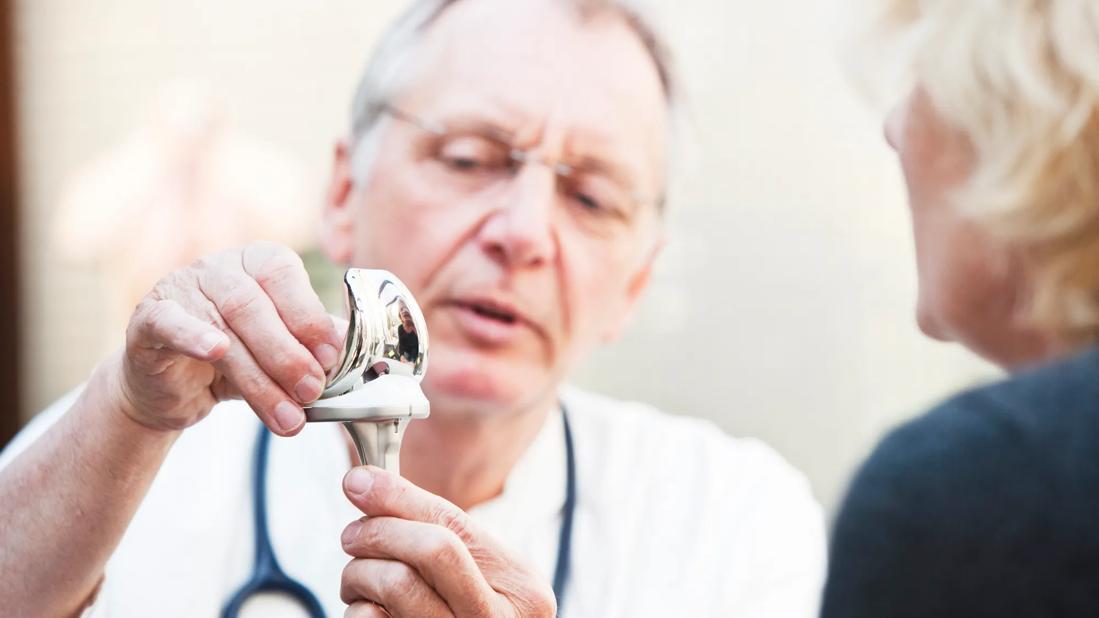
Image content: This image is available to view online.
View image online (https://assets.clevelandclinic.org/transform/e2699c4f-8dab-4d14-8e24-647972d14e79/-total-knee-arthroplasty-473127328)
clinician showing model of knee to patient
Previously, treatment options for a patient with osteoarthritis were minimal, leading to chronic pain, lack of mobility and diminished quality of life. That changed with the advent of arthroplasty, but it was initially only offered in the most severe cases. Now, with advancements in minimally invasive technology, robotics and specific care pathways, the procedure has become refined and expanded to broader patient populations.
Advertisement
Cleveland Clinic is a non-profit academic medical center. Advertising on our site helps support our mission. We do not endorse non-Cleveland Clinic products or services. Policy
As the average age of total knee arthroplasty (TKA) continues to decline, return to sport (RTS) has increasingly become a key outcome measure. However, a standardized definition and criteria for RTS have made patient counseling challenging. While RTS rates are generally high following TKA, timelines and RTS likelihood vary dramatically among patients, and surgeon recommendations are inconsistent.
To help overcome these challenges, a new prospective cohort study published in The American Journal of Sports Medicine, examined several factors relating to RTS following TKA. These include assessing RTS rates, evaluating how patients return to preoperative sport levels, measuring the time required for RTS and identifying factors affecting RTS after TKA.
“Over the last few decades, more patients have expressed a need to continue being more active later in life,” explains orthopaedic surgeon Nicolas Piuzzi, MD, senior author on the paper and Director, Cleveland Clinic Adult Joint Reconstruction Research. “Now, we're doing joint replacement, specifically knee replacement, at a younger age with patients who are more active and who also have expectations of continuing to maintain that high level of activity. But we recognized there isn’t enough data to support or guide patients on what to expect through the surgical process. Our study was designed to specifically assess RTS in the average patient following TKA.”
The group looked at 21,466 primary TKAs performed between 2016 and 2022. Of those, 1,782 patients self-reported as athletes at baseline, and 1,464 of those patients completed one-year follow-up. The group recorded demographic characteristics, comorbidities, baseline and one-year RTS status, time to RTS, athlete type and patient-reported outcomes.
Advertisement
Of the 1,464 patients, 782 (53.4%), achieved RTS, while 676 (46.6%) did not. The group included both contact and non-contact sports. Among the 782 patients who returned, 62% reported being able to resume their previous sport at the same level, 34.5% reported returning at reduced intensity and 3.4% reported switching to a different sport.
“I think it is also important to note that, on average, it took patients about 12 weeks to return to sport,” says Dr. Piuzzi. “By 20 to 25 weeks, 90% of those who were able to return had returned. I think it’s important to have those timelines because it helps us set realistic expectations for our patients in how long it will take them to get back to doing those activities they love.”
However, when it comes to patients who were unable to return, Dr. Piuzzi notes that there are multiple factors to consider for this.
“We found that female and non-white patients had lower return-to-sport rates, along with those with lower comorbidity burden,” says Dr. Piuzzi. “These findings highlight the need for more comprehensive patient data - not just pain and function, but also motivation and longitudinal activity patterns. With current wearable technologies, capturing this information is both feasible and essential to better understand and support our patients.”
Dr. Piuzzi says that while he wasn’t surprised by the results of the study, his group feels that the findings can still impact the RTS conversation around TKAs. Their data can be used to help elevate patient conversations by setting realistic RTS expectations and timelines.
Advertisement
“Beyond the effects on patient counseling, I think this information can help patients by putting everything into perspective,” says Dr. Piuzzi. “When we talk about patients not being able to return to sports, something that’s often unaccounted for is that almost all of these patients were not able to participate in sports at the time of surgery or did so with pain and limitations.
He continues, “We can see that osteoarthritis and joint deconditioning limited these patients in their activities of daily life. Of those patients who underwent surgery, more than half returned to sports. The rest did not return to sports, and so the next question is, why didn't these patients return? The answer to that question requires additional research.”
The research group plans to look further at the impact of activity level in patients and surgical timing. They hope to develop a better understanding of patient activity level and activity decline over a patient’s lifespan leading to more personalized decision-making with patients.
“We want to get to a point where subjectivity is minimal,” says Dr. Piuzzi. We don’t want to simply look at how much pain or limitation a patient is experiencing. Instead, we want to rely more on objective data to help us understand the full picture. We want to use data to show how many steps a patient is walking, their gait speed and their true gait characteristics. If we’re able to characterize that better, I think we’ll be able to do a better job working with a patient to determine their optimal surgery time and their optimal recovery plan. That’s always the goal — individualized care for every patient that optimizes outcomes.”
Advertisement
Advertisement
Step counts suggest recovery is more variable and individualized than commonly believed
Self-care may be just as effective for some patients
Most return to the same sport at the same level of intensity
More report a clinically meaningful change in function at 90 days compared to patients with lower BMI
How to diagnose and treat crystalline arthropathy after knee replacement
Special glasses allowed surgeon to see 3D models and anatomic data superimposed on surgical field
When procedure is performed by high-volume surgeons, outcomes are comparable to total knee replacement

Study findings warrant caution in patients at risk for DVT, cardiovascular issues and more
 Search