Locations:





Bispecific antibody bridging therapy deepens durability of BCMA CAR T-cell therapy without overlapping toxicities in patients with relapsed/refractory multiple myeloma
Image content: This image is available to view online.
View image online (https://assets.clevelandclinic.org/transform/ec7c8c33-79a9-4e6d-a58e-59952f8dfb23/talq-bridging-in-myeloma)
Shahzad Raza, MD
BCMA CAR T-cell therapy has provided a lifeline for many people with relapsed/refractory multiple myeloma (RR/MM). However, the six- to eight-week waiting period for cells to be manufactured is time that many patients simply can’t afford. Roughly 20% of patients experience disease progression or pass away awaiting CAR T-cell therapy. There is a pressing need for bridging therapy to prevent this from occurring.
Advertisement
Cleveland Clinic is a non-profit academic medical center. Advertising on our site helps support our mission. We do not endorse non-Cleveland Clinic products or services. Policy
In a 20-site retrospective study, researchers found GPRC5D-directed talquetamab is not only a viable bridge to CAR T-cell therapy but it may well improve the efficacy of the cell therapy. The study data was presented at ASH 2024 and published in Blood.
“Based on our data, talquetamab is efficacious, feasible and innovative for patients with aggressive multiple myeloma prior to standard-of-care CAR T-cell therapy,” says Shahzad Raza, MD, a multiple myeloma specialist at Cleveland Clinic Cancer Institute and a co-author of the study. This research represents the largest analysis to date of talquetamab as a bridging therapy to CAR T-cell therapy in heavily pretreated patients with relapsed/refractory disease.
Bridging therapy is needed to stabilize disease and to reduce disease burden, which is crucial for improving efficacy of CAR T-cell therapy. Typical bridging therapy fails in roughly 30% of patients with RR/MM awaiting CAR T-cell therapy. A higher disease burden at the time of CAR-T infusion also correlates with worse outcomes and increased toxicity, underscoring the need for effective bridging strategies.
Talquetamab is a bispecific antibody that targets the G-protein coupled receptor, family C, group 5, member D (GPRC5D). It is approved for treatment of RR/MM after four lines of therapy. In the MomenTAL-1 trial, the treatment achieved a roughly 70% response rate for a median duration of 10.2 months. High rates of dysgeusia and weight loss from the drug have limited its viability for long-term use. However, its rapid response profile make it a potential option for bridging therapy.
Advertisement
To better understand the utility of talquetamab, researchers conducted a retrospective analysis of its use specifically as a short course for bridging patients to CAR T-cell therapy.
Eighteen academic centers within the U.S. Multiple Myeloma Immunotherapy Consortium and two cancer centers in Germany participated in this research. The study is notable for its inclusion of patients with features associated with poor outcomes. Patients had received a median of five prior treatment lines. Forty four percent of patients had high-risk cytogenetics and 41% had extramedullary disease (EMD).
In fact, 85% of patients in the study would have been ineligible for registrational CAR T-cell therapy trials.
For this study, 134 patients received talquetamab (0.8mg/kg administered subcutaneously every other week) for a median of 23 days prior to undergoing leukapheresis in preparation for receiving a commercially-available idecabtagene vicleucel (ide-cell) or ciltacabtagene autoleucel (cilta-cell) CAR T-cell therapy. Of those patients, 119 proceeded to CAR T-cell therapy. The 15 other patients did not proceed for a variety of reasons, including disease progression (seven patients), manufacturing failure (six patients) or patient decision (two patients).
The majority of patients received talquetamab after apheresis, with the exception of 19 patients who were prescribed talquetamab prior to T-cell collection in an effort to stave off fast disease progression. Ultimately, 82% of the patients received cilta-cel and 18% received ide-cel.
Advertisement
The researchers analyzed safety outcomes, including:
The median follow up was 6.9 months from the initial talquetamab dose.
The overall response rate to talquetamab itself was 71%.
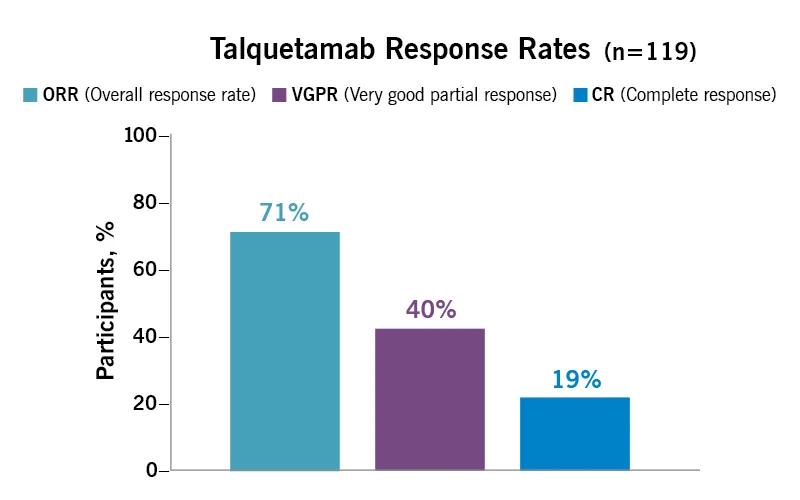
Image content: This image is available to view online.
View image online (https://assets.clevelandclinic.org/transform/d2ba8425-ede0-44ec-9921-7eb68aefcd92/talq-bridging-in-myeloma-inset-1)
Despite the high-risk demographics in this study, 89% of patients were able to move forward with CAR T-cell therapy. For the patients who proceeded to CAR T-cell therapy, 88% had an overall response rate, with 54% achieving a complete response and 18% achieving a very good partial response.
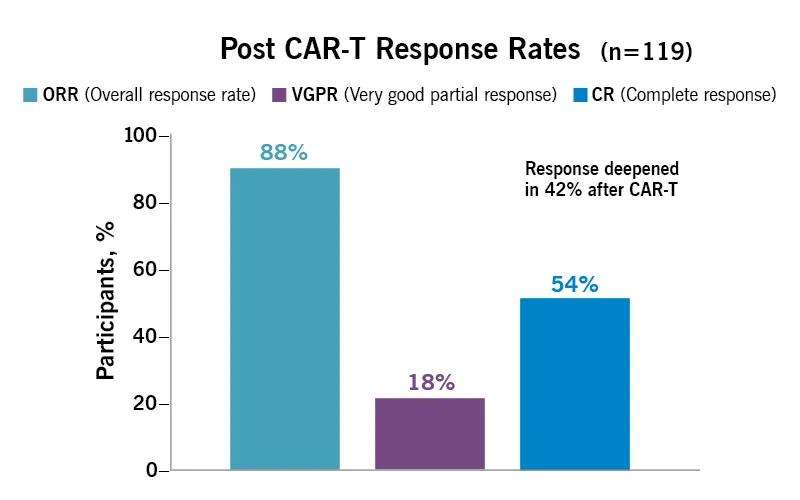
Image content: This image is available to view online.
View image online (https://assets.clevelandclinic.org/transform/afdcfd59-cbcc-40fd-aac8-aa87142e9129/talq-bridging-in-myeloma-inset-2)
The efficacy took hold quickly after just two doses. At a median follow-up of 6.9 months after the start of talquetamab, the median PFS and OF were not reached. The probability of progression at six months was 12.6%.
“This real-world data shows that for many patients with aggressive disease who cannot hold for two months awaiting CAR T-cell therapy, talquetamab may be an effective therapy that achieves a quick response rate. It’s a gateway to making CAR T-cell therapy more successful,” says Dr. Raza.
In 42% of patients, the bispecific antibody therapy deepened the response to CAR T-cell therapy. This may be due to its ability to rapidly debulk disease. Treatment with talquetamab followed by standard-of-care CAR T-cell therapy resulted in a sustained decline in sBCMA levels, which is an indicator of disease burden.
Advertisement
Responses were not significantly different in patients with chromosomal translocations or who received prior BCMA-targeted treatment. “This therapy appears safe and effective, even in patients with poor prognostic features such as high-risk cytogenetics and high disease burden,” says Dr. Raza.
The one outlier was patients with EMD, who did not fare as well. It is unclear whether additional doses of talquetamab would be beneficial for patients with EMD, who continue to have poor outcomes.
Toxicities were manageable. There was no grade 3 or higher CRS. Only 2% of patients experienced grade 3 ICANS. The rates of CRS and ICANS following CAR T-cell therapy were much lower than experienced in registrational trials and what is seen in real-world settings. There were no cases of parkinsonism, peripheral neuropathy or Guillain Barre syndrome observed.
“Based on this data, overlapping toxicities between talquetamab and BCMA targeted CAR T-cell therapy is not a concern,” says Dr. Raza. “This may also indicate that disease debulking has a further benefit in reducing the risk of adverse events.”
In terms of additional side effects, unique talquetamab toxicities included oral, skin and nail issues, such as exfoliation, dysgeusia, dry mouth and dysphagia. In 60% of the cases, the side effects resolved completely after the medication was stopped. Due to the 40% of patients continuing to experience skin and nail issues after treatment cessation, the study authors note that ongoing monitoring of patients is needed.
Advertisement
“Many people believe that you can’t use bispecific antibody therapy before CAR T-cell therapy because it could affect the ability to collect cells or the efficacy of CAR T-cell therapy,” says Dr. Raza. “That wasn’t the case here. Adding bispecific antibody therapy beforehand deepened the response in many cases.”
Further study is warranted to determine whether talquetamab may impact the efficacy of future GPRC5D-directed treatments.
Ultimately, this data is a promising development that makes CAR T-cell therapy a possibility for more patients in need.
Advertisement

Adding 177Lu-PSMA-617 to ADT plus an ARPI cut the risk of radiographic progression or mortality by 28%

New program will help patients improve fitness and manage weight after cancer treatment

Cleveland Clinic hematologist highlights new guidelines and treatment advances in immune thrombocytopenia
NIMBLE replaces weekly tumor board delays with same-day multidisciplinary recommendations
Cleveland Clinic study provides validation for the test, which combines AI and pathological data to predict outcomes in postoperative patients
Advanced imaging technology catches metastases much earlier, allowing treatment with fewer side effects

Reduced radiation for lymph node areas reduces side effects
Large Cleveland Clinic analysis may help resolve a longstanding question over optimal fractionation
 Search