Locations:





Reduced radiation for lymph node areas reduces side effects
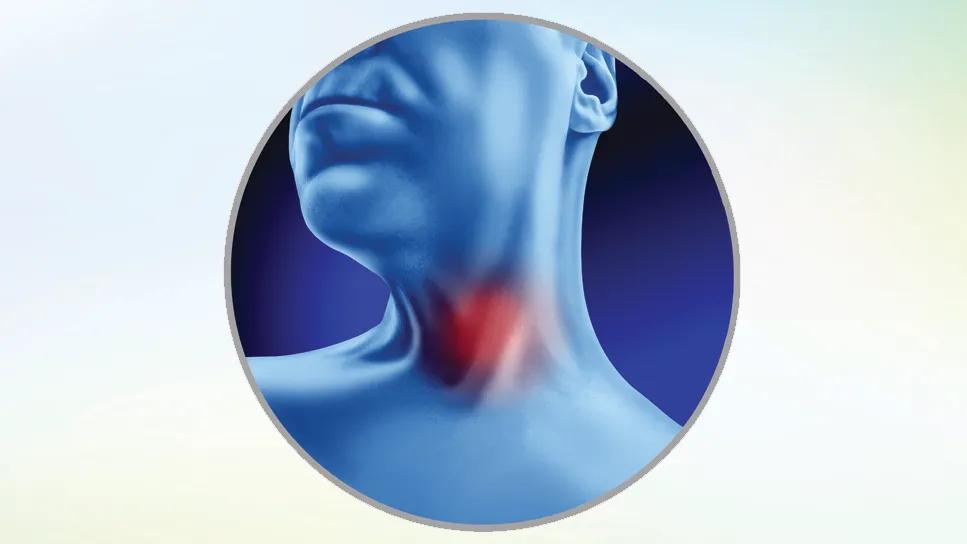
Image content: This image is available to view online.
View image online (https://assets.clevelandclinic.org/transform/4a2163ba-7635-4dbd-90a0-bbc0553c4d55/throat-cancer-blue-tinted-man-1652155881)
Throat cancer
New data show that it’s possible to reduce the dose of chemoradiotherapy to lymph node areas used in the treatment of human papillomavirus (HPV)-associated oropharyngeal cancer (OPC), resulting in fewer side effects without compromising efficacy. The study results were presented at the 2026 ASTRO annual meeting.
Advertisement
Cleveland Clinic is a non-profit academic medical center. Advertising on our site helps support our mission. We do not endorse non-Cleveland Clinic products or services. Policy
Cure rates are high for most cases of HPV+ OPC following the current standard of care treatment involving seven weeks of radiotherapy combined with chemotherapy to the visible disease. During these seven weeks, lower-dose irradiation of the adjacent uninvolved lymph nodes, known as “elective nodal irradiation” (ENI), targets any hidden microscopic disease.
However, de-escalation strategies are being explored to reduce the overall treatment toxicity. While de-escalation shorter than seven weeks (70Gy) has been unsuccessful so far, new findings add to current evidence suggesting that it may be possible to reduce the radiation dose to uninvolved lymph nodes to less than 50-60Gy.
“The cure rate for this cancer is approximately 85 percent, but short and long-term side effects are significant. Our head and neck multidisciplinary team emphasizes toxicity reduction and maximal sparing of uninvolved normal tissues ,” says study lead author, Jacob A. Miller, MD, assistant professor in the Department of Radiation Oncology at Cleveland Clinic Cancer Institute.
The institutional retrospective study included 194 patients who had American Joint Committee on Cancer (AJCC)-8th edition stage I-III HPV+OPC. All were treated with seven weeks of definitive cisplatin-based photon chemoradiotherapy to 70Gy in 35 fractions between 2020 to 2025. Beginning in September 2023, the institutional ENI standard was lower from 54Gy to 30Gy.
A total of 111 patients received 54Gy in the earlier time period to September 2023, and 83 received 30Gy in the later years. Patient and tumor characteristics were similar between the two groups.
Advertisement
At 18 months after treatment, the cumulative incidence of locoregional cancer recurrence was 2.6% with 30Gy versus 3.5% with 54Gy, a nonsignificant difference (p=0.95). Progression-free survival also didn’t differ, 94.9% versus 94.6%, respectively (p=0.70). There were no isolated nodal recurrences within the uninvolved lymph node areas.
The 30Gy ENI group received significantly lower radiation doses to multiple at-risk organs, including the thyroid, swallowing muscles, esophagus, voicebox, middle ear, brainstem, jaw bone, oral cavity, and salivary glands on the opposite side.
Treatment interruptions of a week or longer due to side effects were less common in the 30Gy group, (1.2% vs. 10.0%, p=0.014).
There was no significant difference in weight loss relative to baseline during or after chemoradiotherapy. Feeding tube insertion rates were similar between the two groups (15.8% with 30Gy vs.24.4% with 54Gy, p=0.12), while lymphocyte count depletion was less common after 30 Gy versus 54 Gy.
Current clinical guidelines still recommend ENI doses of 50-60Gy, and retrospective observational data such as these aren’t typically considered sufficient to influence guidelines. There are ongoing efforts to open large randomized trials to determine the optimal ENI dose in this population. Other trials are also examining whether the total duration of treatment can be reduced in certain patient subgroups.
Notably, the incidence of this cancer may decrease over time due to the availability of HPV vaccines. The vast majority (80-90%) of HPV+OPC is caused by HPV genotype 16, one of high-risk genotypes included in the current HPV vaccine. Until the incidence of this cancer begins to decrease with vaccination, there will be continued efforts to decrease side effects while maintain or exceeding the current cure rate.
Advertisement
Advertisement

Adding 177Lu-PSMA-617 to ADT plus an ARPI cut the risk of radiographic progression or mortality by 28%

New program will help patients improve fitness and manage weight after cancer treatment

Cleveland Clinic hematologist highlights new guidelines and treatment advances in immune thrombocytopenia
NIMBLE replaces weekly tumor board delays with same-day multidisciplinary recommendations

Cleveland Clinic study provides validation for the test, which combines AI and pathological data to predict outcomes in postoperative patients
Advanced imaging technology catches metastases much earlier, allowing treatment with fewer side effects
Large Cleveland Clinic analysis may help resolve a longstanding question over optimal fractionation

This single-port option offers advantages for appropriate patients
 Search