Locations:





Emerging evidence suggests a patient-specific approach

Image content: This image is available to view online.
View image online (https://assets.clevelandclinic.org/transform/a0344b67-0d3f-4340-a183-64bc2d4261bb/yellow-and-white-pills-dark-background-1303010190)
yellow and white pills strewn on a dark countertop
By Maureen Keshock, MD, MHSA; Elise Zhang, MS-3; Christopher Whinney, MD; and Kenneth C. Cummings, MD, MS
Advertisement
Cleveland Clinic is a non-profit academic medical center. Advertising on our site helps support our mission. We do not endorse non-Cleveland Clinic products or services. Policy
This article is a shortened reprint of a referenced review article originally published in the October 2025 issue of the Cleveland Clinic Journal of Medicine (2025;92[10]:619-626). Visit that article for the full version with references.
The tide of opinion may be turning against routinely withholding angiotensin-converting enzyme (ACE) inhibitors and angiotensin II receptor blockers (ARBs) before noncardiac surgery, as doing so gives little clinical benefit and may cause harm. While we await clarity from definitive trials, clinicians will have to rely on their clinical judgment and make individualized decisions.
Around the world, more and more people are undergoing major noncardiac surgeries, and they are older and have more cardiac risk factors than patients in the past. Many have hypertension, diabetes, heart failure and other comorbidities, for which they are receiving long-term treatment with inhibitors of the renin-angiotensin-aldosterone system, primarily ACE inhibitors and ARBs.
Approximately 25% of patients undergoing major noncardiac surgery develop perioperative hypertension, which, if uncontrolled, increases the risk of cardiovascular ischemia, cerebrovascular events, and bleeding. On the other hand, intraoperative and postoperative hypotension can also increase the risk of adverse cardiovascular and renal outcomes, even death. Therefore, clinicians need to individualize how they manage ACE inhibitors and ARBs when patients who have been receiving these drugs long-term undergo surgery. However, differing outcomes in observational studies and randomized controlled trials have led to inconsistent guidelines from major cardiovascular societies. This article provides practical recommendations on this topic based on the latest research and guidelines.
Advertisement
ACE inhibitors and ARBs are effective first-line antihypertensive agents and are generally well tolerated. They not only lower blood pressure but also mitigate renal disease, reduce the risk of heart failure and prevent volume overload. Thus, in addition to hypertension, they are indicated to treat heart failure and chronic kidney disease. They are preferred antihypertensive agents in patients with diabetes, too, as they lower the risk of diabetic nephropathy and cardiovascular disease.
ACE inhibitors, as their name indicates, inhibit ACE, thereby preventing conversion of angiotensin I to its vasoconstrictive form, angiotensin II, resulting in vasodilation and reduced vascular resistance. ACE inhibitors also prevent secretion of aldosterone, promoting natriuresis and diuresis and lowering blood pressure (Figure 1). However, they raise bradykinin levels, which enhances vasodilation but can also cause side effects such as cough and angioedema.
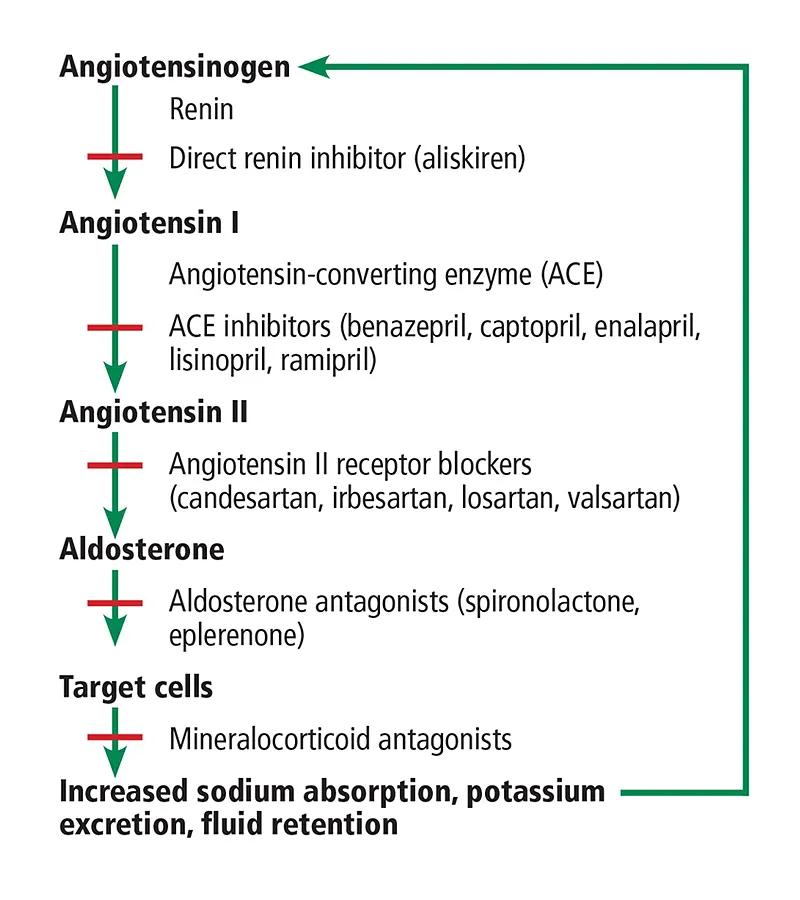
Image content: This image is available to view online.
View image online (https://assets.clevelandclinic.org/transform/6e27fac5-b4d5-4013-a2e2-9535021c38f8/graphic-chart-ace-inhibitors-and-arb)
Figure 1. The renin-angiotensin-aldosterone cascade and drugs that inhibit it. Reprinted from Momoniat et al., Cleve Clin J Med. 2019;86(9):601-607.
ARBs. Angiotensin II acts primarily by binding the angiotensin II type 1 receptor (AT1R). ARBs prevent angiotensin II from interacting with the AT1R, which stops its vasoconstrictive and aldosterone-stimulating actions.
Other drugs inhibit different steps in the renin-angiotensin-aldosterone cascade, but because they are used less often than ACE inhibitors and ARBs, we have less information about how to manage their use perioperatively. These include:
Advertisement
ACE inhibitors and ARBs lower blood pressure and reduce proteinuria, but soon after they are started the serum creatinine level rises and the glomerular filtration rate dips. This effect may actually help protect the kidneys in patients with chronic kidney disease, as it is a result of efferent arteriolar vasodilation and a fall in intraglomerular pressure, which reduces renal hyperfiltration and protects the glomerular endothelium. However, a rise in serum creatinine concentration of 30% or more after starting an ACE inhibitor or ARB is worrisome and may prompt therapy discontinuation.
Renin-angiotensin-aldosterone system inhibitors enhance cardiac performance by reducing ventricular remodeling and fibrosis, which decreases the likelihood of heart failure progression and cardiovascular death. The most significant cardiac advantages for patients with heart failure stem from enhanced cardiac output together with reduced afterload.
Patients with heart failure are less likely to die or need to be hospitalized if they receive ACE inhibitors (or ARBs if they cannot tolerate ACE inhibitors), and these drugs are established treatments for heart failure. In hypertensive patients at cardiovascular risk, they reduce the long-term risks of myocardial infarction and stroke by lowering blood pressure and stabilizing arterial plaque. Therefore, patients receiving these drugs long-term for cardiac indications might fare better if they are continued perioperatively, so as not to precipitate decompensation.
Advertisement
Hypotension is the primary risk associated with these drugs. By blunting angiotensin II–mediated vasoconstriction, they can lower blood pressure too much, particularly in volume-depleted or elderly patients. The combination of chronic renin-angiotensin-aldosterone system blockade and general anesthesia can result in profound and refractory hypotension.
Acute kidney injury. Perioperative ACE inhibitor and ARB use that leads to hypotension may precipitate acute kidney injury. Intraoperative hypotension has been strongly associated with acute kidney injury after cardiac surgery (and so are ACE inhibitors and ARBs). Similarly, a 2024 meta-analysis of noncardiac surgeries found that patients whose ACE inhibitors and ARBs were withheld had a significantly lower incidence of postoperative acute kidney injury compared with those who continued them.
The concern for precipitating renal injury led to the 2024 Kidney Disease: Improving Global Outcomes (KDIGO) guideline recommendation to consider holding renin-angiotensin-aldosterone system inhibitors in the 48 to 72 hours before elective surgery in patients with chronic kidney disease, while recognizing the risk of delayed resumption of therapy.
Hyperkalemia. Chronic ACE inhibitor or ARB therapy suppresses aldosterone, leading to decreased potassium excretion. Patients with normal kidney function have an incidence of hyperkalemia of about 2% when they take these drugs, but those with underlying chronic kidney disease or other circumstances (e.g., higher baseline potassium level, diuretic use, diabetes) can be at much greater risk. Perioperatively, factors such as acute kidney injury, tissue trauma or transfusions may further elevate potassium.
Advertisement
Angioedema, induced by bradykinin, is uncommon but potentially life-threatening when it threatens to close off the airway.
Before 2024, different guidelines provided conflicting recommendations regarding renin-angiotensin-aldosterone system inhibitor use in the perioperative period.
The European Society of Cardiology’s 2022 guidelines, on the one hand, said withholding these drugs in hypertensive patients and patients without heart failure undergoing noncardiac surgery “should be considered,” in view of concerns about hypotension.
The Canadian Cardiovascular Society’s 2017 guidelines similarly recommended stopping them on the day of surgery to avoid hypotension.
The Society for Perioperative Assessment and Quality Improvement, in a consensus statement published in 2022, recommended holding ACE inhibitors and ARBs on the day of surgery but considering continuing them if the procedure is low risk.
The 2014 American College of Cardiology and American Heart Association (ACC/AHA) guidelines, in contrast, suggested that it was reasonable to continue renin-angiotensin-aldosterone system inhibitor therapy in patients with heart failure, emphasizing cardiovascular stability rather than hypotension risk.
However, these recommendations were based on observational data, not randomized controlled trials, leading to inconsistent clinical practices.
In contrast, the 2024 ACC/AHA guideline incorporated data from randomized controlled trials and meta-analyses. This guideline states that for select patients undergoing high-risk procedures, holding renin-angiotensin-aldosterone system inhibitors may be helpful to minimize hypotension, but that continuing them is reasonable in patients with heart failure. Specifically, the guideline recommends the following:
The 2024 KDIGO clinical practice guideline for chronic kidney disease also further supports a cautious approach, including a specific practice point recommending the planned discontinuation of ACE inhibitors and ARBs (and sodium-glucose cotransporter 2 inhibitors) before elective surgery. The rationale is to reduce the risk of perioperative complications such as acute kidney injury, hypotension, metabolic acidosis and hyperkalemia. The KDIGO guideline also emphasizes the importance of resuming these agents postoperatively, particularly in patients with heart failure or proteinuric kidney disease.
As such, judicious withholding of renin-angiotensin-aldosterone system inhibitors in vulnerable populations — and promptly resuming them — may strike the safest balance between renal protection and hemodynamic stability.
Have we been worrying too much about intraoperative hypotension? Since episodes of hypotension are generally well managed with intraoperative measures, the need to withhold ACE inhibitors and ARBs remains a subject of debate.
Although continuing these drugs has been associated with hypotension, high-quality evidence shows that it does not lead to an increase in postoperative cardiovascular events. This perspective raises the question of whether a blanket recommendation to discontinue these drugs before surgery is appropriate or whether a more patient-specific approach should be adopted.
A recent editorial in the European Heart Journal (2024;45[13]:1156-1158) notes that, to date, eight randomized trials have examined interventions aimed at reducing the negative effects of perioperative hypotension. These interventions included notification of hypotension, use of artificial intelligence algorithms, modulating intraoperative pressures with inotropes and preoperative withdrawal of a potential hypotensive medication (e.g., ACE inhibitors and ARBs); none of them was found to be superior to standard anesthesiologist practices.
In light of emerging research, the tide is turning toward continuing ACE inhibitors and ARBs during noncardiac surgery. For instance, another editorial, this one in the British Journal of Anesthesia (2024;132[5]:831-834), hypothesizes that the increase in myocardial injury after noncardiac surgery seen in patients with low preoperative N-terminal pro–brain natriuretic peptide (NT-proBNP) levels may be due to these patients having higher angiotensin II concentrations, leading to a more pronounced arterial rebound when treatment is withheld. Sudden increases in blood pressure can contribute to myocardial injury.
In view of the varying society guidelines, clinicians must still weigh several factors when deciding how to manage ACE inhibitors and ARBs in the perioperative setting:
Because of the potential risks associated with withholding ACE inhibitors and ARBs, along with emerging evidence suggesting no significant harm from their continuation, current cardiovascular society recommendations increasingly support maintaining these medications.
Upcoming large-scale randomized controlled trials will eventually bring clarity, but clinicians should currently steer through the perioperative medicine developments using evidence-based methods. Gathering available data, including the indication for the drug, will be beneficial in preoperative medication management. Optimal perioperative care depends on assessing cardiovascular status alongside surgical risks and institutional practices while incorporating biomarker data, when appropriate, and patient-focused approaches.
Dr. Keshock is with the Department of Regional Practice Anesthesiology, Cleveland Clinic. Ms. Zhang is with the University of Central Florida College of Medicine. Dr. Whinney is with the Department of Hospital Medicine, Cleveland Clinic. Dr. Cummings is Director, Center for Perioperative Medicine, Integrated Hospital Care Institute, Cleveland Clinic.
Advertisement

Logistic feasibility supported for treating obstructive HCM under the REMS program

Multidisciplinary care for patients with immune-related adverse events

Cleveland Clinic will offer rapid, pinpoint airborne transport of medications and other medical items

Additional analyses of the two trials presented at 2023 ESC Congress

Early planning can help prevent disruptions in treatment, medication access and support

Looking at the real-world impact and the future pipeline of targeted therapies

End-of-treatment VALOR-HCM analyses reassure on use in women, suggest disease-modifying potential

Study reveals key differences between antibiotics, but treatment decisions should still consider patient factors
 Search