Locations:





Innovations and practical insights for safe return to sport after lower-limb injury
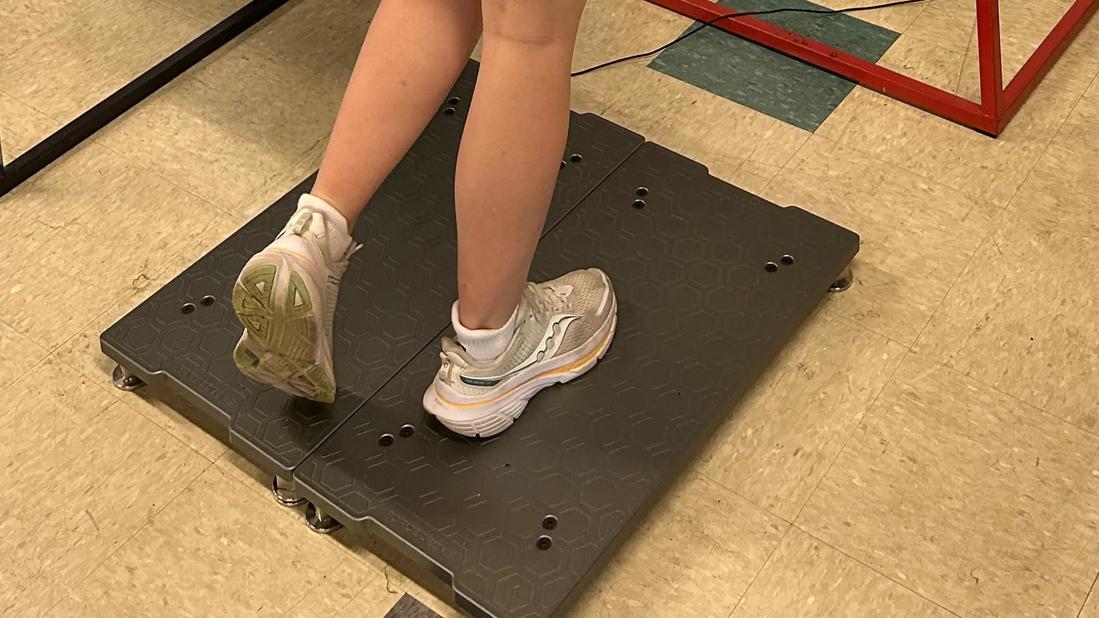
Image content: This image is available to view online.
View image online (https://assets.clevelandclinic.org/transform/8dd928c9-30db-4a4d-a2f7-cfc8561eb567/cqd-pressure-pad)
Patient using force plate
Following a torn ACL or other serious lower-limb injury, one of the most important aspects of recovery for an athlete is assessing safe return to sport (RTS). Biodex isokinetic testing is often relied on as the gold standard in this assessment, as it allows caregivers to objectively measure strength symmetry. Similarly, force plates are also heavily relied on as well. While Biodex machines test maximum strength and power imbalances, force plates can assess functional, dynamic and multi-joint movements.
Advertisement
Cleveland Clinic is a non-profit academic medical center. Advertising on our site helps support our mission. We do not endorse non-Cleveland Clinic products or services. Policy
While these devices have been used primarily for lower-limb injuries, Cleveland Clinic has been exploring ways to expand their usage.
“The Biodex machine is really good at providing us with information about how a muscle group works while moving a joint through its entire range of motion,” says physical therapist Matt Popiolkowski, PT, DPT. “It’s a big part of our return to play component, especially for ACL injuries. Some of our PTs are using it for training purposes as well I use it quite frequently just within my rehab. It's a different way of training, and you can tweak it do isometric training where the patient is just moving against a fixed position. You can get really good muscle recruitment from that.”
Dr. Popiolkowski also says that eccentric training, where the muscle loads under length, can be done with the machine as well. He explains that the range of motion can be set, and if a patient is having difficulty with motion early on, the machine can be a way of initiating a little bit of movement. The different components of the machine can also be configured to test upper extremities, like the shoulder.
“With the rehab, you can scale it to any speed of movement or any amount of repetition,” says Dr. Popiolkowski. “You can have the patient do a certain workload over time or have them try to get to that goal by a certain number of repetitions. There's a lot that you can do to work different components with it. You can even do an endurance component where they try to get through as many repetitions before hitting an 80% fatigue level, for example.”
Advertisement
For athletes coming back from a significant lower-limb injury, such as an ACL tear, the Biodex machine typically isn’t introduced to the care path for testing until at least four months out from the reconstruction at the earliest.
“As far as training, you can start some open chain movements, like a leg extension or a curl moving in space, sometimes as early as four to six weeks out,” says Dr. Popiolkowksi. “However, you want to be cautious as far as how much resistance you're putting on it. There’s a real balance involved here because you’re relying on what you’re seeing objectively and what the patient is telling you about where they are mentally. You’re applying those metrics to determine if they’re ready for the Biodex machine, which will provide data and metrics to determine their readiness to return to sport.”
One of the major limitations of the Biodex machine is its size and the amount of space that it takes up. When they first came out, isokinetic training and Biodex units were very popular in clinics. However, as clinical spaces got smaller and shifted towards open plans with every inch of space used, the Biodex machine fell out of favor. Dr. Popiolkowski believes that’s changing with its usage in the return to sport component.
While the Biodex machine is static due to its size, force plates, on the other hand, are much smaller and can still provide similar information and metrics.
Dr. Popiolkowski says that while there are widely-performed, return-to-play tests involving various jumping exercises, athletes are also really good at compensating. So, an athlete recovering from an ACL reconstruction might find ways to use their hip more, for example.
Advertisement
“With traditional single-leg jump testing for return to play, athletes can sometimes compensate and do well with those and essentially pass them. With force plates, a lot of the tests involve maximum effort jumping or push-testing, and we can identify where an athlete might still have a true deficit,” he explains. “Then, when we evaluate what that muscle can produce through its full range, as we do with the Biodex, then we see there's actually a deficit here. These machines really complement each other well.”
He continues, “That’s really valuable information because before tools like Biodex and force plates, that athlete would have passed these tests, and their provider might have said, ‘You're good to go.’ But now we have these tools and tests that help us more accurately decide what is best for the athlete.”
One of the areas of return to sport that is lacking, according to Dr. Popiolkowski is upper extremity evaluation. Force plates can help in this regard. Dr. Popiolkowski will have his patients get into a plank or push-up position, putting direct force on the force plates. Another test involves patients lying flat with an outstretched arm above and putting a force straight down.
“There are a number of different upper-extremity tests with the force plates that we’ve been incorporating into care,” says Dr. Popiolkowski. “Having this level of data has been very beneficial for us, and I think this type of usage with force plates will continue to be a valuable component with our upper extremity return-to-play evaluations.”
Advertisement
One of the topics of debate surrounding the machines is the order in which patients could benefit from both machines.
Dr. Popiolkowski says he prefers to test patients on the force plates first. He reasons that while these tests do involve the patient exerting maximum effort, they only require several repetitions. Unlike the Biodex which requires maximum effort and muscle recruitment across several working sets of repetitions.
“I usually have my patients do a dynamic warm-up to make sure they’re ready to go, and then we’ll practice a bit on the force plates,” he explains. “The overall repetitions for the test are low — they are anywhere from three to six repetitions at the most. Then there's a rest break in between. On the other hand, the Biodex can be fatiguing because they’re putting out maximum effort through multiple repetitions with two different types of resistance. So, I like to do the force plates first. I think it’s a good primer too for them to go to the Biodex, and they won’t be too fatigued for the second machine, so they can still get the maximum out of that.”
For Dr. Popiolkowski, the Biodex and force plate machines have been incredibly valuable tools when it comes to return-to-play evaluations.
“We’re constantly looking for ways to not only evaluate effectively and thoroughly, but we’re also looking for ways to be innovative with the tools at our disposal,” says Dr. Popiolkowski. “The data we get from these machines allows us as PTs to shift our focus from helping our patients return to play quickly to helping our patients return to play safely and confidently, and in ways that reduce reinjury rates. “That's our number one goal for PT — we want you to get back performance-wise, but our number one goal is we want your re-injury rate to be as low as possible.”
Advertisement
Advertisement

Cleveland Clinic’s Global Peak Performance Center and PGA TOUR partnership pair advanced assessment with longitudinal follow-up to enhance clinical decision-making

Research by Cleveland Clinic and Sports Data Labs to improve health and function in everyday patients as well as elite athletes
A behind-the-scenes look at Cleveland Clinic’s role as medical services provider of the 2023 Summer Series

Rest is often not the best care for gamers’ overuse injuries
With a better understanding of timelines and contributing factors, clinicians can help athletes undergoing TKAs set realistic expectations
Systematic review of MOON cohorts demonstrates a need for sex-specific rehab protocols
Clinical complexity demands personalized care strategies
Cleveland Clinic’s Esports Medicine team weighs in on importance of multidisciplinary care
 Search