Locations:


Patient experiences pain relief without pharmacologic intervention
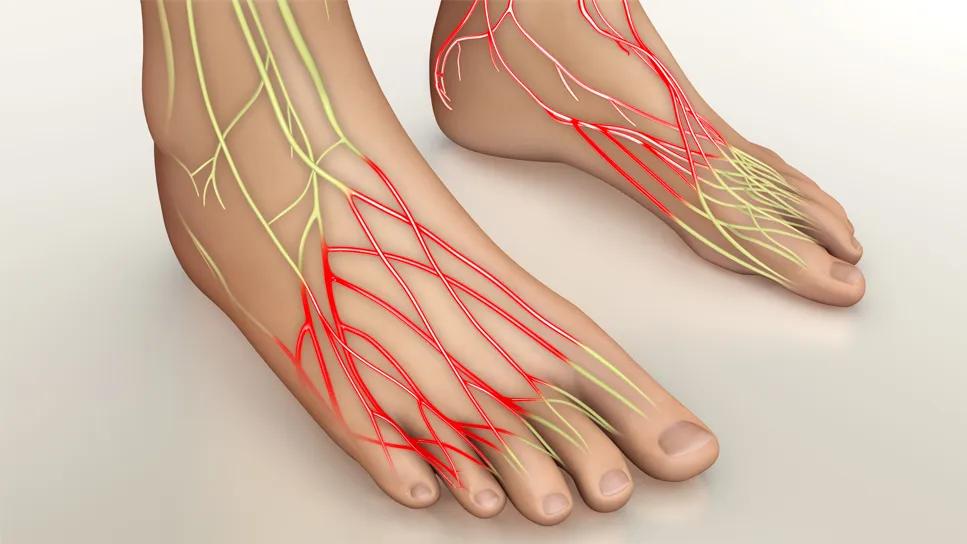
Image content: This image is available to view online.
View image online (https://assets.clevelandclinic.org/transform/e3586c19-b5e1-4d39-a123-fd865c4c58cb/illustration-neuropathy-in-feet-2193179255)
Neuropathy in the feet
Many patients suffer from debilitating peripheral neuropathy amid their cancer treatment. One such patient experienced pain in her extremities during treatment for ovarian cancer. She found relief through an innovative treatment approach called Scrambler Therapy. Following the ten-day treatment, she was able to once again enjoy travel, hiking and her work in nursing.
Advertisement
Cleveland Clinic is a non-profit academic medical center. Advertising on our site helps support our mission. We do not endorse non-Cleveland Clinic products or services. Policy
Only an estimated 20% of ovarian cancers are detected early. In this patient’s case, the cancer was found during an elective hysterectomy for adenomyosis. During the procedure, the patient's fallopian tubes were removed and sent for routine pathology. The pathologist spotted a lesion that could be an early warning sign of ovarian cancer. She flagged the lesion and analyzed it for cellular changes. As a result, the cancer was caught early in the disease course, at stage 2A.
In the summer of 2025, the patient received chemotherapy, immunotherapy, targeted therapy and surgical intervention to treat the ovarian cancer. Starting in the third cycle of carboplatin and paclitaxel, she began experiencing constant numbness, burning and tenderness in her hands and feet. At her initial assessment, she rated her level of pain or discomfort as seven out of ten.
Neuropathy is a common adverse event from many cancer treatments. “An estimated 40-60% of people who receive chemotherapy or non-traditional chemotherapeutic agents experience peripheral neuropathy. For about half of those patients, the condition is chronic and doesn’t resolve when treatment is over,” explains Laura Shoemaker, DO, Chair of the Department of Palliative and Supportive Care.
In this case, the neuropathy pain worsened and became disruptive to the patient’s life. As a nurse and an active hiker, she needed to preserve her agility and mobility.
The Palliative Medicine department worked closely with her oncologist to support her in alleviating this discomfort. Initially, they prescribed pregabalin, but she experienced side effects that made this an unviable option.
Advertisement
Around that time, Dr. Shoemaker’s team had opened a clinical trial studying how an FDA-approved electro-analgesic device called Scrambler Therapy could treat chemotherapy-induced peripheral neuropathy.
Radiation and chemotherapy can induce nerve damage, leading to abnormal signaling to the brain and resulting in pain and numbness. Scrambler Therapy has the potential to break that cycle of pain, without the use of medications. The Scrambler Therapy device applies low-intensity electric pulses to override pain signals from damaged nerves, essentially “retraining” the brain to interpret those signals differently.
This approach has already shown promise for treating persistent neuropathic pain caused by a variety of conditions. Dr. Shoemaker’s team set out to study which patients respond best and how long the benefit lasts.
Finding a non-pharmacologic option for treating peripheral neuropathy holds great appeal, given the shortcomings of today’s medications which have limited efficacy as well as a high side effect burden.
The patient decided to join the clinical trial. In this study, patients are randomized to either receive ten days of an active Scrambler signal or an inactive “placebo” signal. For those in the experimental group, the Scrambler device transmits a non-painful electrical stimulus for roughly 45-60 minutes per session.
Since it’s a randomized controlled crossover trial, everyone who enrolls has an opportunity to receive active therapy. If they’re part of the control group, they’re told this afterwards and given the opportunity to return to receive active Scrambler treatment.
Advertisement
In the case of this patient, the results were life changing. By the 10th day of Scrambler Therapy treatment, her pain level was zero and numbness level was one. She was able to return to her work caring for patients. Soon afterwards, she and her husband enjoyed a grand walking tour of Greece.
Scrambler Therapy can disrupt the cycle of pain. “For some patients, reducing a chemotherapy dose can relieve neuropathy pain but for others, the nerve damage is so substantial that the symptoms don’t subside. They get in a loop of chronic nerve pain,” says Dr. Shoemaker. “Scrambler Therapy doesn’t heal the nerves per se; it creates new signals to replace those pathologic chronic pain loop signals.”
The therapy is non-invasive. “One of the best things is that Scrambler Therapy doesn't hurt or have known side effects,” says Dr. Shoemaker. “In all the studies to date, the only possible adverse event reported was minor skin irritation from the adhesive applied to the skin. Patients who’ve tried medications without experiencing relief are usually willing to invest the time and effort to see if this helps.”
More study is needed. Although Scrambler Therapy is FDA approved, there’s much that clinicians still need to know about it. “It’s not good enough to know if a patient’s pain is better or worse right after the therapy. There are a lot of applications for this therapy, and we need to more systematically see which patients are the best candidates and will gain the most benefit,” says Dr. Shoemaker. “We’re also tracking which chemotherapeutic agent each patient was on so we can look back retrospectively and see if any patterns emerge in terms of patient benefit.”
Advertisement
Administering Scrambler Therapy takes expertise. It takes a fair amount of provider skill and training to know how to administer the therapy. Practitioners receive feedback from patients during each treatment session and can adjust as needed to potentially improve outcomes.
Scrambler Therapy may work best in situations where the insult that caused the nerve damage is no longer occurring. Dr. Shoemaker and her colleagues are testing this theory and are following patients longer term to better understand if the pain relief benefits persist. Although the primary study outcome they’re tracking is pain relief, the researchers are also gauging the impact of the therapy to alleviate numbness, tingling, cold/hot sensation, stiffness and itchiness from peripheral neuropathy.
Advertisement
Advertisement
Hematologist/oncologist Sandra Mazzoni, DO, shares insights into treatment decision-making and more
Therapy eliminates the need for phlebotomies
Inside Cleveland Clinic’s Quest for an Ovarian Cancer Screening Tool

CELMoD therapy receives approval based primarily on measurable residual disease

Are we missing patients?

Expanding treatment options for patients with advanced and recurrent rectal cancer
Study analyzes creative approaches to support people facing housing insecurity
Evaluating AI initiatives and their impact on operations and care delivery
 Search