Locations:





Visual snapshots of how we manage challenging cases
Cleveland Clinic’s Miller Family Heart, Vascular & Thoracic Institute consistently turns complex patient presentations into outcomes that save, restore and enhance patients’ lives. The paired images in the photo essay below present a few examples across several of our subspecialty areas.
Advertisement
Cleveland Clinic is a non-profit academic medical center. Advertising on our site helps support our mission. We do not endorse non-Cleveland Clinic products or services. Policy
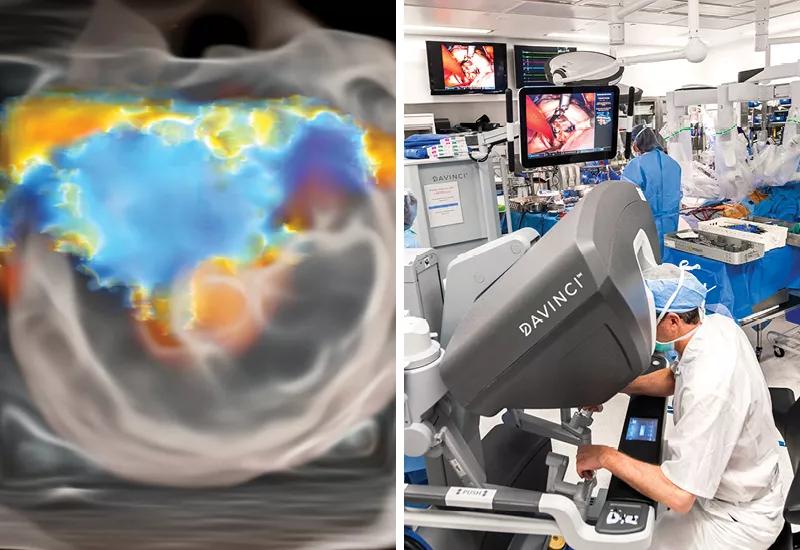
Image content: This image is available to view online.
View image online (https://assets.clevelandclinic.org/transform/2d81c19e-ab6d-4b6b-89c5-031198fefa86/22-HVI-3477523-CQD-slides-800x550-1-MVR_jpg)
Images of mitral valve mastery. Cleveland Clinic heart teams have performed more than 4,200 consecutive mitral valve repairs without an operative death. Left: 3D echocardiogram showing severe mitral valve prolapse with regurgitation. Right: Operating room photo during a robot-assisted mitral valve repair. Robot-assisted surgery has been used for a growing number of repairs of isolated degenerative mitral valve disease at Cleveland Clinic in recent years.
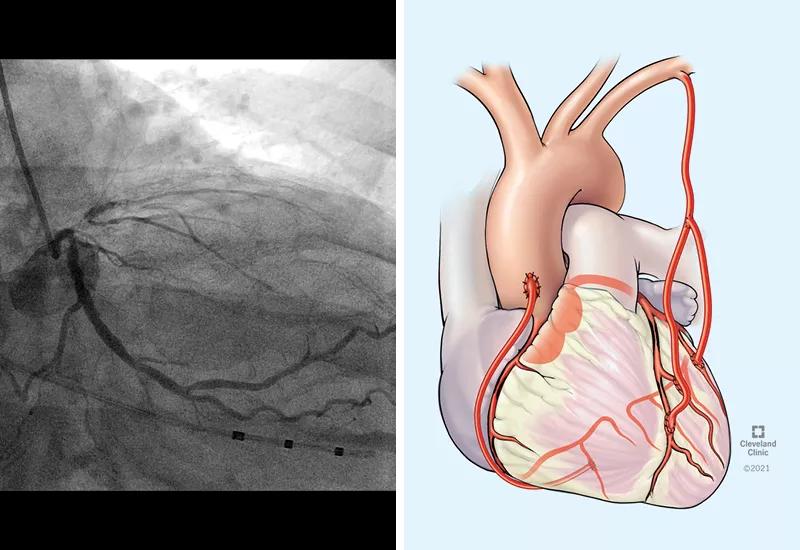
Image content: This image is available to view online.
View image online (https://assets.clevelandclinic.org/transform/da3e0bb5-1bb4-4fa5-9c35-1db0a60d5144/22-HVI-3477523-CQD-slides-800x550-2-CABG_jpg)
Maximizing multiarterial CABG. More than a third (34%) of coronary artery bypass graft (CABG) recipients at Cleveland Clinic receive multiple arterial grafts, with overall operative mortality of 0.5%. Left: Coronary angiogram showing severe multivessel coronary disease. Right: Illustration showing total arterial revascularization after CABG.
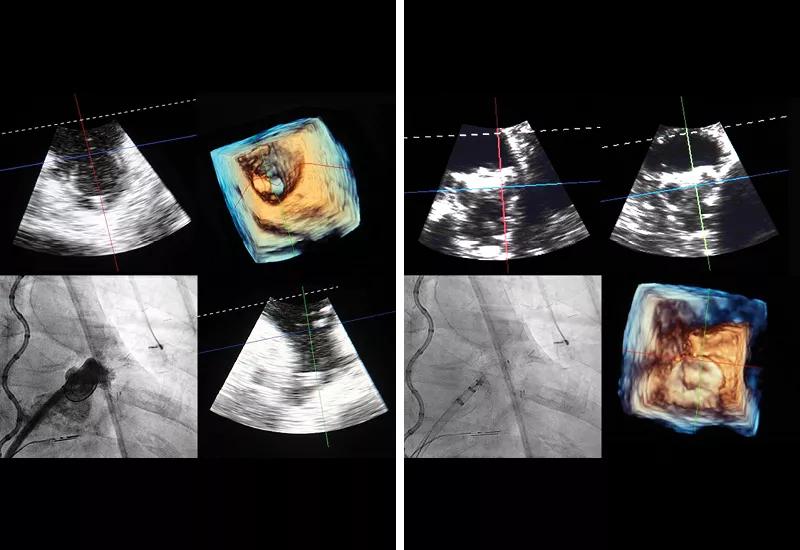
Image content: This image is available to view online.
View image online (https://assets.clevelandclinic.org/transform/b31a0a41-65ef-4f75-a096-40702da09e11/22-HVI-3477523-CQD-slides-800x550-3-ablation-LAAO_jpg)
Pairing AF ablation and LAA occlusion. Cleveland Clinic is one of the few centers that offer concomitant atrial fibrillation (AF) ablation and implantation of the Watchman™ left atrial appendage (LAA) occlusion device. We do so using 3D intracardiac echo catheter technology to guide device placement instead of conventional transesophageal echo. Left: Intracardiac echo and contrast fluoroscopy images of the LAA before Watchman deployment in a patient undergoing combined AF ablation and LAA occlusion. Right: Intracardiac echo and contrast fluoroscopy images in the same patient after Watchman deployment.
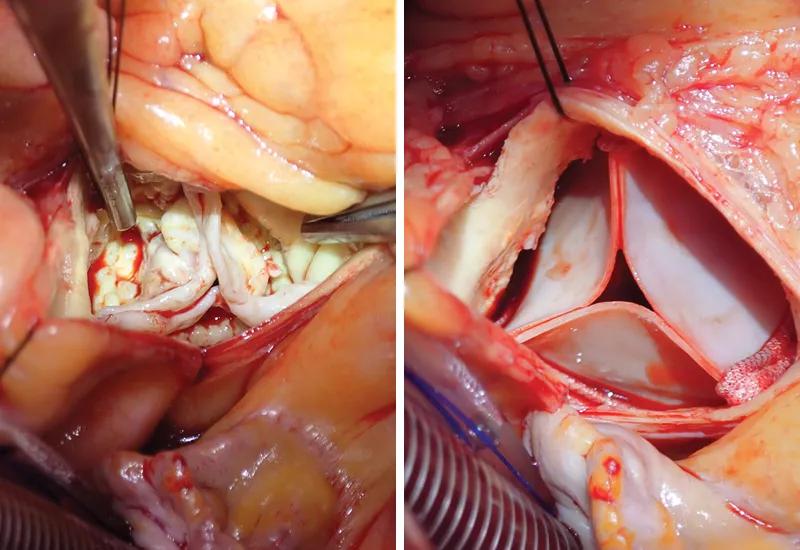
Image content: This image is available to view online.
View image online (https://assets.clevelandclinic.org/transform/5977a9e8-c40e-4b93-b09b-18b1bcfa4111/22-HVI-3477523-CQD-slides-800x550-4-AVR_jpg)
Unsurpassed aortic valve replacement experience. Cleveland Clinic heart teams have performed more than 15,000 surgical aortic valve replacements in the past 10 years, the most in the U.S. Left: Operative photo of a degenerated, calcified, stenotic aortic valve. Right: Photo of a bioprosthesis in the same patient after surgical aortic valve replacement.
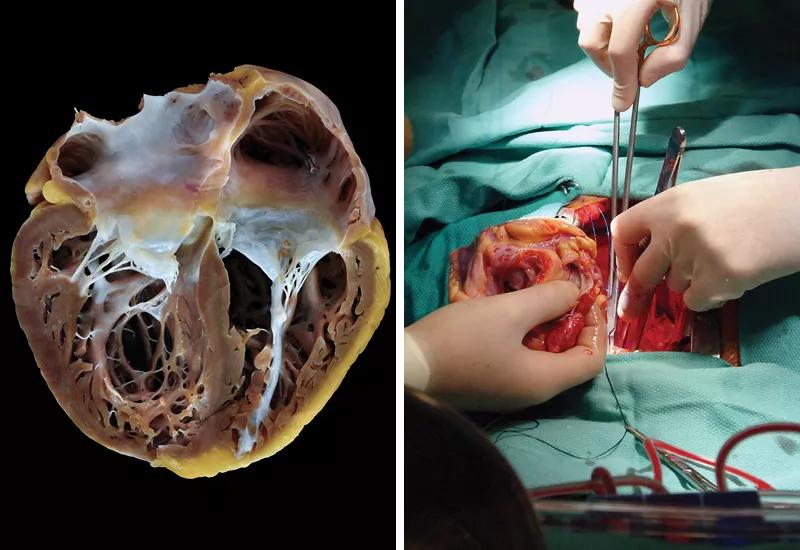
Image content: This image is available to view online.
View image online (https://assets.clevelandclinic.org/transform/a4d45e14-49de-4740-82e2-99e3a9519673/22-HVI-3477523-CQD-slides-800x550-5-transplant_jpg)
Standout transplant survival. Heart transplant recipients at Cleveland Clinic have one-year and three-year survival rates of 96% and 94%, respectively, in the latest reporting period. Left: Photo presenting a four-chamber view of a dilated cardiomyopathy specimen from a heart transplant patient. Right: Operative photo of a heart transplant in progress.
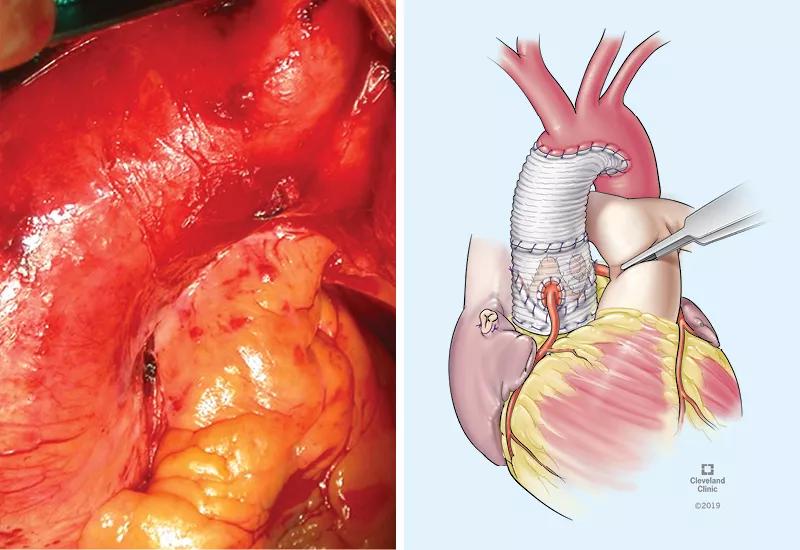
Image content: This image is available to view online.
View image online (https://assets.clevelandclinic.org/transform/92c814b8-c247-42d3-8438-dd1ceb43d085/22-HVI-3477523-CQD-slides-800x550-6-aorta_jpg)
Sparing the valve in aortic root aneurysm repair. In patients with aortic root aneurysm, replacement of the aortic valve with a bioprosthesis risks valve degradation, while replacement with a mechanical prosthesis requires lifelong anticoagulation. To avoid these drawbacks, Cleveland Clinic offers appropriate patients root reimplantation with preservation of the aortic valve. In over 1,200 such operations studied to date, we have achieved >98.4% operative survival and >95% freedom from reoperation. Left: Operative photo of an aneurysm involving the aortic root. Right: Illustration of a completed aortic root replacement with reimplantation.
For detailed outcomes data across the breadth of our cardiovascular and thoracic care, visit clevelandclinic.org/hvtioutcomes and clevelandclinic.org/e15.
Advertisement
Advertisement
Practical takeaways for the reality of overlapping cardiovascular, kidney and metabolic disease
Cleveland Clinic pioneers a new paradigm in cardiovascular care delivery
Site visits offer firsthand lessons in clinical and operational excellence in cardiovascular care
Cancer drug helps treat decades-long symptoms in patient with complicated lymphatic issue
Findings support emphasis on markers of frailty related to, but not dependent on, age
Findings establish overweight/obesity as a modifiable risk factor for cardiovascular disease
Observational study supports adding CAC score to traditional risk factors for precision medicine approach
Inflammation found more predictive of events than LDL-C in pooled analysis of RCTs
 Search