Locations:





Phase 2 study brings pivotal advances in treatment efficacy and safety for the most challenging-to-treat population

Image content: This image is available to view online.
View image online (https://assets.clevelandclinic.org/transform/83e547c0-36c5-4571-a8dc-fb9a80fd3f23/phase-2-study-of-talquetamab-and-teclistamab)
Dr. Raza
Combining teclistamab and talquetamab deepens the depth and durability of response in patients with relapsed/refractory multiple myeloma with extramedullary disease (EMD), according to an international trial. Nearly 80% of patients achieved an overall response rate with a manageable safety profile through this novel dual-targeted approach, according to study outcomes recently published in the New England Journal of Medicine.
Advertisement
Cleveland Clinic is a non-profit academic medical center. Advertising on our site helps support our mission. We do not endorse non-Cleveland Clinic products or services. Policy
These results exceeded standard therapies, including bispecific monotherapies and BCMA CAR T-cell therapy, for a population of patients who usually have a dire prognosis. “It’s exciting to see that combining two bispecifics together is providing durable responses in patients whose survival rates have typically been quite poor,” says Shahzad Raza, MD, study co-author and a hematologist/oncologist at Cleveland Clinic Cancer Institute. “These outcomes represent a bold step forward that has the potential to be practice changing.”
The bispecific antibody teclistamab targets BCMA, while the bispecific antibody talquetamab targets GPRC5D. As monotherapies, teclistamab and talquetamab each provided modest benefits to patients with EMD. However, early research found combining the two medications made a notable difference.
This study focused on patients with EMD, including those with nonsecretory or oligosecretory myeloma, who are generally excluded from clinical studies. The study outcomes were presented previously at the European Hematology Society (EHA), International Myeloma Society (IMS) and most recently at the American Society of Hematology (ASH) annual meetings.
True EMD, which is defined as soft-tissue plasmacytomas that are not contiguous to the bone, is a highly aggressive form of multiple myeloma and is associated with dismal outcomes. Historically, survival rates for those with EMD have been around one to two years.
Patients with EMD may initially respond to conventional treatments but the responses tend to be suboptimal and inferior to those without EMDs.
Advertisement
This phase 2 extension study was performed on talquetamab plus teclistamab exclusively in patients with drug-resistant, true extramedullary myeloma. The primary end point was overall response. Secondary end points included the duration of response, progression-free survival, overall survival and safety.
The RedirecTT-1 trial enrolled 90 patients, who received a combination of 0.8 mg per kg of body weight of talquetamab and 3.0 mg/kg of teclistamab every two weeks, with the option to switch to once a month dosing based either on confirmed ≥VGPR (very good partial response) after cycle 4 or the physician’s discretion after cycle 6. Patients’ progress was monitored via full-body PET CT scans as well as MRIs, blood work and bone marrow biopsies.
Of this population of patients with drug resistance and true extramedullary disease, most responded to the combination of talquetamab and teclistamab. Seventy-nine percent of the 90 patients in the study achieved an overall response rate, including 54% who achieved a complete response. The median progression-free survival was 15.4 months.
Responses were consistent across tumor burden, cytogenetics, organ involvement and number of extramedullary sites.
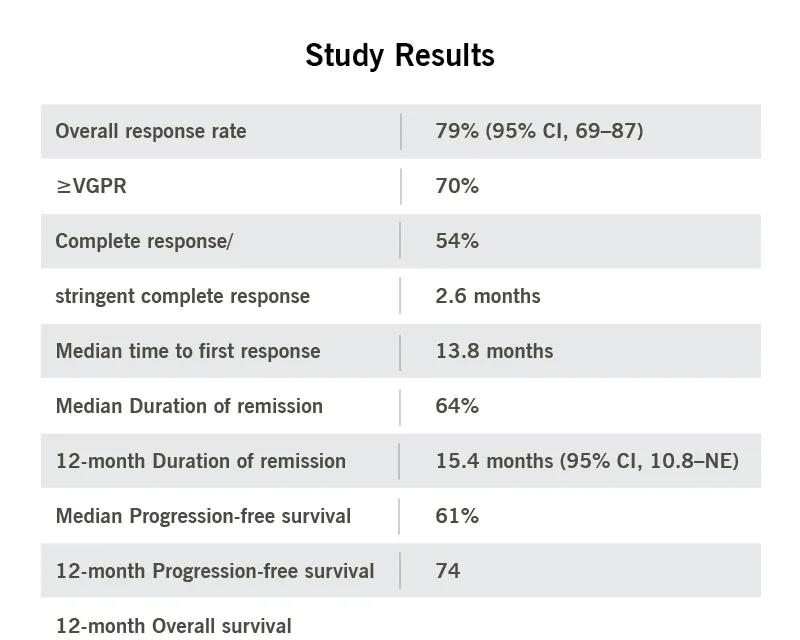
Image content: This image is available to view online.
View image online (https://assets.clevelandclinic.org/transform/2ba66323-c210-4ddc-b072-5b28c2d1b082/redirec-tt-1-emd-extramedullary-disease-inset-1)
More than 76% of responders switched to monthly dosing after cycles 4-6. This change in dosing did not diminish responses. In fact, 93% deepened or maintained response after switching.
The rate of adverse events was consistent with previous studies of these agents delivered as monotherapies and did not increase as a result of combining the two therapies. Few patients discontinued treatment due to adverse events, and no new safety signals were indicated. Oral toxicities were mainly grades 1-2, with only 4% having grades 3-4.
Advertisement
Infection rates were high but manageable and seen during the early treatment course. The researchers found that monthly administration of IVIG helped lower infection rates. Other toxicities were manageable.
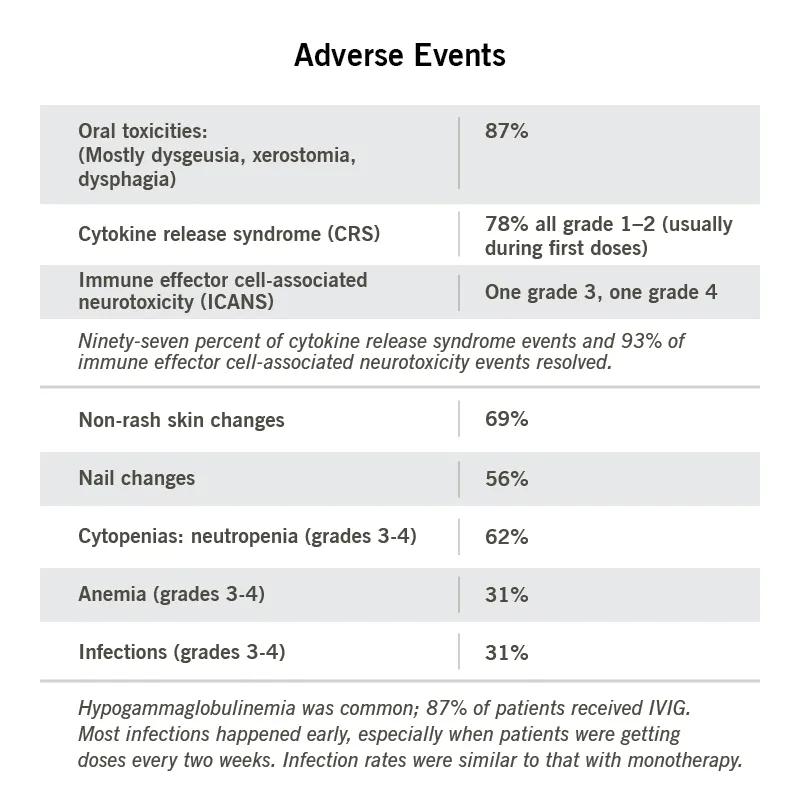
Image content: This image is available to view online.
View image online (https://assets.clevelandclinic.org/transform/442eb563-77e5-4445-ba00-e4fa9b3a0cc9/redirec-tt-1-emd-extramedullary-disease-inset-2)
Five patients died due to infection, one from pneumonia due to COVID-19, one from pneumonia due to klebsiella infection, one from sepsis due to klebsiella infection, one from pneumonia due to unspecified infection and one from pseudomonal sepsis.
“I’m grateful to our institute, my colleagues and our patients who participated in this groundbreaking research,” says Dr. Raza. “This unique combination of therapies may be a game changer for this group of patients who previously had few treatment options available to them.”
Cleveland Clinic Cancer Institute continues to investigate new therapies such as trispecific antibodies, bispecific T-cell engagers and allogenic CAR-T for treating multiple myeloma.
Hear our podcast with Dr. Raza about the RedirecTT-1 trial.
Advertisement
Advertisement
The shifting role of cell therapy and steroids in the relapsed/refractory setting
Making sense of the fast-moving treatment landscape
Explaining common misconceptions about chimeric antigen receptor therapy

Clinicians share practices to streamline initiation of care
Prediction and bioinformatic data could prove valuable for therapeutic interventions targeting this malignancy
Findings from large database important to inform clinical practice
Study of 401,576 patients reveals differences in cancer burdens as well as overall survival
Despite sicker patients, response rates of teclistamab in a real-world study were similar to those from a pivotal clinical trial
 Search