Locations:





Systematic review indicates more can be done for higher-risk patients
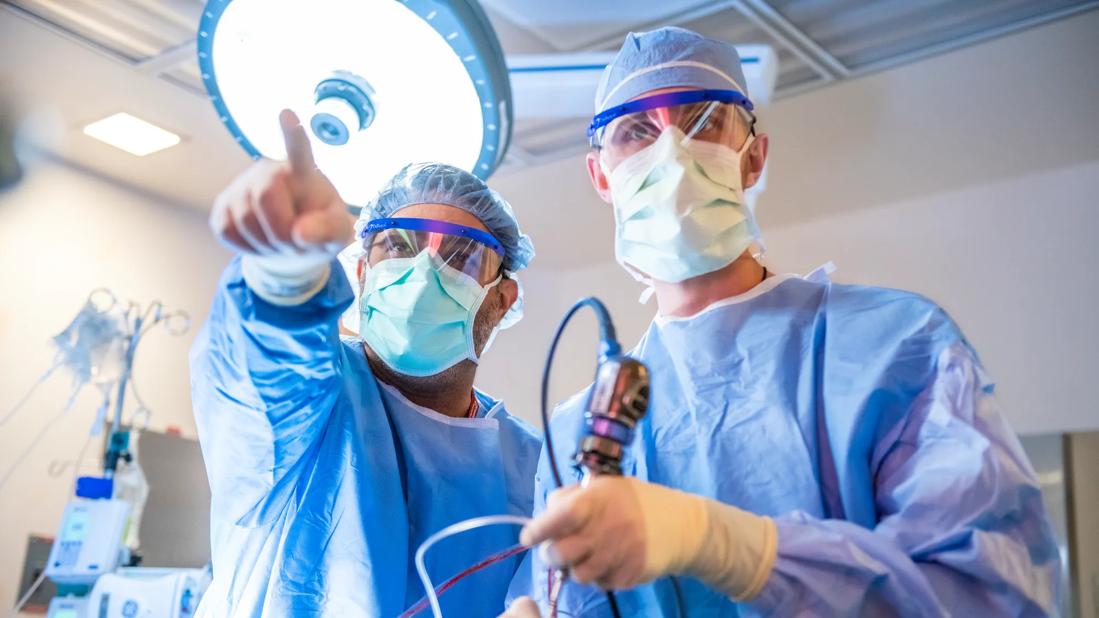
Image content: This image is available to view online.
View image online (https://assets.clevelandclinic.org/transform/7d6161dd-3462-4035-9d04-1c4096861099/HNI-2506912_10-28-21_032_SG)
Surgeons in operating room
While there are several benefits of endonasal skull base surgery (ESBS) over traditional open craniofacial approaches for treating certain skull base lesions, including lower perioperative morbidity and improved patient outcomes, the overall rate of venous thromboembolism (VTE) is unclear. Prior studies have indicated that while the risk appears low, evidence demonstrating the actual risk of VTE in ESBS is lacking.
Advertisement
Cleveland Clinic is a non-profit academic medical center. Advertising on our site helps support our mission. We do not endorse non-Cleveland Clinic products or services. Policy
There are known established risk factors for VTE, which include prolonged operative time, elevated body mass index, advanced age, neurologic disease and malignancy. Given concerns for postoperative cerebrospinal fluid (CSF) leaks for these patients, as well as bed rest and immobility following ESBS surgeries, there is concern that these factors could increase the risk of VTE in some patients.
A recent study appearing in Otolaryngology-Head and Neck Surgery performed a meta-analysis and systematic review on prior literature to quantify VTE, deep venous thrombosis (DVT), pulmonary embolism (PE) and bleeding complications after endonasal skull base surgery. The group also looked at the variability between prior findings and surgical approaches.
“Although the overall rates of VTE and significant bleeding after ESBS appear to be low, evidence remains mixed regarding expected incidence rates,” says Christopher Roxbury, MD, MBA, a Cleveland Clinic rhinologist and endoscopic skull base surgeon and the paper’s senior author. “We also wanted to better understand the impact of underlying pathology, surgical approach and patient-specific risk factors on these complications.”
The systematic review included 108 studies, of which 99 were retrospective cohort studies, seven prospective cohort studies, one case series and one mixed retrospective‐prospective cohort study. The group assessed the non-randomized studies for bias using the Newcastle‐Ottawa Scale — 93 studies (85.3%) were rated low risk of bias (7‐9 out of 9 stars), and 16 (14.7%) were rated as moderate risk (4‐6 out of 9 stars); none were high risk (0‐3 out of 9 stars).
Advertisement
Across all studies, there were 25,462 patients recorded, and the population sizes ranged from six to 2,032 patients. For studies with available data (n = 97), the mean age was 47.9 years, and 53.2% of patients in studies with reported data (n = 93) were female. There were 21,410 pituitary patients (84.1%), 3084 Cushing's patients (12.1%) and 1156 malignancy patients (4.5%). Of the studies where surgical approach could be determined (n = 20,346), there were 16,778 standard approaches (82.5%) and 3,568 expanded approaches (17.5%).
The research group recorded 193 VTE events across the 108 included studies (n = 25,462). The pooled random‐effects incidence was 1.4% (95% CI 1.1%‐1.7%), with a 95% PI of 0.3% to 6.2% across settings. Sixty-seven studies reported zero VTE events.
Among 105 studies (N = 23,024), there were here were 86 DVT events, and, again, several studies reported zero DVT events (77.1%). The pooled incidence was 1.0% (95% CI 0.8%‐1.2%), with a PI 0.4% to 2.8%
In over 105 studies (N = 23,024), there were 102 PE events. The pooled incidence was 1.1% (95% CI 0.8%‐1.3%). Of the studies, 67.6% reported zero events.
Among studies that explicitly reported VTE (including zero events), the aggregate rate of VTE was 193/25,462 (0.8%) from 108 studies, the aggregate rate of DVT was 86/23,024 (0.4%) from 105 studies and the aggregate rate of PE was 102/23,024 (0.4%) from 105 studies.
The group also compared VTE incidence rates among standard and expanded surgical approaches. The pooled incidence rate for standard approaches was 1.5% (95% CI 1.2‐1.9; k = 71; N= 13,632; I2 = 42.5%), while the pooled incidence rate for expanded approaches was 3.1% (95% CI 2.1‐4.8; k = 34; N= 1999; I2 = 22.7%). Individual rates were 1.0% for DVT (95% CI 0.8%-1.2%; PI 0.4%-2.8%) and 1.1% for PE (95% CI 0.8%-1.3%; PI 0.3%-3.6%). Overall bleeding occurred in 2.2% (95% CI 1.8%-2.7%; PI 0.5%-9.5%).
Advertisement
In addition to the variance between surgical approaches, the group also found that VTE incidence rates were highest among patients with Cushing’s disease [(3.8%, 95% CI 3.0%-4.8%) and malignancy (4.5%, 95% CI 2.9%-7.1%).
The group concludes that although VTE and PE rates are generally low in ESBS patients, variability between settings and patient risk means some may face higher complication rates. They believe their study illustrates several important conclusions about which patient populations and which surgical approaches could increase risk.
“While there are significant limitations to the data currently available, our study suggests that certain populations – those with Cushing’s disease, sinonasal malignancy, or those undergoing expanded approaches, could have higher risk of VTE than previously reported,” says Dr. Roxbury
“The findings emphasize that these patients may be at higher risk, and chemoprophylaxis regimens should be more tailored in these patients.”
Given the generally low rates of VTE, the authors suggest that universal VTE prophylaxis may not be practical. However, given the dire consequences of VTE, it is nevertheless important to recognize populations where prophylaxis could be beneficial. They suggest that future research could look to establish risk-adapted models to better optimize outcomes by balancing and adjusting for hemorrhagic and thrombotic risks.
“To improve prophylaxis strategies for patients undergoing ESBS, it is important to use standardized reporting, risk stratification and prospective data collection,” says Dr. Roxbury. “These measures will allow us to improve the evidence base and perhaps more precisely determine which patients should receive more aggressive prophylaxis and perioperative monitoring.”
Advertisement
Podcast content: This podcast is available to listen to online.
Listen to podcast online (https://www.buzzsprout.com/2241209/18837246)
Advertisement
Advertisement

Despite advancements in the specialty, patient-centered care needs to remain a priority
Two cases — both tremendously different in their level of complexity — illustrate the core principles of nasal reconstruction
By using free vascularized fascia lata flaps, surgeons can overcome some of the aesthetic and functional challenges historically associated with nasal reconstruction

Pre-operative SMA balloon occlusion helped reduce intraoperative blood loss in a high-risk procedure
Post hoc analysis of CLEAR Outcomes trial bolsters its case as a statin alternative

Data-driven segmentation approach shows promise for seizure characterization with utility for clinical decision making
Insights from one of the first studies of invasive monitoring in the rare form of focal cortical dysplasia
A case study in pairing imaging acumen with subspecialty expertise to yield answers and symptom relief
 Search