Locations:





Cleveland Clinic and Cleveland Clinic Abu Dhabi expand access to potentially curative care
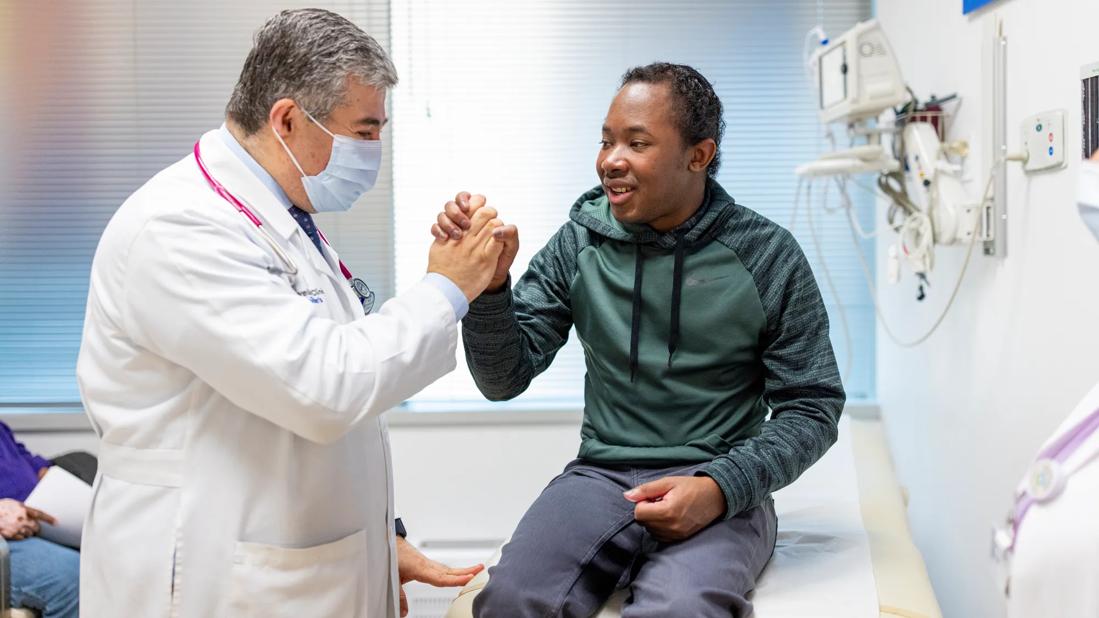
Image content: This image is available to view online.
View image online (https://assets.clevelandclinic.org/transform/f637409e-3270-4639-bce0-7f0998853646/CCC_3613010_02-09-23_077_LDJ)
Doctor in a white coat holding hand of a patient in a clinic room
Sickle cell disease and thalassemia are highly prevalent in the Middle East, affecting tens of thousands and placing a profound burden on healthcare systems and families. Until recently, accessing the latest, potentially curative therapies required crossing international borders — and for many, traveling thousands of miles.
Advertisement
Cleveland Clinic is a non-profit academic medical center. Advertising on our site helps support our mission. We do not endorse non-Cleveland Clinic products or services. Policy
Today, Cleveland Clinic and Cleveland Clinic Abu Dhabi are collaborating to offer gene therapy locally for these inherited blood disorders, redefining what’s possible for patients and providers in the region.
Since 2022, several gene therapies for sickle cell disease and transfusion-dependent beta-thalassemia (TDT) have gained U.S. Food and Drug Administration approval. Gene-addition therapy betibeglogene autotemcel (Zynteglo®) for TDT was approved in 2022, followed in 2023 by gene-addition therapy lovotibeglogene autotemcel (Lyfgenia®) for sickle cell disease and gene-editing therapy exagamglogene autotemcel (Casgevy®) for sickle cell disease and TDT.
“Because these transformational therapies were not widely available in the Middle East at that time, we began considering how to serve patients there safely but also as conveniently as possible,” says Rabi Hanna, MD, Chair of Pediatric Hematology, Oncology and Bone Marrow Transplantation at Cleveland Clinic. “That’s what initiated our collaboration.”
The goal is to bring proven care models and treatment pathways to patients in the United Arab Emirates and beyond, says Fatin Sammour, MD, a hematology specialist at Cleveland Clinic Abu Dhabi.
“Cleveland Clinic Abu Dhabi is building on the knowledge, protocols and multidisciplinary standards already established across Cleveland Clinic,” she says. “That foundation will help us develop the capability to deliver highly specialized gene therapy locally.”
Both sickle cell disease and TDT are hereditary blood disorders caused by variants in the HBB gene. In sickle cell disease, a single mutation causes red blood cells to have a rigid, sickle shape, leading to vaso-occlusion and end-organ damage. TDT results from ineffective erythropoiesis and profound anemia due to gene mutations, often requiring lifelong blood transfusions.
Advertisement
These conditions can result in severe complications, significant morbidity and reduced life expectancy.
Historically, allogeneic blood or marrow transplant has been the sole curative option, but it comes with a risk of graft rejection or sometimes graft-versus-host disease, and it is not available to patients without a compatible donor.
Gene therapy, by contrast, modifies the patient’s own blood-forming stem cells — removing or correcting the disease-causing variants — then returns them to the marrow to restore normal hematopoiesis. This approach can potentially eliminate the need for transfusions in TDT and reduce or eliminate painful vaso-occlusive crises in sickle cell disease.
“Gene therapy is a one-time, transformative intervention that enables patients to pursue a normal life,” Dr. Hanna says. “However, it’s not a simple infusion. It’s an intensive journey that can take up to one year.”
The steps typically include:
Advertisement
Since the collaboration began, patients have undergone screening at Cleveland Clinic Abu Dhabi, traveled to Cleveland for stem cell collection and gene therapy infusion, and returned to Abu Dhabi for follow-up care.
Now, Cleveland Clinic Abu Dhabi is preparing to provide all steps of the treatment.
“Initially, roughly nine months of patient care took place in Abu Dhabi and three months in the U.S.,” Dr. Hanna explains. “But as the Abu Dhabi team has gained experience with patients of all ages and comorbidity profiles, we’re working toward doing the entire process there. Patients will no longer need to go abroad for any part of this life-transforming care.”
Video content: This video is available to watch online.
View video online (https://cdnapisec.kaltura.com/p/2207941/sp/220794100/playManifest/entryId/1_dlwt7hen/flavorId/1_5f3sgelj/format/url/protocol/https/a.mp4)
“International travel poses major logistical, financial and emotional burdens for patients and their families,” Dr. Sammour adds. “Our program at Cleveland Clinic Abu Dhabi is making it possible for patients to receive highly specialized, leading-edge care while staying within their own healthcare system and community.”
Both physicians emphasize the importance of early referral for gene therapy evaluation.
“Gene therapy is complex and demands early, coordinated planning,” Dr. Sammour says. “Early referral allows the team to assess eligibility, manage complications and address logistical considerations.”
Patients with sickle cell disease should be referred if they:
Advertisement
Patients with TDT should be referred if they:
“Even patients who are unsure about gene therapy should seek expert evaluation,” Dr. Hanna advises. “There is often misinformation about the process and eligibility, and we want to give patients, families and referring physicians the clarity they need. Gene therapy still involves chemotherapy and may not be right for everyone, but we are working to develop gentler regimens and new approaches that could provide access for more patients.”
As Cleveland Clinic and Cleveland Clinic Abu Dhabi expand gene therapy access, this cross-continental collaboration is redefining hematology care in the Middle East.
“Geography should never be a barrier to life-changing therapy,” Dr. Hanna says. “Our vision is for Cleveland Clinic Abu Dhabi to serve as a regional center for patients from across the Middle East, Africa and India, helping to eliminate access challenges.”
For Dr. Sammour, the impact extends beyond a single treatment.
“Gene therapy has the potential to change what is possible for patients with inherited blood disorders,” she says. “By building the expertise and infrastructure for safe, effective delivery, we’re laying the groundwork for future cellular and genetic innovations as well.”
Advertisement
Advertisement
Helping families understand what treatment can and cannot change

Interim results of RUBY study also indicate improved physical function and quality of life

Integrated care model reduces length of stay, improves outpatient pain management

New course offers insights into clinical, psychosocial and ethical dimensions of care
Watch for sudden unilateral vision loss without pain

Efficacy, safety and tolerability data shared at hematology meeting
Nurses play key role in comprehensive lifetime treatment program

How to combat the rise in mortality when patients become adults
 Search